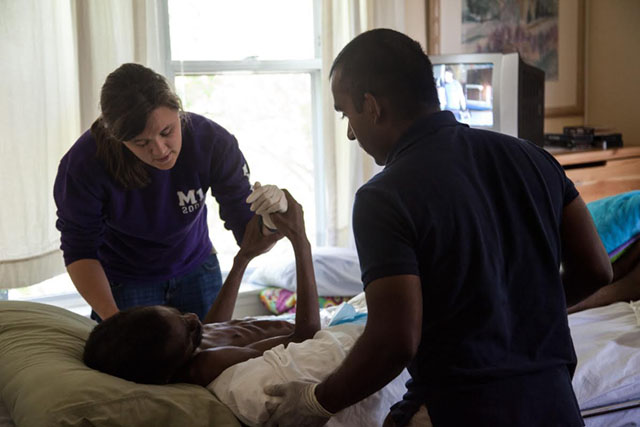
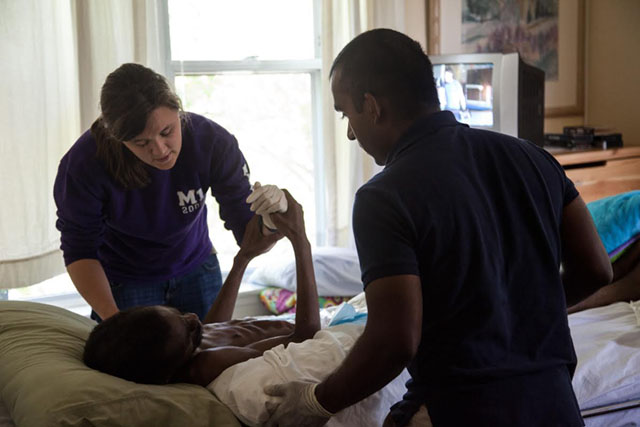
 Volunteers Cameron Cochran (left) and Istiaq Mian (right) work to reposition a patient at Joseph’s House, a hospice for homeless men and women in Adams Morgan. (Photo by Lucian Perkins)
By DCist contributor Allie Goldstein
Photographer Lucian Perkins was there for the fall of communism in Russia in the 1990s. He was on the border of Macedonia and Kosovo in 1999 to witness 50,000 refugees trapped in a no man’s land. He’s captured the toll of war in Yemen and Iraq, and he’s been behind the scenes of Fashion Week in New York.
But his recent project, The Messengers, Perkins’ first full-length documentary, was shot just blocks away from his own home.
Working as a staff photographer for The Washington Post for more than two decades gave Perkins a “taxi-driver-level insight into D.C.’s nooks and crannies.” He won a Pulitzer Prize alongside reporter Leon Dash for a 1994 story that chronicled the life of Rosa Lee Cunningham, a black matriarch whose struggles with petty theft, addiction, and eventually HIV exposed the cycle of poverty lurking in the shadows of the nation’s capital. Another Pulitzer came in 2000, for Perkins’ intimate depiction of the Kosovo refugees (he shared the prize will fellow Post photographers Carol Guzy and Michael Williamson).
More recently, Perkins has built up a small portfolio of short films on topics as varied as the Syrian refugee crisis, a free medical clinic in Virginia, the Big Apple Circus, and childhood obesity. He became enamored with the idea of capturing a longer story on film. Technology was developing so quickly that “it became possible for one person like myself to actually film, edit, and do a documentary.”
He found his subject in one of D.C.’s in-plain-sight nooks. Located on Lanier Place in Adams Morgan, Joseph’s House is a hospice for homeless men and women dying of AIDS. It has been open since 1990, around the time that AIDS peaked in the United States. Perkins started filming there a few years ago.
“What immediately interested me were the volunteers,” he said. “Here were these young kids in their early 20s who were going to spend a year there.”
In the final stages of production, with an expected release date this spring, The Messengers chronicles the stories of two of these volunteers as they interact with the residents of Joseph’s House.
The volunteers came there for different reasons. Cameron Cochran sought a new path in life after dropping out of college, while Brittney Cavaliere wanted to work with HIV-positive patients. Spending time as hospice workers taught each of them more than they anticipated.
The residents of Joseph’s House sometimes outlive their doctors’ death sentences as they gain strength and purpose, often taking on the unexpected role of mentoring the very people who came to help them.
Through the eyes of resident James Hardy and others, Cochran learned to see herself as they did: a strong, capable person.
“It was a shared community where these people were [the volunteers’] elders,” Perkins explained. “They helped guide them to a better understanding and a better appreciation of life. People who we would discard in society had a lot to contribute, because they were in fact amazing people that had incredible hardships.”
The Messengers doesn’t dig into these histories of hardship, instead focusing on the story arcs that begin once people step inside the doors of Joseph’s House. Although AIDS hangs over the process, as does poverty and racial injustice, the photojournalist ultimately decided to tell a different story, one about building a bridge between life and death, and crossing it consciously.
Much of the documentary is shot from a fly-on-the-wall perspective that Perkins cultivated over months of filming and trust-building. Yet there are moments when the photographer can’t help but be reflected in his subjects’ eyes. In one scene, resident Cecil Wiggins speaks directly to the camera, explaining that to be bedridden is like being in a cage. To some extent, Perkins captures this sentiment with his cinematography, as shots taken from the front porch of the house show life—school buses, bicycles, and baby carriages—passing by, oblivious to the final passages underway inside.
It’s not much of a spoiler to reveal that several of the people we meet in the film die. Perkins doesn’t shy away from it, focusing on a mouth agape, an emaciated body, a last desperate breath.
“For me the most difficult thing was, how much stuff do you show?” Perkins said. “I didn’t want to make it gratuitous, but I wanted to show enough of it to make it real.”
Though some bedside scenes are disconcertingly intimate (who are we to watch a stranger’s death?), the discomfort serves a purpose, and is balanced by lighter-hearted moments that paint the residents as more than just patients.
Elijah Scriver, for instance, teaches everyone how to crack crabs. He also runs a mini spa on the porch where, moved by the story of Jesus and his disciples, he washes the volunteers’ feet as they listen to gospel music. Glimpses into the residents’ personalities make their deaths feel personal, and the volunteers’ despair surrounding these losses is real and raw.
Perkins saw first-hand how to approach death as an intentional, shared process. When the residents of Joseph’s House begin to die, volunteers sign up for time slots to sit with them and hold vigil around the clock, whether it takes a few hours or a few days. When Perkins’ own mother was dying last spring, he spent weeks by her side, and they shared some of their most profound moments together.
“The moment that that person takes their last breath, all of a sudden you realize that person is gone forever,” Perkins said. “That’s a moment I saw frequently at Joseph’s House. It’s the one moment that you can never really prepare yourself for. It’s also one that, if all possible, it’s so important to be there.”