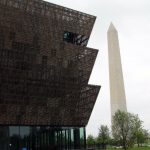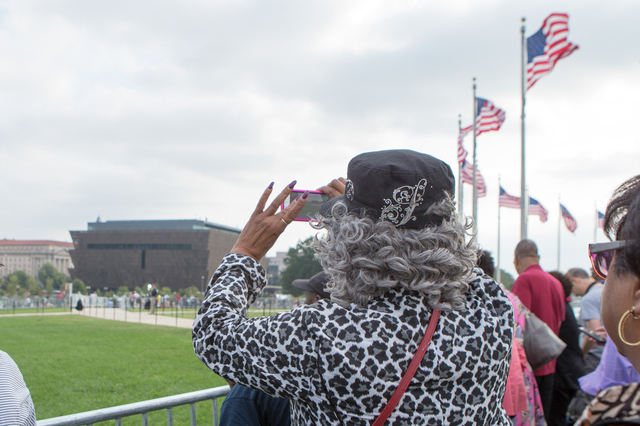
President Barack Obama presided over the grand opening ceremony at the Smithsonian Museum of African-American History and Culture on Saturday — but not before a long, pregnant pause. After more than an hour of performances, benedictions and other speeches, the crowd of thousands watching on jumbotrons next to the Washington Monument seemed to develop a collective impatience.
Whether scripted or accidental, the moment served as the final hurdle in a cycle of delays over more than a century that threatened to derail the museum’s opening.
D.C. resident Janathel Shaw said that she’s been hoping for the museum since North Carolina Senator Jesse Helms railed against an early concept plan during a hearing in the mid-90s. She maintained hope since then that the project would come to fruition, but it was far from a guarantee.
“I’ve been longing for a day like this. I’ve been praying for it,” Shaw said. “I am absolutely elated.”
The journey ended after four years of construction (you can watch a timelapse video), and the grand opening ceremony marked the moment with style. Oprah Winfrey and Will Smith warmed over attendees with a banter-filled poetry presentation; Winfrey got some of the day’s loudest applause. Georgia Representative John Lewis, a veteran of the civil rights movement, delivered a passionate overview of the progress he’s witnessed. Supreme Court Chief Justice John Roberts urged the crowd to revisit landmark court decisions like Dred Scott for insight into the forces that shape African American life.
But the noisiest audience response of all was reserved for Patti LaBelle, whose scorching rendition of Sam Cooke’s protest anthem “A Change is Gonna Come” ended with an endorsement of Hillary Clinton for president.
For Alice Wilson of Long Island, New York, the performance conjured a vivid childhood memory: her mother explaining why she couldn’t use one of the water fountains in her hometown of Charleston, South Carolina.
“It really overcame me. It just brought it all back,” Wilson says of the performance. “I told her, ‘Water has no color.’ But she said, ‘It don’t matter.’” That was fifty-seven years ago.
This weekend, Wilson got a firsthand look at how far race relations in this country have come. But she’s not blind to how far they still have to go. “With all these killings going on and everything, in a lot of ways we’re still not free,” she says. President Obama said as much late in his speech, pointing out that one new museum won’t solve a nation’s problems overnight.
Wilson was so moved by the ceremony that she wanted to talk to someone about it right afterwards. So she started a conversation with the woman next to her: Betty Bell of Chatham, Virginia. Within a few minutes, their friendship had blossomed, thanks to what Bell calls the power of “the sisterhood.” Bell bolstered Wilson’s recollections with some of her own: hot dog stands, local drug stores, and public restrooms that barred black people from entering. “Back then, we were called ‘coloreds’,” Bell said with a hearty laugh.
That elated spirit and a sense of history’s forward march was evident throughout the event. Many in the audience raised their fists high during the national anthem. Hugs were a frequent sight, and not all of them appeared to be between people who already knew each other.
Two Civil War re-enactors from Philadelphia proudly hoisted an enormous American flag and sported period-accurate uniforms. “I’m here making a statement that we have a history, and we’re a major part of that history,” Larry Harris of the 3rd Regiment United States Colored Troops Reenactors said at the event.
An anecdotal survey of a few crowd members affirms what’s already been reported: Tickets were a hot commodity and remain hard to come by. Visitors without them said they plan to return later this year to see inside. “I wanted to be a part of history,” said Alex Deas, one of 500 alumni of the fraternity Omega Psi Phi, a nationwide fraternity founded at Howard University in the 1910s, who attended.
Others said the grand opening gave them hope for the future. Shaw said she wants young children to “marvel” at aspects of their past they might never have discovered. Henry Holland, a high school teacher from Philadelphia, brought his African-American History students for a day trip to see the ceremony. He recalls visiting the other Smithsonian museums at a young age, but it never occurred to him that there could be one dedicated to his ancestors.
His students tackled the event with high energy. When asked what they were most looking forward to on the day, they shouted, almost as one: “The president!” Some in the audience waited most of their lives before someone with their skin color took the nation’s highest office. For these children, the most grueling wait was the pause before Obama took the stage.
Jerome, one of Holland’s 15-year-old students, summed up the day simply. “Just to be here on a historical day,” he said. “This is really big.”