 Rachel Sadon
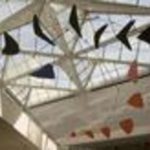
Though the atrium remained open during three years of renovations at the National Gallery of Art’s East Building, there wasn’t much to see beyond the architecture itself and the dramatic 76-foot Alexander Calder mobile suspended elegantly in the atrium. Now, there is an entirely new room devoted to Calder—and that’s just a small fraction of the offerings.
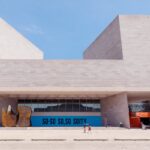
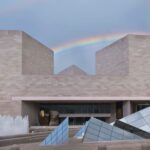
Galleries in the I.M. Pei-designed building have been closed as they underwent renovations that also included the construction of 12,250 square feet of new spaces. With two sky-lit towers and an outdoor sculpture terrace complete, the National Gallery is just about ready to welcome visitors on September 30.
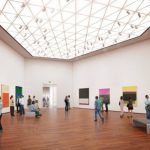
Upon arrival, they’ll find a complete reorganization of the permanent collection, both in terms of where and how the works are presented. Curator of modern art Harry Cooper described some of the changes as “mini-revolutions,” updates that have long been commonplace elsewhere but represent significant shifts for the conservative institution.
Those include hanging art largely in a chronological way, going between movements from cubism through post-minimalism. Displaying works on paper alongside paintings, increasing the amount of wall text, and adding a black box for video would also hardly be notable elsewhere, but they’re new for the institution. And interwoven are pieces from the now defunct Corcoran Gallery, most excitingly from the Washington Color School.
The expansion “was a momentous occasion to rethink and reinstall our permanent collection. I think you’ll see it is a much different collection than when we opened in 1978,” said National Gallery director Rusty Powell. The updates were designed by Perry Chin, a former associate of Pei, and they blend in seamlessly. “It gives us a new museum, but we have continued the ‘vocabulary of Pei,’ to use Perry’s words,” Powell said.
Most dramatically, two new towers are bridged by a sculpture garden. The Calder room is a dazzling rotunda of colors, shapes, and shadows (created by the skylight above) from nearly 50 works spanning nearly 50 years. A sculpture garden, anchored by the electric blue rooster Hahn/Cock on loan from Glenstone, offers a connection to the second tower. A cathedral for fans of abstract expressionism, the room is split between Barnett Newman’s seminal Stations of the Cross and 10 of Mark Rothko’s seminal abstractions.
In addition to hardwood floors and aesthetic updates, other important changes to the building are even more quotidian: a new elevator and sets of stairs. But they’ll improve visitors’ experiences and options for moving throughout the building, with the added benefit of bringing it up to code.
“I did a little math this morning,” Cooper said at a press briefing. “I believe the number of possible routes is 12 factorial, approximately 47 million.” The layout is not always intuitive (though certainly more so than before), with unconnected galleries often startling a planned path to sometimes surprising effect.
On my way to find In the Tower: Barbara Kruger, one of the three temporary exhibitions that will open along with the building, I stumbled on a room of large and small-scale Henri Matisse works. It (delightfully) diverted me from my mission, but also prompted a serendipitous train of thought about technique and the unintentional linkage between Kruger’s paste-ups and Matisse’s cut-outs.
Matisse works will always be found there (they’ll rotate every six months because of the delicacy of paper) but the tower will be home to rotating exhibitions after the Kruger show comes down at the end of January.
For now, each of the three temporary exhibitions not only stand on their own as well worth the visit, but offer up particular resonance on the occasion of the building’s re-opening.
Photography Reinvented: The Collection of Robert E. Meyerhoff and Rheda Becker on the upper level celebrates a gift of 34 contemporary photographers. The large-format prints “challenge our expectations about how photography depicts the world and what it represents,” said senior curator of photographs Sarah Greenough.
In many cases, the gift doubled, tripled, or even quadrupled the National Gallery’s holdings of photographs by the artists represented. Some—including Marina Abramović, Cindy Sherman, and Vik Muniz—are the very first for the collection. “It magnificently expanded out ability to tell the story of late 20th and early 21st century art in the newly reimagined East Building.”
On the lower level, Los Angeles to New York: Dwan Gallery tells a story of mid-century art through the career of Virginia Dwan. In addition to exploring avant garde movements in the U.S. and France, and the rise of bicoastal transportation networks, the exhibition asks viewers to consider the gallery as a form. It features some 100 works that touch on 40 shows (of the 134 that Dwan did) during a very different time in the art world.
It traces “the rise of gallery networks to a time when the commerce of contemporary art was less dominant than it is today,” said James Meyer, the deputy director and chief curator of the Dia Art Foundation. The works include Andy Warhol’s very first Brillo boxes, early Robert Rauschenberg, works from Yves Klein’s first U.S. show, and Ed Kienholz’s Back Seat Dodge ’38 (the subject of an obscenity outcry in 1966); it also introduces land art to the National Gallery for the first time.
(Both also very directly reference the roles of art patrons—which you can noodle on in the National Gallery’s new room, Collectors Committee: Recent Gifts.)
But perhaps no exhibition is better suited thematically to considering the National Gallery’s “mini-revolutions” in how art is presented, and how viewers relate to it, than Kruger’s bold works. While she explores meaning, gender, media, and commodification across a number of mediums (including the large-scale text wrap Belief+Doubt at the Hirshhorn), this is the first thematic show about Kruger’s work—focusing specifically on her body of paste-ups that match images with bold texts.
The show sprang from the National Gallery’s acquisition of Untitled (Know nothing, Believe anything, Forget everything), which slices an image of an woman being administered eye drops with text in red strips.
Kruger’s subjects are in-profile, gazing off to the side, a deliberate contrast to the active verbs directing the viewer. “My understanding of this body of work connects it to the act of viewing and being viewed,” Molly Donovan, associate curator of modern art, told DCist, describing Kruger earlier as an “anthropologist mining our culture.”
The graphics and juxtaposition of words are witty and engaging, direct plays on the roles of creator and audience and the construction of meaning.
“The entire East Building is filled with these dynamic moments,” Donovan says, in reference to when viewers complete the walk up the tower’s stairs to face a wall-sized work entitled Half Life. Kruger’s work is immediately arresting, she says. “It stops you in your tracks.”
The National Gallery of Art’s East Building will officially re-open on September 30, including three opening weekend concerts. A community weekend is planned for November 5-6. The Evenings at the Edge series debuts on October 13. See the National Gallery’s website for more information.