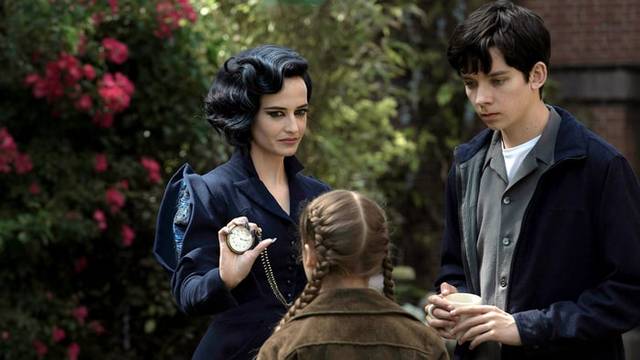

Eva Green, Georgia Pemberton and Asa Butterfield (Jay Maidment/Twentieth Century Fox Film Corporation)
Over a career that has spanned more than two decades, director Tim Burton has become something close to a household name by virtue of his singular style and steady output. He’s an undeniable talent with an unconventional point of view, and his latest effort, Miss Peregrine’s Home for Peculiar Children, boasts many of the virtues and failings that have come to define him.
At this stage in his career, Burton’s macabre imagination doesn’t have many more places it can go. Miss Peregrine has some gorgeous sequences, dazzling creatures, and moments of haunting visual poetry. But at times it feels loaded down by its Burton-ness: pallid lighting, cluttered shots, excessive makeup. Particularly when the movie shifts gears from showcasing the manifestation of Burton’s inner consciousness to telling a convincing story, it falters.
The movie opens with its best joke: a typically grim reimagining of the Warner Brothers logo transitions seamlessly into a shot of … a brightly lit store sign on a sunny Florida day. What follows is a dreary first act in which imaginative teen Jake (Asa Butterfield) sees his grandpa (Terence Stamp) die in front of him, attends bemused therapy sessions with a psychologist (Allison Janney), proposes a trip to Wales with his neglectful father (Chris O’Dowd), and spends most of his screentime in a mood best described as “generically brooding.”
Soon, but not soon enough, he stumbles into another world he’s only heard about in his grandfather’s bedtime yarns, reinforcing his conviction that the cruel mortal plane is not for him. The title character, played with vivacious warmth by an underutilized Eva Green, leads a home of children with unusual, impractical, or otherwise alienating superpowers. They live in a Loop which allows them to age normally despite repeatedly living the same day: September 3, 1940. Other Loops, as we learn in one of too many exposition dumps later on, repeat different days in different places.
There’s a lot more plot, but Burton and screenwriter Jane Goldman seem to lose interest in it almost as much as I did, once it became clear that convolutions were piling up without compelling stakes. Samuel L. Jackson shows up in the third act to chew scenery and eyeballs; a chaotic climactic battle pits living skeletons against each other on a London pier. It’s a mess.
Burton didn’t adapt the book by Ransom Riggs because he believed it would take viewers down a satisfying narrative path, of course. He picked it because it allowed him to indulge in kooky creatures, bizarre distortions of reality, and other supernatural baubles. All three take over the movie in spades, so much so that the sterling cast is marginalized — Dame Judi Dench gets barely four lines of dialogue before she’s ushered offscreen.
The movie spends too much time on Jake’s trifling internal conflicts and too little time on its best assets: Miss Peregrine and her peculiar children. Green’s performance is lovely—melancholy and maternal, with a hint of swaggering sexuality. The children’s powers generate many of the film’s most memorable images: a little girl pulling a human-size carrot from the garden, a teenage boy breathing life into a dystopian robot creation; a horde of bees tumbling from a young lad. These moments are pure Burton, but they also work in service of a larger idea about ostracized children and adolescent sadness.
One scene fulfills the potential the rest of the movie flirts with but doesn’t reach. Wide-eyed Emma, played by promising newcomer Ella Purnell, introduces Jake to the new world he’s just stumbled into. She points to a squirrel on the ground and tells him to outstretch his hand. Before Jake knows it, Emma’s lighter-than-air body sends them soaring towards the tree, where they deposit the squirrel before floating back down. The moment is both triumphant and sad, a stirring evocation of swirling emotions.
The script later sequesters Emma in a tepid romance with Jake, but for a moment, her personality and history get a vivid showcase. If only Burton had found more moments like this.
—
Miss Peregrine’s Home for Peculiar Children
Directed by Tim Burton
Written by Jane Goldamn
With Eva Green, Asa Butterfield, Samuel L. Jackson
Rated PG-13 for intense sequences of fantasy action/violence and peril
127 minutes
Opens today at a multiplex near you