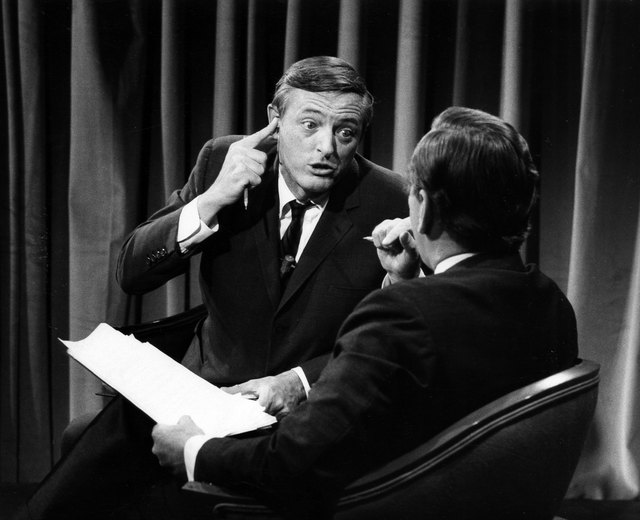
 William F. Buckley, Jr. and Gore Vidal go head-to-head. ABC Photo Archives/Getty Images)
On schedule, debate fever has taken over America once again, as it does every four years. Yet this cycle has been more contentious than ever.
Tonight on PBS, viewers can see what is arguably the foundation for the current political circus. The documentary Best of Enemies looks back at a series of televised debates between political adversaries and public intellectuals Gore Vidal and William F. Buckley, Jr. during the 1968 Republican and Democratic National Conventions. In the process, it reveals a surprising array of similarities to recent events, suggesting that politics is more of a continuum than we may realize.
Just as much of Donald Trump’s presidential campaign has been built on an impulse to attract attention and generate ratings, the Vidal-Buckley debates were born out of financial need. ABC, one of only three television networks at the time, was faltering in the ratings as CBS and NBC drew more eyeballs with the likes of Walter Cronkite, Chet Huntley, and David Brinkley. The network lacked the resources to adequately cover the convention in full, so it went in a different direction, bringing together two commentators from wildly opposed political leanings in the hopes that sparks would fly.
Did they ever. The firebrand conservative Buckley bristled at Vidal’s liberal sensibilities and blasted the Hollywood screenwriter’s artistic bona fides. Vidal countered that Buckley presented America with a warped vision of its merits and drawbacks.
The arguments were billed as reasoned debates among peers, but the barbs quickly grew personal over ten nights of verbal sparring. By the end, Vidal called Buckley a “crypto-Nazi,” and Buckley retorted that Vidal was “queer,” threatening to “sock him in the face.”
Network executives looked on in horror.
It’s impossible to watch this documentary and not be reminded of what’s been playing out on cable TV and across the Internet this year. Richard Nixon even tells a crowd that he plans to “make America first again.”
One of the film’s interview subjects describes the Vidal-Buckley contest as a kind of theater designed to keep Americans entertained. Buckley himself points out during one of the debates that people watch television looking to be reassured by the faces they see and the personalities they discern, not necessarily by the words they hear or the rhetoric they detect. And of course, much of the insult-laden dialogue in the 1968 debates seems to anticipate recent exchanges between Hillary Clinton and Donald Trump.
Beyond its contemporary resonance, the movie also paints a fascinating portrait of its central subjects, delving into Vidal’s skeptical relationship with gender conventions and Buckley’s uncanny savvy with exploiting the manipulative power of television, which at that time was more centralized and less explosive in its presentation. A documentary about either one on his own would be fascinating viewing. Directors Morgan Neville and Robert Gordon keep the focus tight on the debates, and the ideas that can be gleaned from them leave the film with plenty to chew on.
Best of Enemies earned a theatrical release early last year, but its debut as part of the Independent Lens documentary series makes perfect sense. If history helps provide context for the present and future, those mystified by current events ought to check it out, if only to marvel at how much has changed, and how much remains the same.
Independent Lens: Best of Enemies debuts on WETA, Channel 26, tonight from 9 to 10:30 p.m.