 Rachel Sadon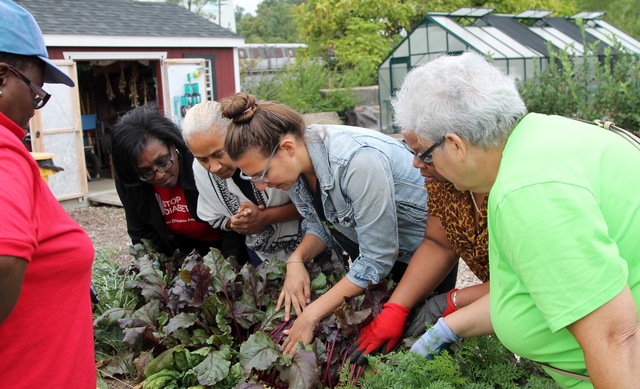
In a garden that seems to appear from nowhere, just a few yards from Metro tracks outside the Capital Area Food Bank’s warehouse, Amanda Marino holds out an outstretched hand. It looks like she is clasping a set of particularly gnarly pebbles.
A group of seven women and one man peer into her palm, but they’re stumped as to what exactly the wizened kernels might turn into. “These tortured, ugly-looking seeds are beets,” Marino says brightly. The students respond with glee, exclaiming “beets?!” in return.
Members of the class, who run or work for organizations that distribute food from the Capital Area Food Bank, take turns pinching their fingers into the shape of a lobster claw and planting the beet seeds a half-inch apart in a raised demonstration bed. Marino then leads the group up a few feet and turns to emerald-hued plants that are already growing in a dense square, advising the class on how to thin out seedlings that are sprouting too close together.
Some of them, though, are already ripe for picking. Pulling out a small, but fully-formed specimen, Marino announces “this is a baby beet.” And without missing a beat, members of the class let out a collective “awww.”
“Now I’m going to try to cook these, these are going to be my dinner tonight,” says Eva Rollins, who volunteers at a food pantry run out of a church in Southeast. “I just learned how to cook beets, using foil in the oven. But I didn’t know you could use the leaves. And I just learned you can juice this part,” she says, gesturing to the fuchsia stalk.
After the afternoon is over, Rollins and the rest of the group will bring that unbridled enthusiasm for vegetables—and new knowledge about how to grow them—back to their communities, part of the Capital Area Food Bank’s ongoing and increasingly creative efforts to spread the gospel of fresh produce.
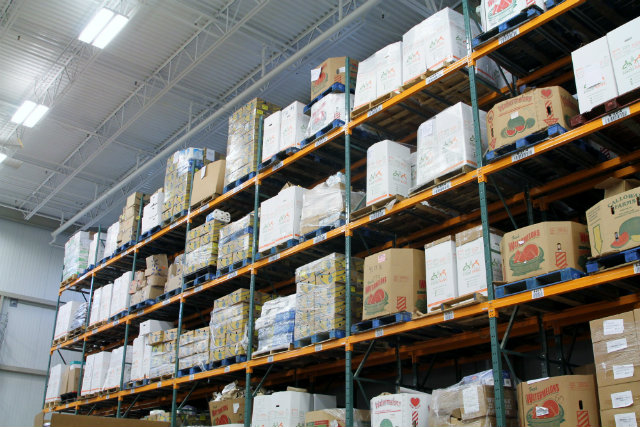 When the Capital Area Food Bank moved into a new building, it more than doubled the available warehouse space. (Photo by Rachel Sadon)
Before the Capitol Area Food Bank moved to a gleaming new 123,000 square foot facility in Michigan Park four years ago, it was turning away over a million pounds of food a year. There just wasn’t room to store it.
Now, though, it’s refusing certain foods—sheet cakes, full-calorie sodas, candy—for a better reason: they don’t meet nutritional standards. About half of the people the food bank serves have high blood pressure or share a household with someone else who does. Another quarter either have diabetes or live with someone who does.
“With so many of those we serve struggling with diabetes or heart disease, we have a real moral imperative to improve our food stream,” Capital Area Food Bank CEO Nancy Roman said when announcing the crackdown this summer.
The change didn’t come out of the blue. CAFB has been steadily working to unclog junk food from the system for several years. In 2013, the food bank introduced a nutrition tracker to monitor the salt, sugar, and fiber content of the foods it takes in and distribute.
The following year, Shoppers agreed to limit sheet cakes and other bakery goods from its donations, and Giant stepped up in 2015 to try out a new, more comprehensive program to improve the food bank’s supply. In addition to sorting out leftover cakes and pies, the company also committed to increasing high-protein donations and encouraging customers to donate healthier items.
Finally, in July, CAFB cut the junk food cord entirely.
The flip side, of course, is that it’s seeking to replace the unhealthy stuff with nutritious foods. And for that, produce is paramount.
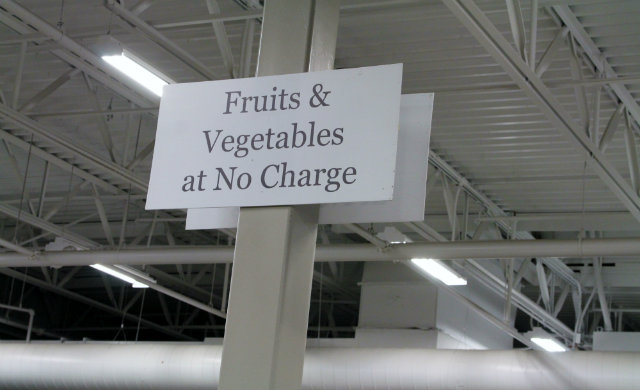 The Capital Area Food Bank offers fruits and vegetables to their partner organizations at no charge. (Photo by Rachel Sadon)
“As we lower the amount of food in warehouse that doesn’t meet our wellness goals, we’ve renewed our focus on growing demand for produce,” says Kirsten Bourne, the food bank’s director of marketing.
CAFB’s member groups do the direct distribution to the region’s hungry, and they range from church food pantries that may only be open a few days a month to some of the area’s biggest hunger-related nonprofits. The food bank sells donated foods to partners for a mere $0.19 a pound (essentially a maintenance fee to cover tracking and storage), and items that are in high demand, which the food bank purchases, are sold at cost. But fruits and vegetables are always free of charge.
Refrigeration, transportation, and timing all affect any particular pantry’s ability to take and distribute fresh produce, so the food bank is committed to making it as seamless as possible. “We’re taking down any barrier we can,” Bourne says. Of the 44 million pounds of food the food bank distributes in a year, about a third is now produce.
Agreements with local farms mean that they have a steady supply of greens and other vegetables on offer. The food bank distributes recipe cards—developed in CAFB’s own test kitchen—to encourage the use of fresh produce.
Monthly “produce hubs,” which are being piloted in Virginia and Prince George’s County, allow partner groups located further out in the region to pick up fresh vegetables much closer to home (at the last one, CAFB distributed more than 8,000 pounds in one day). An Agency Achievement Academy offers workshops that run the gamut from implementing new food distribution models to cooking demonstrations. And the food bank manages a grant to build gardens directly on the sites of their food pantry partners.
A new program, Harvest for Health, combines many of those in one afternoon. The food bank’s partners are invited in for a tour of facility, a nutrition lesson, and a tour of the Urban Demonstration Garden—which is where we find Marino, giving a hands-on demonstration of fall planting and harvesting.
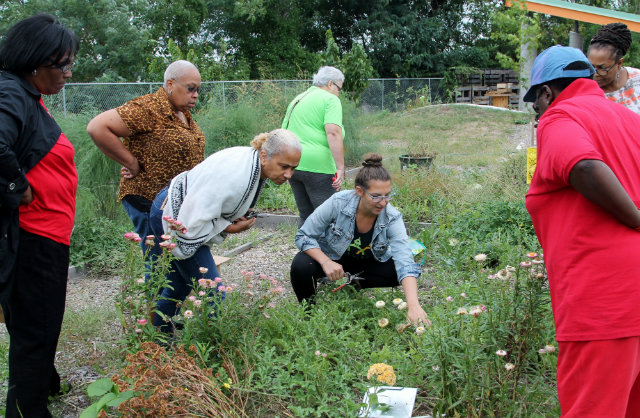 Amanda Marino demonstrates harvesting techniques to women who run food pantries around the region. (Photo by Rachel Sadon)
About 900 pounds of produce from the urban demonstration garden found its way to the food bank’s shelves last year, distributed for free just like the veggies donated by commercial farms. Much of the rest of the garden’s output is used in demonstration classes—the raw materials for pickled or canned tomatoes. Groups who come to visit also take home some of the produce.
As the lesson continues, the students’ hands start to fill up with beets, peppers, and greens plucked directly from the beds.
They ask questions about the value of using shears versus pulling off the vine and discuss the benefits of transplanting versus planting seeds directly. Toward the end of the lesson, Marino asks the group if they want to focus more on nutrition or harvesting techniques. They answer in unison: “harvesting!”
“We don’t get this [gardening experience] often,” says Brenda Shields of Temple of Praise, which runs nutrition-related programming and an emergency food pantry.
The idea of the urban demonstration garden is to change that, to empower the food bank’s member agencies to take the soil into their own hands. CAFB often refers to the garden as a “learning laboratory.”
“What we’re piloting, it really came out of a lot of research and listening sessions of what might be valuable to our partners,” Marino says. “They definitely are hungry for more technical skills.”
Some of the food pantries are already growing on site, or beginning to experiment with container gardening. The demonstration garden reflects the variety of ways they can do so—with raised beds that might be easier for seniors to tend, cinder block gardens for sites with less in-ground space, even a beehive for groups that want to think about honey production.
One of the challenges, though, is actually getting all the way out to Michigan Park. The food bank entices partners to make the drive by offering innovative programming. But they also work to build gardens directly on site.
That is the other half of Marino’s job: managing a grant, funded by the USDA and administered through UDC, to help food pantries and other groups get growing themselves.
“We build the beds, deliver the soil, and also deliver training of how to start a garden. What comes from our partners is how they want to incorporate it in their work,” says Marino. “We’re a conduit for resources and technical help. How they want to use it is up to them.”
One of the women her lesson that day, Cora Clark, has taken advantage of the program to bring a garden to the onsite food pantry at Arbor View, an apartment complex with low- and moderate-income households.
As the food bank shifts away from distributing unhealthy items, these various programs are filling in the void. “We realize the impact we have on the communities we serve by the food we distribute,” Marino says. “My job is a testament to the food bank’s interest in promoting wellness—because they believe in it.”