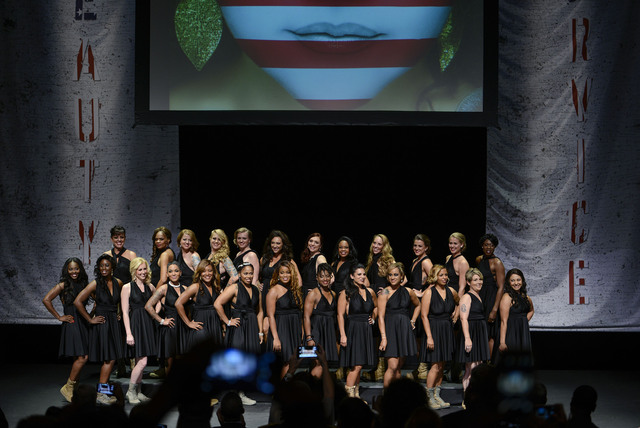
On Sunday night, while millions of Americans tuned in to watch the second presidential debate, twenty-five women were strutting across the stage at Shakespeare Theatre Company’s Sidney Harman Hall in satin black dresses and combat boots.
Held in Las Vegas last year, the Ms. Veteran competition returned to D.C., where it was held for the first time in 2012. Unlike other pageants, there is no swimsuit competition. Age and marital status aren’t factors. And the goal is to provide housing for homeless women veterans and their children, while showcasing “The Women Beyond the Uniform.”
“I think people forget that we are women,” Ms. Veteran America Founder Maj. Jaspen (Jas) Boothe says. “When you see me in uniform, you see Major Boothe, but you don’t see Jas as a mother and you don’t see Jas as a wife.”
The evening was emceed by actor Lamman Rucker and self-proclaimed “Glamputee” Marissa Strock, a combat disabled veteran who came in the top 10 in the 2013 competition. Judges included women veterans from different branches of the military.
Under banners that read: “poise,” “grace,” “beauty,” “service,” the finalists switched between combat boots and heels, smiled for the audience, flexed their muscles, and demonstrated their talents, including physical aptitude. For the first section of the event, twelve “GI JoAnnes” took center stage in workout gear and “served like a girl” t-shirts.
Amid hooting and hollering, Boothe stepped out in her glittering army green gown, combat boots and tiara to demonstrate proper push-up form.
The round is a bit like “Simon Says” for push-ups. As a leader counts off, the contestants coordinate their movement with the cadence of his voice. Women are ejected for moving during a pause, being off-tempo, or breaking form. It’s tough, especially when they have to hold their bodies inches from the ground on bent elbows. By the time petite U.S. Army Reservist Chiquita Peña cranks out one final push-up—winning this round—the crowd goes wild.
The rest of the competition looks more or less like what you might expect from a beauty pageant. There’s an eveningwear segment, a talent portion, and a question and answer round. But these women are not pageant divas and debutantes, trained in the ways of big smiles and bigger hair—well, except for Air Force Captain Kelby Tyler-Kuhn. A former Miss Washington County, the blonde contestant made the final 10 and took home the “Showstopper Award for Talent” for her performance on piano.
The talent portion was a mixed bag that featured poetry, various dance forms, gymnastics, and musical performances. Many chose to show off their singing voices, like first runner-up Army Captain Tiye Young, who wowed the audience with her beautiful acoustic cover of Nina Simone’s “Feeling Good.”
Others expressed less conventional talents such as speed painting, a sword demonstration, a short story from a sexual assault response coordinator, and even a slideshow. “Remember what this looks like now,” Molly Mae Potter, of Austin, said of her photographs from the North and South Poles.
After acing the question and answer section, Potter went on to win the competition. “I’m wearing the crown of a united voice,” she tells DCist. During her year-long reign, she says, “I’m really looking forward to working with communities across the country, to help start this revolution to really start talking about homeless female veterans in their community and what they can do.”
Potter is well-suited for the job. During her 2010 deployment to Afghanistan, she sustained injuries that resulted in a traumatic brain injury and PTSD. She now advocates for treatment and resources to help veterans heal from the “invisible wounds of war.”
“She’s fantastic when it comes to advocating. That’s one of the things we noticed about her,” Ms. Veteran America Director Denyse Gordon says. “The message is consistent. She maintains the integrity of why Ms. Veteran America was created. My hope for Molly Mae is that she continues to get out there and spread the message, because even though a large segment of the population knows about homelessness among veteran women and how profound it is, not everyone does.”
Like Potter, Gordon served in the Air Force. She’s also a Ms. Veteran America winner, the competition’s first. “What I try to tell all the queens is to think of this as a 12-month, short tour, like you’re deployed, because you’re actually going out and it’s time to just roll up your sleeves and get out there and get the message done and at the end of your reign you can say alright, job well done.”
Gordon says a lot has changed since that 2012 inaugural competition. Most noticeably is the size of the event and the number of women who put their names in the helmet, so to speak. “When I competed, I don’t even think we broke 60 or 70 [applicants],” she says. This year brought in about 400 applications.
During their time as Ms. Veteran America, each queen tours the country to talk about the competition and the cause it promotes.
Homelessness among women veterans is a deeply personal issue for Boothe, who became homeless in 2005 after losing her health to cancer and her home and belongings to Hurricane Katrina. “It was something that I experienced at the time as a single mother,” she says, “and through my experience I learned that there were no specific supportive services for homeless women veterans and their children, so I ended up with my son sleeping on my aunt’s couch and living off of about $300 in welfare.”
After living through that experience, Boothe founded the nonprofit Final Salute Inc. in 2010 to provide women vets and their kids with suitable housing. The beneficiary of Ms. Veteran America, the organization has provided over 10,000 transitional housing days, and opened three transitional homes—including one in Alexandria, where the proceeds of this year’s competition will go.
“We still have a lot of work to do as a country when it comes to taking care of and supporting our veterans equally, but more specifically raising awareness and getting women veterans and their children the support that they desperately need,” Boothe says.
During Sunday night’s competition, Booth shared the stories of two female veterans who didn’t receive the support they deserved. The first was Serena Vine, a formerly homeless WWII vet who lived in the Washington DC VA Hospital and died with no known friends or family. When Boothe heard that only four people would be attending the veteran’s funeral, she put a call out on social media. About 200 people came to the funeral this summer to honor Vine’s life and service.
“We could honor her in death, but what about while she lived?,” Boothe asked through tears. “There are 55,000 more stories like this.”
In May, 52-year-old veteran Antoinette Brown was mauled to death in Dallas by a pack of loose dogs. Coverage of the attack focused on the city’s “loose dog problem.” Angry citizens said the dogs were a known hazard that should have been taken care of long before Brown encountered them. But when Booth recounted the story Sunday night, she focused on the bigger, more pervasive issue: that a veteran was outside at nearly 5 in the morning seeking shelter.
Final Salute, Inc. provides three programs for women veterans, including its Savings Assessment and Financial Education (S.A.F.E) program, which aims to prevent homelessness by providing emergency financial support and financial literacy education, and its Housing Outreach Mentorship Encouragement (H.O.M.E) program.
“It’s not a hand out. It’s a hand up, and they’ve earned it,” Boothe says. “I take it as a personal duty to help these women because they are my sisters.”
H.O.M.E is a transitional housing program that provides shelter, food, clothing, and other services to homeless women veterans and their children. Based in the D.C. area, the program includes a 9,000 square foot facility in Alexandria, Va. that can accommodate 10 women and children.
“These women deserve nothing but the best,” Boothe says.
To learn more about the non-profit, visit Final Salute, Inc, or text SALUTE to 80077 to donate by phone; $25 provides a day of shelter to homeless women veterans and their children.