 (Courtesy of Craig Atkinson)
In 2013, Craig Atkinson decided he wanted to direct his first feature film: a documentary showcasing the lives of American police officers and their increasingly militarized responsibilities in a time of terrorism-induced paranoia. He didn’t intend to take sides or to expose police ineptitude. But you might not know that from watching the final product.
Do Not Resist paints a grim portrait of the modern police state, from the cruelty of SWAT raids on innocent civilians guilty only of marijuana possession to the brutality of the rhetoric delivered in training exercises nationwide.
In an interview after a recent screening of the film at the AFI Silver, Atkinson said his main goal was to provide an “authentic portrayal” of the present situation, now the subject of national headlines after several high-profile instances of police misconduct. He brings personal experience to the subject as well — his father once worked as a SWAT officer in inner-city Detroit.
The film opens on a bravura 10-minute sequence capturing the frantic tension of the 2014 protests in Ferguson, Missouri, where disenfranchised black residents faced off against a police department wielding tanks, tear gas, and brute force. Atkinson captures stunning close-ups of protesters and their opponents, lingering on telling moments of normalcy, as when two police officers fist bump with their shields, then launch into an animated conversation about overtime pay, all while marching towards protesters. A haunting, percussive score thuds in the background, lending the scenes a feeling of great tension.
Atkinson had been in the process of gathering footage for the movie when he heard about the protests, immediately realizing that they fit into his narrative. He traveled to Missouri with only a small, handheld Canon video camera. When daily reporters departed from the scene before midnight to file their nightly stories, Atkinson stayed on the street and kept the cameras rolling.
Suddenly, the story that Atkinson and his film crew were uncovering had gone global. A national conversation about militarized police departments in rural communities emerged from the protests. Atkinson soon realized the mission of his movie had to change.
“We thought we were going to be breaking a story to the American public. Then Ferguson happened,” Atkinson says. “It became very challenging because it was almost as if we were trying to hit a moving target.” For the last year and a half of production, Atkinson and his team worked “damn near every single day, all the while thinking that by the time we finished it, no one was ever going to care about this film.”
 Atkinson traveled to Ferguson during the protests. Photo courtesy of Craig Atkinson.
Despite those concerns, Atkinson wanted to raise the public awareness of aspects of the issue that might have been left out of traditional media coverage. For instance, the Ferguson protests and others since represented a crystallization of a long-developing response to ongoing injustice, not a reaction to one event. Furthermore, the story goes beyond individual officers, as Atkinson discovered when he started researching the roots of the issues.
As has been reported in recent years, many cities have taken to over-ticketing their residents to compensate for funding shortages elsewhere in their budgets. New and barely used military vehicles have found their ways to local police departments across the country, often without proper oversight of their whereabouts or the reasons for their relocation.
Atkinson adopts a fly-on-the-wall approach to these revelations. A few explanatory title cards serve as the only interruption from the depiction of real life unfolding. Viewers seeking talking head interviews, voiceover, or commentary of any kind from Atkinson or his father will be disappointed. Atkinson knew from the start he didn’t want to employ those tried-and-true techniques, even though they can simplify the process of crafting a thesis.
“I would bring up police issues that would start to question whether they were too militarized or had gone in a new direction, and they thought I was crazy, or they thought I was a conspiracy theorist,” Atkinson says. “I said, quite frankly, no one is going to believe anything I say. Instead, I said let’s put the camera in front of situations and let them unfold.”
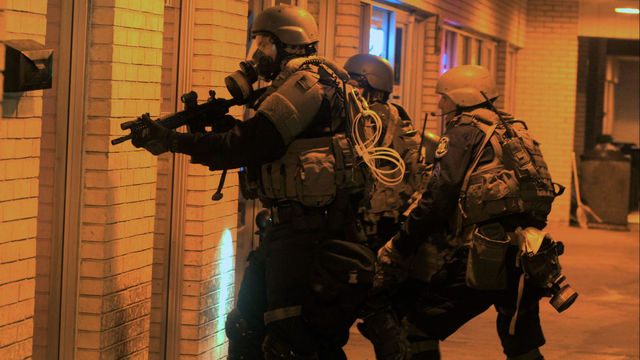
Early in the production process, to Atkinson’s surprise, police departments were willing to cooperate with his request to accompany them on SWAT missions. Without the national scrutiny, several departments in different parts of the country weren’t ashamed or embarrassed of situations like a raid midway through the film, in which a team of armed officers break into a ramshackle home, turning up nothing more than a gram of marijuana at the bottom of a backpack.
“I felt like such a jerk filming this family. I would have never filmed the family like that on my own. I was expecting Pablo Escobar to get pulled out of this house,” Atkinson says. “The officers were totally unaware that it would even read as anything other than another day on the job.”
When Atkinson’s dad saw the film, certain scenes made him very uncomfortable. He acted on only 29 search warrants during his 13-year SWAT career, a stark contrast to more than 200 per year that many SWAT units now claim. “He was saddened to see the mission creep,” Atkinson says.
Atkinson hopes moments like these will spur further action, or at least open the public’s eyes. Do Not Resist picked up a Best Documentary Feature award at the Tribeca Film Festival earlier this year, and it will be showing in 30 cities and arriving on several streaming platforms over the next few months.
“It’s been a very dynamic conversation,” Atkinson says. “I’m hoping that the film is a visual example of a lot of these headlines that we continue to hear about. It’s giving the communities who have been saying they’ve been experiencing this type of mistreatment for decades, and officers who are working on transforming their culture, an example of something they can point their constituents to, to say ‘This is what we were talking about.’”
Do Not Resist begins a one-week run at the AFI Silver Theater tomorrow .