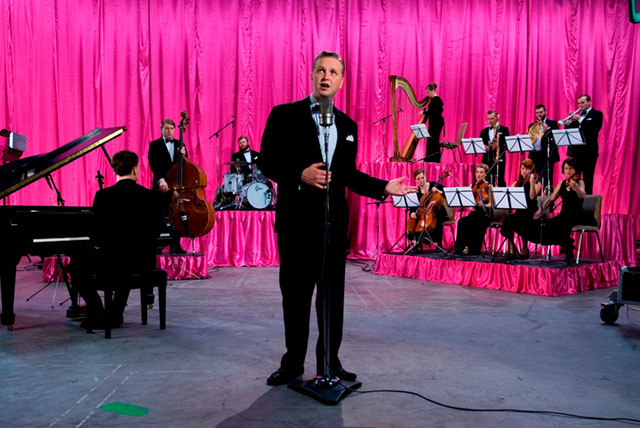
 Ragnar Kjartansson, God, 2007 (Rafael Pinho/Hirshhorn)
By DCist contributor Elena Goukassian
If you’re a fan of Sigur Ros and slow TV—the Scandinavian craze of seven-hour continuous shots of train and ship journeys, burning fireplaces, knitting hands, and birdfeeders—you’ll love Ragnar Kjartansson.
The Icelandic artist collaborates with Sigur Ros’s former keyboardist, Kjartan Sveinsson to create meditative video works that can span many hours. “I’ve never watched slow TV, but I make slow TV,” Kjartansson says. “It’s turning something that’s a narrative into a painting.”
Opening this weekend, the Hirshhorn presents the first major survey of Kjartansson’s work in the U.S., an exhibition that includes large-scale video installations, paintings, drawings, photography, and even live performance.
Kjatransson’s best-known works are the videos—the narratives turned into painting. Regular Hirshhorn visitors may remember seeing his S.S. Hangover in the museum’s Black Box Series in 2014 (it’s returning for this exhibit). Created for the 55th Venice Biennale, the S.S. Hangover was a hybrid Greek/Icelandic/Venetian wooden boat with six brass musicians on board, playing music composed by Sveinsson while the boat slowly circled the historic Venetian Arsenal. The performance took place for six hours a day, every day for six months; the resulting two-channel video runs almost three hours.
Many of Kjartansson’s video works combine the slow-TV mentality with calming, profoundly ambient music. The video installation God features Kjartansson in a black tux, singing the words “Sorrow conquers happiness” over and over, like a slow dance Frank Sinatra with a small orchestra behind him.
In The Visitors, the artist sits in a bathtub playing guitar, while eight other musicians—on accordion, drums, piano, cello, and more guitars—play along, each in a separate room of the same house. They all play in unison, yet they’re all alone. The Visitors is set up so that each individual musician takes up his or her own giant projector screen, and the installation takes up a huge amount of space, surrounding museum patrons in a melodious harmony, sometimes even bringing them to tears.
A musician as well as a visual artist, Kjartansson says he uses music in his artwork for its emotional qualities. “Music is an important thread through everything we do in our lives,” he says. “When you incorporate music into visual art, it changes the context.”
In 2014, Kjartansson and Sveinsson created a whole opera together, but without any singers or action onstage. Der Klang der Offenbarung des Göttlichen (The Explosive Sonics of Divinity) included several hand-painted stage sets of landscapes Goethe would be proud of and a full orchestra in the orchestra pit, but without any action (or even any singers) on stage. It was like a live version of one of his video projects, and small maquettes of the sets appear in this exhibition.
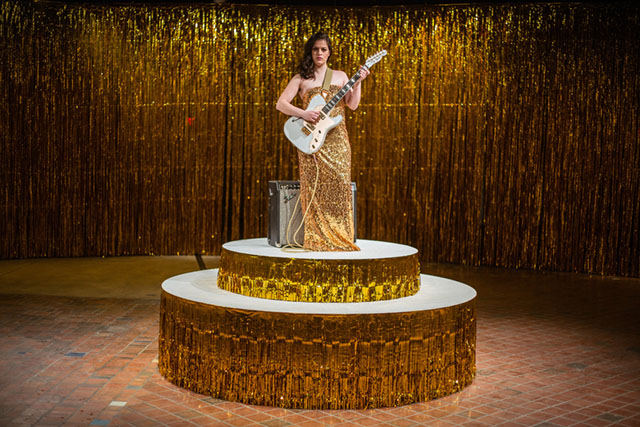
Kjartansson’s newest musical performance piece, Woman in E, will be central to the Hirshhorn show. The performance features a woman in a glittery gold dress standing on a revolving pedestal and playing an E-minor chord over and over on an electric guitar.
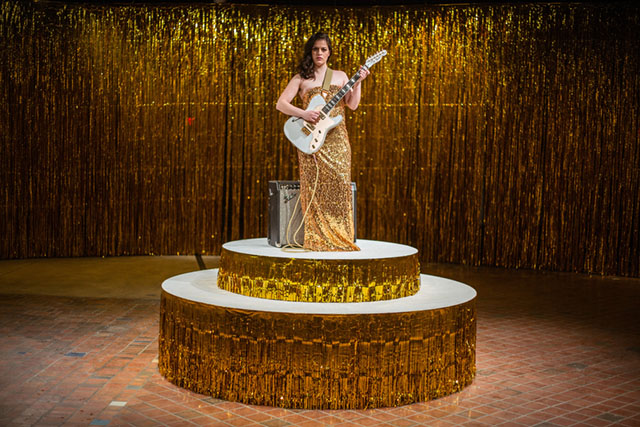 Ragnar Kjartansson, Woman in E, 2016. (Andrew Miller/Hirshhorn)
Woman in E was originally performed in Detroit earlier this year, with a rotating cast of local Detroit musicians playing the part, on display like a fancy Cadillac at a car show. At the Hirshhorn, fourteen local guitarists will take the stage, taking turns so that the performance continues throughout museum opening hours all the way through exhibition closing in January. The Hirshhorn helped Kjartansson find the performers—which include Hand Grenade Job’s Beck Levy and Erin McCarley—and the artist immediately went to work familiarizing himself with their music and their bands online, using their music to inform each woman’s unique performance of a single note. “I’m getting to know the ladies’ work as we go,” he says, “and composing their characters as they do Woman in E.”
Kjartansson has always identified as a feminist, and his works both celebrate women’s contributions—like Woman in E—and poke fun at the societal norms of masculinity. In The End – Venezia, the artist spent six hours every day for five months painting a total of 144 canvases of a male model friend of his wearing a speedo, while the two of them drank lots of beer and smoked way too many cigarette, just like a stereotypical Bohemian artist. (The resulting paintings are displayed salon style at the Hirshhorn.)
But the artist is quick to point out that he’s not making fun of these stereotypes. “I have the desire to be a stereotypical visual artist,” he says. “It’s an ironic view, mostly it’s hilarious and full of machismo. Jackson Pollock became the Mickey Mouse of it all.” But at the same time, “I’m fascinated by artists,” he says. “I come from a country where there are no objects, only stories.” Kjartansson turns those stories into paintings.
“Ragnar Kjartansson” runs through January 8 at the Hirshhorn Museum and Sculpture Garden, 700 Independence Ave SW. Free.
Meet the Artist: This Friday at 6:30 pm, our very own Ian Svenonius joins Ragnar Kjartansson in a conversation about art, music, and—knowing Spiv—other outlandishly random philosophical topics.
Meet the Women in E: Next Saturday, the 22nd, hear the bands of our local Woman in E performers at Hirshhorn Fall Fest, a free, daylong festival.