 (Janus Films)
Cameraperson bills itself as the memoir of its director, longtime documentary cinematographer Kirsten Johnson, whose credits include Fahrenheit 9/11, Darfur Now and Citizenfour. But the movie isn’t as straightforward as that suggests. In fact, it’s hardly straightforward at all — it jumps around in time and space, resulting in a filmed mosaic that showcases both Johnson’s subjects and her own life.
It’s a movie about many things, all of them rendered with grace and subtle ingenuity. Cameraperson is unlike any movie I’ve ever seen. It deconstructs aspects of its own genre, even as it serves as an innovative entry into that genre’s historical canon. I’m equally surprised that someone was able to pull off this experiment and that it hasn’t been tried more often.
The movie is comprised of short segments of footage left on the cutting room floor during editing of the films Johnson has shot over the years. Title cards announce the geographic location of the following sequence, except in the case of the brief Citizenfour footage, which is preceded with “Location withheld.” Johnson’s oeuvre spans a range of topics, and Cameraperson spans a range of locales, from the boroughs of New York City to spots in Europe, Africa, and Asia.
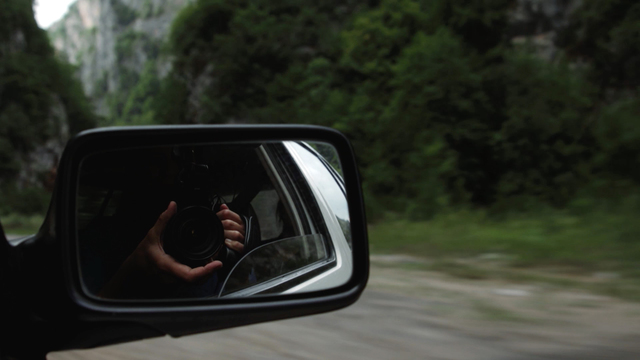
Beautiful sights abound, but Johnson’s camera doesn’t always linger on them. Sometimes the only footage from a given documentary finds her in the process of framing a shot, coaxing an interview subject or surveying her surroundings for the most cinematic sights. Johnson can often be heard muttering to herself and her crew from behind the camera. There’s no better way to see how a documentary is made than to watch an expert make one. Cameraperson capitalizes on that idea, offering an intriguing window into the filmmaking process.
What emerges is a self-reflective, occasionally critical portrayal of the practice. The Johnson behind the camera—often much younger than Johnson is now—sometimes seems so preoccupied with the task at hand that she fails to notice something naturally beautiful occurring around her. Every so often, she’ll nudge her interviewee to deliver more emotion while he’s on camera, subverting the perceived objectivity of the medium.
But it’s hard to argue with the results. By not revealing the films from which each scene is derived, Johnson divorces this film from her own prior work. The movie also offers poignant glimpses into Johnson’s home life: tending to two perky children, guiding her mother through Alzheimer’s. The implication is that Johnson, like every documentarian, is a product of the sum total of her experiences. Her empathy for her subjects develops even when she’s not at work. Making a documentary, it seems, requires an investment of self.
For some, the prospect of scrutinizing Johnson’s work might feel too much like navel-gazing. But Cameraperson provides plenty of dazzling sights and sounds for those who want the sensory experience that the best documentaries offer. Stunning views of Sarajevo, Brooklyn, the Penn State football field, LaGuardia Airport, and the streets of Uganda are a few of the sights that get a brief moment in the spotlight. Characters and circumstances return for updates throughout the movie; a memorable one takes place in a Nigerian hospital.
But the key to Cameraperson is the powerful effect of seemingly disparate scenes woven together into a coherent whole. No single scene provides the answer to the questions the movie’s layout poses. To enjoy it is to watch closely, to savor the quiet moments of a prolific creator reflecting on all that she’s seen and done.
—
Cameraperson
Directed by Kirsten Johnson
With Kirsten Johnson
Unrated
103 minutes
Opens today at Landmark E Street Cinema
Cameraperson Trailer from Janus Films on Vimeo.