 Rachel Sadon
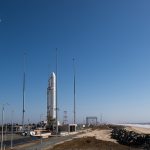
 The Orbital ATK Antares rocket, with the Cygnus spacecraft, was raised onto a vertical position on Friday. It is the company’s sixth contracted cargo resupply mission to the International Space Station. (Photo by Bill Ingalls, courtesy of NASA)
Two years after a dramatic explosion and two recent postponements, an Antares rocket is set to soar again this evening from NASA’s Wallops Island facility in Virginia. And, weather permitting, much of the East Coast will be able to see it against the night sky.
The launch is scheduled for 7:40 p.m., and it will come into view in much of D.C. about 105 seconds later (according to Orbital ATK, the rocket’s manufacturer, that is when it will reach 5 degrees above the horizon and thereby be visible over most buildings). Viewers will have a second opportunity, about 54 seconds later to see it in the second stage—when it is likely to be even brighter. From Orbital:
The enhanced second stage in this Antares launch is ignited considerably sooner than in previous Antares launches. This means that the rocket will still be fairly high up over the horizon as viewed from most locations. In addition the solid motor on the second stage is usually brighter than the liquid fuel engines of the first stage. Even if you don’t see the first stage, it is possible you may be able to spot the second stage! You should also remember that there is a 54 second gap between the first and second stages; during this time the rocket will not be visible.
Of course, you’re also guaranteed a sighting if you tune in to NASA’s livestream.
The launch was originally delayed due to Hurricane Nicole, and then again as the result of a faulty cable. It will be the first flight of an Antares rocket, since upgraded with new engines, since the 2014 launch failure. It is carrying a Cygnus supply ship to the International Space Station.
In addition to carrying supplies for the crew, the rocket is also bringing materials for new science experiments that include investigations into fire in space, studies on how light effects sleep and daily rhythms, and a new way to measure neutrons.
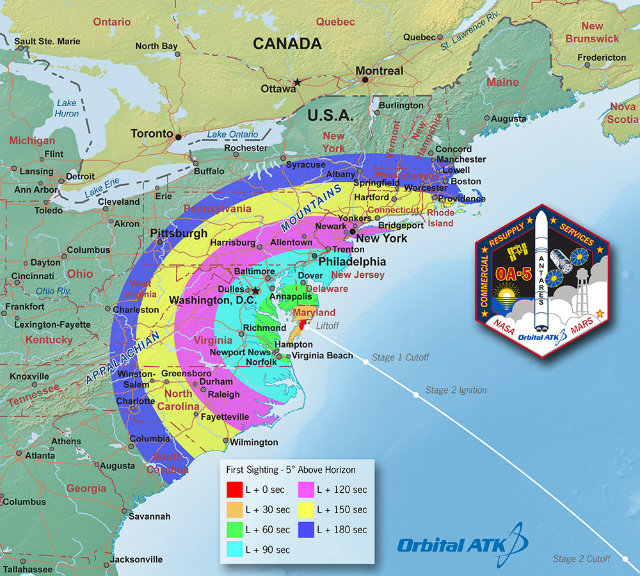 The rough time that viewers along the East Coast can expect to see Antares for the first time that it is launched. The map shows the time when the rocket will reach 5 degrees above the horizon. (Courtesy of Orbital ATK)
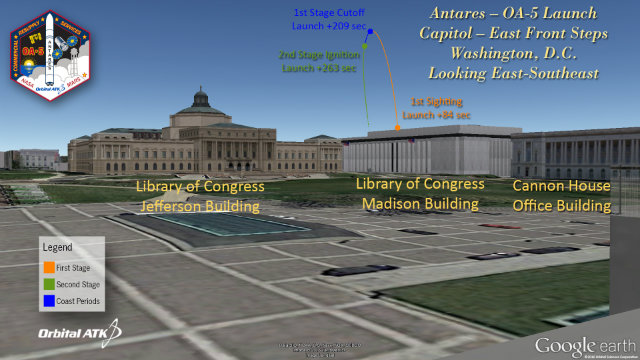 The trajectory of the rocket, as it will appear from downtown D.C. Note: for 54 seconds between the first and second stages, it will not be visible. (Courtesy of Orbital ATK)
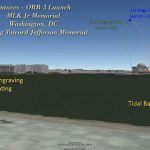
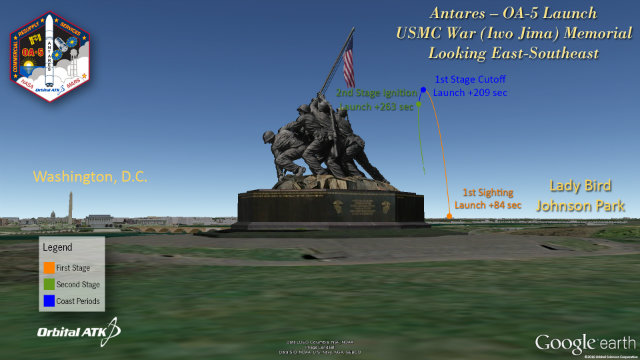 The trajectory of the rocket, as it will appear from the Iwo Jima Memorial. Note: for 54 seconds between the first and second stages, it will not be visible. (Courtesy of Orbital ATK)