It’s tough to be an inventor.
Not because we lack imagination or creativity, but because, like it or not, making stuff takes tools and space—two things at a premium if you live in a typical D.C. apartment. Your landlord and neighbors probably wouldn’t be thrilled about that new woodworking hobby. Table saws are loud.
So if you want to run a fabrication business, invent a new product, or make some large-scale art, the TechShop chain of maker spaces is quickly becoming a go-to place to do so. It’s not for everyone (more on that later), but hundreds of people have already made this spot in Crystal City their own.
The 22,000-square-foot space—a former Safeway until 2005, then vacant until TechShop opened in 2014—is a nerd’s dreamscape. Name an expensive machine, they have it: oscilloscopes, 3D printers, a vacuum former, an injection molder (and the means to make your own dies for it), CNC routers, and a waterjet cutting, which can slice through six inches of solid metal.
I took a tour with TechShop member ambassador Steve Davis, general manager Gadsden Merrill, and “dream consultant” Elizabeth Smith, who also helps out with marketing for the space.
The Hub is the main space after entering TechShop. Here you find the 3-D printers, electronics/soldering/Arduino station, and a few of the other tools, as well as computers loaded up with software for designing and modeling. There’s also spaces to gather and hang out here, and a classroom for kids to learn robotics and other STEAM (that’s STEM+Art, for those of you not up on the trendiest education acronyms) skills.
In the Hub I met Tareq Khalaf, who is using the vacuum former to create a better—spillproof—coffee lid. (Seriously, look for this thing at coffee shops near you soon.) I also met Christian Cooper, an Army veteran who has a fabrication business making signs, lamps, tables, and more. He started at the TechShop in Austin, but most of his clients were in D.C., so he picked up and moved here.
“I saw TechShop on TV and I was like, ‘I want to learn everything,’” Cooper says. “Now I can weld like a beast.” Right now he’s sold on D.C., but given that there are TechShops in seven states and three foreign countries, he’s thinking that he might move his operation overseas just for the heck of it.
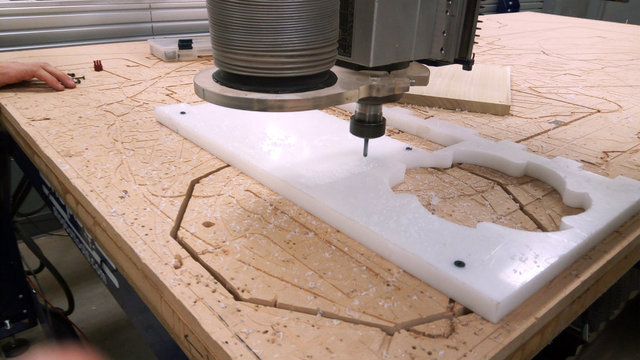
Off the Hub is the sewing and fabric area, where members can screen print, cut vinyl, or use industrial-level sewing machines to put together fashion creations. The woodshop, meanwhile, has a CNC router, table saws, a drill press, and a lathe, among others.
In fact, Tom Swift, a designer, architect and woodworker who built the furniture in Teaism, teaches classes there. And TechShop offers a rather mind-bending array of classes for adults: etch a wine glass, create a piece of jewelry, build a cabinet, or sculpt a metal flower.
Don Johnson has been a member for two years. “I didn’t know one end of a wood lathe from another” when he joined as a post-retirement hobby, he said. Now he turns out striking pens and bowls.
The metal shop is where you can cut, shape, or weld metal. There’s also a plasma cutter (“It’s like a personal lightsaber,” Merrill says) and the aforementioned waterjet machine.
Perhaps the coolest bit of equipment at the shop, the cutter shoots a jet of water, mixed with an abrasive, at 60,000 PSI toward whatever you hate most. Merrill and Davis described how for TechShop’s two-year anniversary, they played a game of Battleship with a sister makerspace, using the waterjet to explode plastic bottles that stood in for the ships. Watch the video of it at work. Yes, I jumped.
Waterjet in action at the TechShop DC-Arlington from DCist on Vimeo.
So what’s the catch? Well, unless you’re actually running a business out of TechShop (which is totally feasible), you’re going to be spending a fair amount of money. Membership is $150 per month, and for each piece of equipment you want to use, you must take a “safety and basic use” class, which start at $80. If you want to use a lot of machines, that adds up fast. Materials are extra (in most cases, you can bring your own; in others, you can buy them from TechShop).
If you just want to dink around with a couple machines as a hobby or experiment, there are several less expensive options. For one, the D.C. public library offers 3-D printing, laser cutting, wire bending, and soon a sewing machine in its Fab Lab, all for free (well, paid for with your tax dollars). It’s a small space and slots on the machines fill up fast, as to be expected with a free space.
There are also a smattering of maker spaces scattered throughout the DMV, such as Greenbelt Makerspace (also free and open to the public), Catylator in Silver Spring, HacDC in Mt. Pleasant, Nova Labs in Reston, to name a few. Depending on your tool needs and the number of hours you can put into your project, one of these may be a better option. But if you envision spending serious hours in a makerspace, or need tools beyond a 3-D printer or basic woodworking, you pretty much want to be at TechShop. Or ask your neighbors to buy really good earplugs.