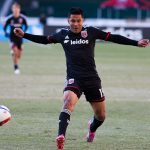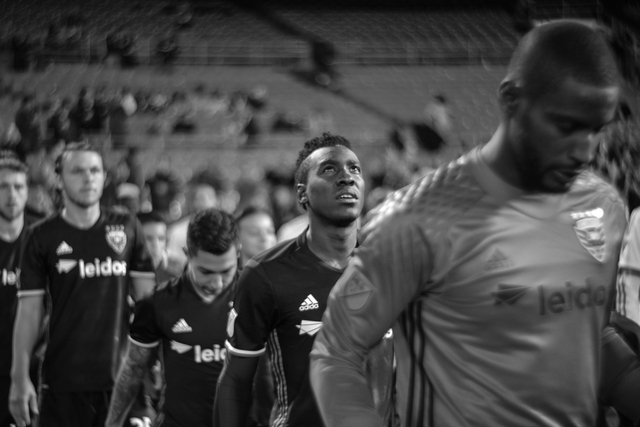

Lloyd Sam and his teammates take the pitch. Photos by Pablo Iglesias Maurer.
With a few days to spare before Halloween, D.C. United went ahead and turned into a pumpkin last night.
After weeks of promising play and stretches where they legitimately looked like an MLS Cup contender, United welcomed the Montreal Impact to RFK on Thursday and promptly laid an egg.
Gone was the dynamic, creative attack driven by Luciano Acosta and Patrick Mullins. Gone was the grit and tenacity that’s come to define Ben Olsen’s D.C. side. Instead, United struggled to string together passes and were beaten to every second ball.
It took Montreal just four minutes to find the opener, dampening the spirits of the 12,773 who turned out on a school night in hopes of seeing United book passage to the conference semifinals. The early goal was a dagger: D.C. didn’t register a single shot on goal in the opening 45 minutes. By the time the Impact netted their second just before halftime, the game seemed all but over. It finally ended in a 4-2 loss.
The Highlights:

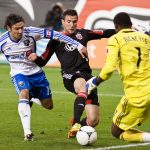
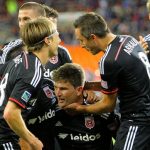
Nacho Piatti, Nick Deleon and Ben Olsen. Photos by Pablo Iglesias Maurer.
The Good: Nacho Piatti, The Impact’s ability to cope with the absence of Didier Drogba. There’s little to rave about on the D.C. side, but Montreal certainly did their best to entertain. Argentine playmaker Ignacio Piatti was the maestro of the Impact’s attack, exploiting United all night long down the right flank and connecting masterfully with a speedy Dom Oduro and forward Matteo Mancosu, who has been a revelation in the absence of Didier Drogba.
Speaking of Drogba, the former Chelsea legend was in attendance at RFK last night, the latest turn in a bizarre series of events which have seen him refuse to play after being named a sub in one match and miss the next one with a back injury which seems dubious at best. Full credit to the Impact, then, for overcoming that drama and getting the job done.
The Impact are actually statistically better without Drogba, but many have been left wondering whether the 38-year-old will ever be seen in an Impact kit again. On Thursday, Impact head coach Mauro Biello told me he’s leaving that door open.
“If he’s healthy,” said Biello, “he will be available [for our next game.]”

United’s Steve Birnbaum vies for a header. Photos by Pablo Iglesias Maurer.
The Bad: Where were D.C. United? After a slow start to the year, a few mid-season acquisitions—most notably the signings of Lloyd Sam and Patrick Mullins—completely revitalized United’s attack. A formation change from Ben Olsen completed the package, and United have recently been playing a brand of soccer that hasn’t been seen at RFK in ages.
Where was that last night? After the match, both Olsen and United winger Patrick Nyarko suggested that D.C. may have been “reading a bit too much of our own press,” suggesting that they may have entered the match-up against the Impact a little on the cocky side.
I tend to agree. Historically, Olsen’s sides have thrived on the underdog role and have played best when fueled by a lack of respect, not by an abundance of it. That much seemed to be on display last night, when they faced a wounded Montreal side.
“We were second best from the go,” Coach Ben Olsen said. “I don’t know if we were reading our own press a little bit and thinking it was going to be easy and we were going to walk to the championship, but that’s not how it goes.”

The Rest: D.C. enter the off-season facing an abundance of issues. Though Olsen’s core remains strong (players like Sam, Nyarko, Bobby Boswell, Steve Birnbaum and Bill Hamid will surely remain), there are question marks. Will United be able to work out a deal to retain Acosta, who comes with a price take of around $1 million? Will Chris Rolfe—who’s been struggling with post-concussive symptoms and missed the lion’s share of 2016—return? There’s also the little issue of D.C.’s stadium plans, plans which are currently in risk of beingheld up over objections to the stadium’s design and neighborhood benefit. It should be an interesting off-season.