Rachel Kurzius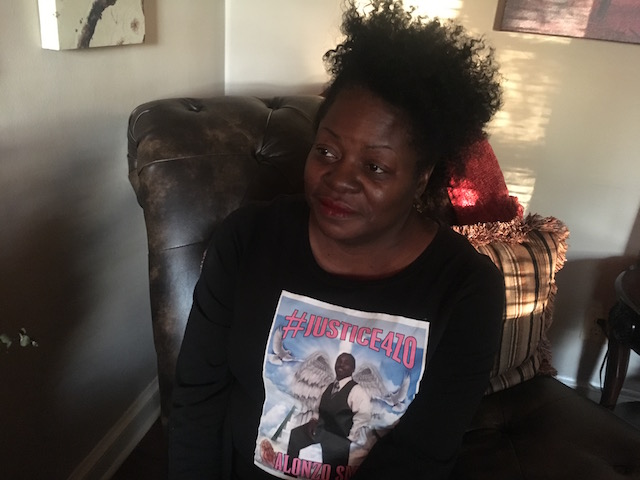
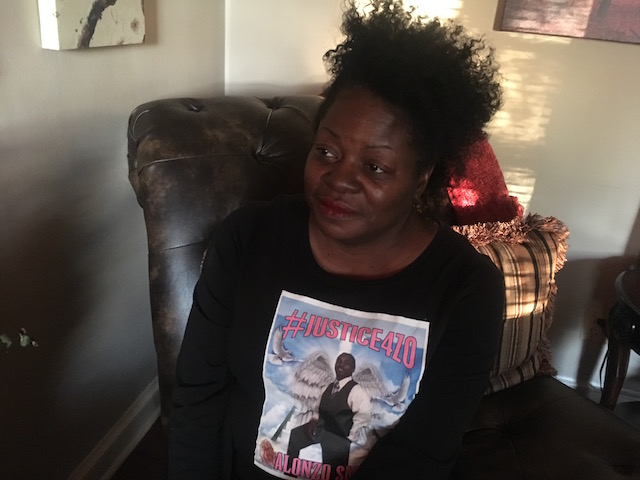 Beverly Smith in her living room. (Photo by Rachel Kurzius)
Tonight, the day before the year anniversary of her son’s death during a confrontation with D.C. special police officers, Beverly Smith is facilitating a grief support meeting at Anacostia Library for parents who have lost their children.
The monthly meetings are called COLAS—which stands for Circle of Love and Support.
“We talk about how to turn their pain into power, and share how they get through it on a daily basis,” says Smith. “It’s a roller coaster and people actually think they’re losing their mind. I’m not an expert in this, because I still go through it daily, but it helps me as well as the participants. It’s like we’re getting through it together.”
Alonzo Smith was discovered in the early morning of November 1, handcuffed and unconscious in the custody of two special police officers at the Marbury Plaza apartments on Good Hope Road SE. He later died in an area hospital. The 27-year-old’s death was ruled a homicide.
His death was the second in a two month span last year involving special police officers, and it prompted the first public release of body-worn camera footage in D.C. Several months later, the mayor and police chief proposed enhanced training requirements for special police officers, who are awarded limited arrest powers.
While the special officers involved in the other case have been indicted, the U.S. Attorney’s Office for D.C. announced several weeks ago that there wasn’t enough evidence to charge the special police officers involved in Smith’s death.
But Beverly Smith hasn’t stopped seeking justice.
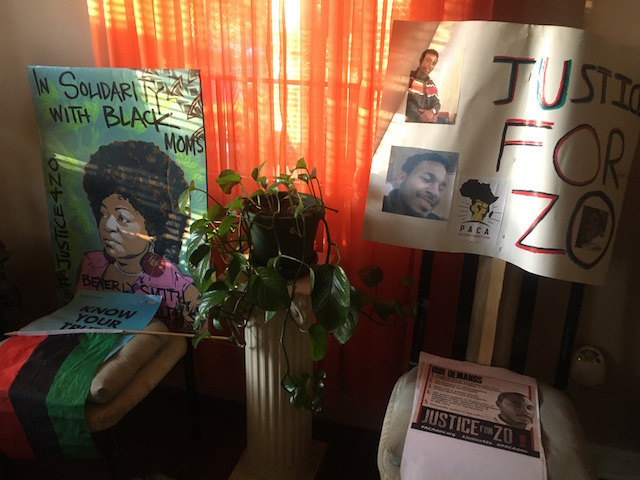 Protest posters and signs in Beverly Smith’s house. (Photo by Rachel Kurzius)
Smith might not call herself an expert on the subject, but she can rattle off the five stages of grief, just as she can list the different vertebrae of the spine, talk about the intricacies of grand juries and other ex parte proceedings. She also co-founded Pan-African Community Action, a grassroots organizing group. And that is just a fraction of what she’s learned since the death of her 27-year-old son.
“It’s good to know all of these things because it helps prepare me to fight injustice, but it is very sad how I became educated in this arena,” she says.
At her home in Woodland SE, she is wearing a black #Justice4Zo shirt that depicts her son with angel’s wings. She lights up when she talks about his love for flag football, his work ethic, and how much the kids at Accotink Academy, where he worked as a teacher’s assistant, “adored my son.”
Smith says she knew something was amiss by early Sunday “when I saw he didn’t post any selfies—that’s not like Alonzo. He’ll post selfies every weekend, every day, and I knew something was wrong.” She was texting him to see if he was okay, but he wasn’t responding. At that point, he was already dead.
Still, she was not notified until about 36 hours after his death, which she says continues to upset her. “Two internal affairs officers appeared at my door. I let them in and before they said anything or showed me any pictures, I said, ‘What happened to my son?'” she says.
Smith didn’t see her son’s body until a week later, when it was released from the D.C. medical examiner’s office. “It was the most horrible thing I’ve seen in my whole life. That image will always be in my mind. The back of his head was cut open—it was just awful.” Describing this scene is the only time that her voice breaks with emotion.
The medical examiner’s office later ruled Alonzo Smith’s death a homicide. The office announced he died of sudden cardiac arrest, complicated by “acute cocaine toxicity while restrained,” with “compression of torso” as a contributing factor.
The homicide ruling means that Mr. Smith died at the hands of another, but it didn’t prove criminal intent.
A day after that, Mayor Muriel Bowser released nine minutes of police body-worn camera footage that depicts police responding to the scene, where they found a security guard with his knee on the back of an unconscious man in handcuffs. After that, the video shows police officers bringing additional restraints, calling an ambulance, and administering CPR to Smith.
However, the Bowser administration did not release the names of the involved officers. “The public has a right to know who these officers are,” Smith says. “My family has a right to know who these officers are.”
She describes her reaction to the administration releasing the name of the officer who killed motorcyclist Terrence Sterling in September. “I was very angry, point blank,” she says. The mayor’s office says that special police officers are governed by different rules than D.C. Police.
Earlier this month, the U.S. Attorney’s Office for D.C. announced it would not pursue charges against the two special police officers from Blackout Investigations involved in his death. Those officers have arrest powers and 40 hours of training.
According to the attorney’s office, there wasn’t enough evidence to conclude, beyond a reasonable doubt, that the special police officers “violated Mr. Smith’s civil rights by using excessive force or that they possessed the requisite criminal intent at the time of the events.” Instead, they say, evidence points to the “significant amount of cocaine” in his system.
“I was prepared for that,” Smith says, but she maintains that the U.S. Attorney’s Office got it wrong. She says the attorney’s office minimized the the bruising on her son’s body.
As she promised last winter, she is still trying to get his body exhumed for an independent autopsy, and a family member has established a GoFundMe page to help raise the funds to do so. She continues to fight for the release of the two special police officers’ names, too, and says civil cases against the city and Blackout Investigations are in the works.
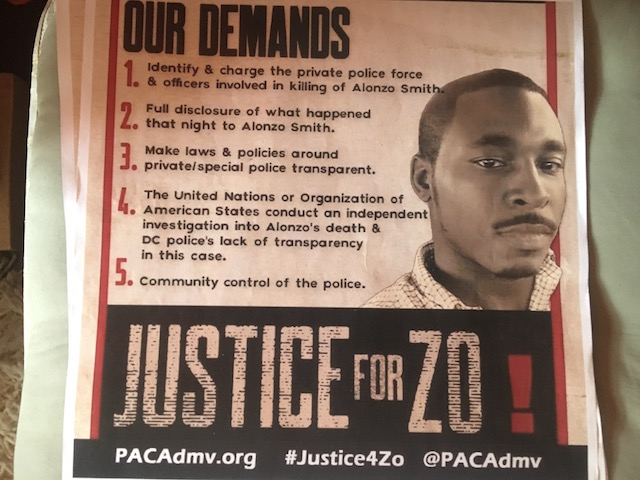 A Justice for Zo flyer. (Photo by Rachel Kurzius)
But now, the idea of Justice for Zo expands beyond her son. “It’s not just about fighting for justice for Alonzo now. It’s become bigger, with justice for all who are victims of police brutality,” she says.
In addition to her work with Pan-African Community Action, which is focusing on educating members of the community through education sessions, she is also involved with the Coalition of Concerned Mothers—travelling across the country in solidarity with other parents and raising awareness.
“I am a member of a club that no mom wants to be in, but I didn’t have a choice,” she says, though adds that the other members’ support helps ground her. “They’ve been a blessing in my life and they’re helping me keep it all together. Only another parent who had the experience losing a child can understand the experience, the emotions, the trauma.”
She also testified on Capitol Hill earlier this month as part of Every Case Matters, a group that works to highlight some of the less publicized instances of death at the hands of police.
She wants to keep her focus on legislators because “that’s how laws are changed. Protesting is good, protesting is a prerequisite of change—it brings awareness to the community of what’s going on, but the real change happens in Congress.” Some legislative goals include getting rid of grand juries for indicting officers, mandating that law enforcement departments collect data on police-involved shootings, and building support for a referendum in D.C. that would create community control of MPD.
Smith is also working to see Alonzo’s son, her seven-year-old grandson, on a more frequent basis.
As she prepares for the year anniversary of her son’s death, Beverly Smith says that “some days I haven’t reached the fifth stage of grief—accepting. Some days I think he’ll come home and then I realize he won’t.” She still hasn’t gone through his things.
On November 1, there will be a candlelight vigil for Alonzo Smith outside of the Marbury Apartments.
When asked if police brutality was on her radar before her son’s death, she said, “Absolutely not. What I’ve learned now, and what I tell other people, because of me being affected personally by it, is to get involved now. Don’t wait until, God forbid, it comes knocking at your front door.”