 Rachel Sadon
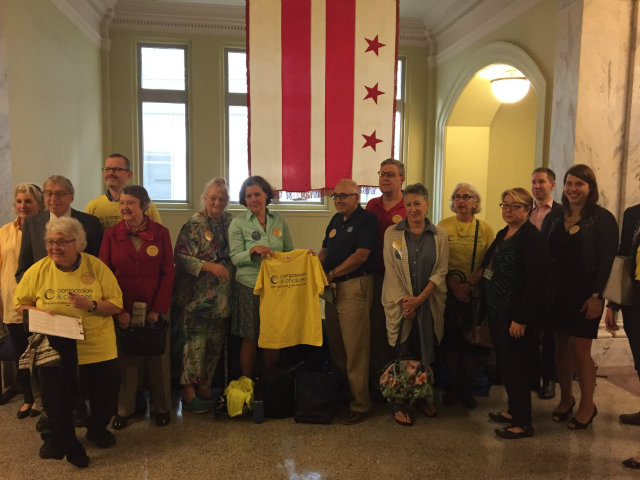 The national group Compassion & Choices came out in support of the Death With Dignity bill. (Photo via Twitter)
The D.C. Council advanced legislation today that would allow physicians to prescribe life-ending drugs to terminally ill patients, passing it by an 11-2 vote on first reading.
Ward 3 Councilmember Mary Cheh introduced the Death with Dignity bill last January, fully expecting the controversy that ensued. “I expect that some may oppose this bill on the basis of religious beliefs or moral principle,” she said at the time. “But there is latitude to recognize that all life is valuable while also respecting the rights and decisions of others.”
A number of people passionately testified against the bill at a hearing last month. In a story about the backlash, a Washington Post story’s headline quoted one woman saying “‘It’s really aimed at old black people.” Others, organized under the banner of No D.C. Suicide, opposed it on religious grounds. Ward 1’s Brianne Nadeau and Ward 7’s Yvette Alexander voted against the bill.
But proponents believe equally strongly that the decision is a personal one to make, and that providing aid in dying offers dignity and a release from pain for terminally ill patients who wish to exercise that option.
“Today we are celebrating a historic victory for human dignity and individual freedom in our nation’s capital,” said Sarah Levin, a senior legislative representative of the Secular Coalition for America, said in a statement. “As a secular D.C. resident who has personally witnessed a close family friend endure a long, painful death against his wishes, I am comforted to know that this legislation will prevent D.C. residents from being forced to suffer as he did.”
While some on the Council grappled with their own religious and moral beliefs, they overwhelmingly voted to let terminally ill patients who have less than six months to live make their own choice. “I will not take the liberty of even thinking for others on matters of life or death,” said At-large Councilmember Anita Bonds.
Among the bill’s provisions are a number of safeguards against abuse, including requiring patients make both oral and written requests more than two weeks apart. Two witnesses, one of whom cannot be a relative, must also attest that the decision is voluntary.
If the bill passes on second reading, it will go to Mayor Muriel Bowser, who has not taken a public stand on the issue. And if it makes it past a 30-day Congressional review period, D.C. would join Oregon, Montana, Vermont, Washington, and California in allowing medical aid in dying.