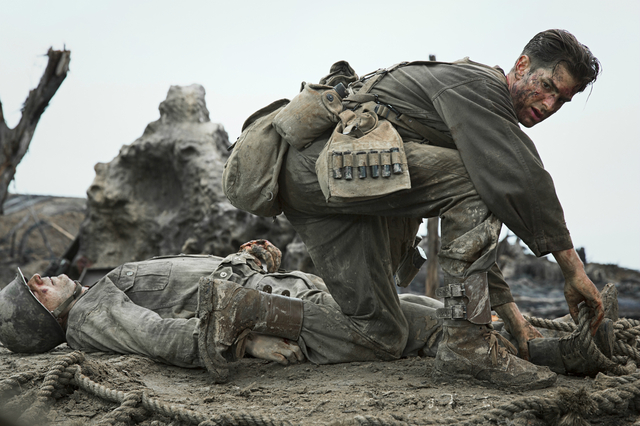
 Desmond Doss (Andrew Garfield) goes into battle without a gun in Hacksaw Ridge. (Photo courtesy of Lionsgate)
There’s no way to watch Hacksaw Ridge—the new film from Mel Gibson, the director—without thinking about Mel Gibson, the man. Gibson’s personal record includes numerous racist, anti-Semitic, and homophobic slurs, accusations of domestic violence, and a general ethos of unbecoming surliness.
Now, after a decade-long directing hiatus, the celebrated filmmaker is back with another ultra-violent epic. Many of its best qualities can be attributed to Gibson’s work behind the camera. The script is formulaic and full of clunky dialogue, and some of the performances don’t quite land. But with a visceral impact and visual sweep, Gibson does battle sequences better than almost anyone else in the business.
Gibson’s personal failings don’t invalidate his technical gifts, and his technical gifts don’t excuse his personal failings. Reality is ambiguous. The same can’t be said of the didactic Hacksaw Ridge.
Its subject is Desmond Doss (Andrew Garfield), the first conscientious objector to win the Medal of Honor. A short prologue spells out the central conflict: Desmond nearly kills his friend during a playful brawl, then looks with remorseful eyes at a painting of the “Thou Shalt Not Kill” commandment. The world may want Desmond to kill, but with a pure heart and firm principles, he declines.
The dilemma is rife with tension, but Gibson misses opportunities to explore its nuances. Nearly every scene, particularly in the rocky first half, involves someone trying to convince Desmond to pick up a weapon or commit violence. Only occasionally does Desmond appear conflicted by his choice or battered by others’ skepticism.
An awkward meet-cute between Desmond and a nurse named Dorothy (Teresa Palmer) provides early relief from the horrors to come. But before long, Desmond enlists in the Army, where he runs up against cruel bullies, hard-nosed officials, and a foulmouthed sergeant played by Fred Claus himself, Vince Vaughn. There’s lots of hand-wringing about whether Desmond should be allowed to go into battle without carrying a weapon, but of course he does, because this is a war movie directed by Mel Gibson, and because it happened that way in real life.
Hacksaw Ridge comes alive with some of the most intimate, gory, and unsettling battle sequences I’ve ever seen. It’s no spoiler to say that Desmond survives wartime with barely a scratch, and indeed, it’s hard to imagine the real Desmond evading so many bullets and grenades. But these scenes have a kinetic beauty. You can almost smell the rotted flesh and feel the tremors of oncoming explosives.
Despite this powerful depiction of war, the movie built around those setpieces never quite gels. Garfield is a capable actor who’s intriguing in every part, but he’s almost too visibly intelligent for the simple-minded Desmond, especially when he’s making doe eyes at Dorothy. Vaughn appears to be having fun as a stock character. Palmer’s Dorothy is appealing, but she gets almost nothing to do after Desmond enlists, and disappears from the movie entirely once he goes to war.
The script from Andrew Knight and Robert Schenkkan doesn’t trust the viewer to grasp the significance of Desmond’s achievement. He was a hero and a unique kind of rebel. But as the movie repeats those sentiments, it dulls their impact. Hacksaw Ridge is about someone who abhors violence, but its most impressive moments are brutally violent.
—
Hacksaw Ridge
Directed by Mel Gibson
Written by Andrew Knight and Robert Schenkkan
With Andrew Garfield, Vince Vaughn, Teresa Palmer
Rated R for intense prolonged realistically graphic sequences of war violence including grisly bloody images.
138 minutes
Opens Friday at a theater near you