By DCist contributor Julie Strupp
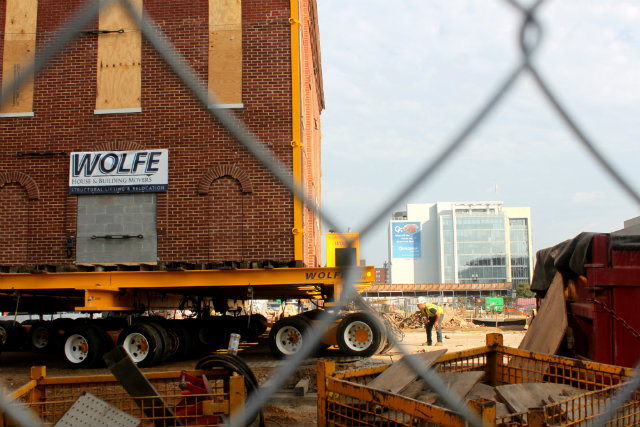
A D.C. synagogue once again evaded the wrecking ball, physically relocating this morning for the second time its storied history.
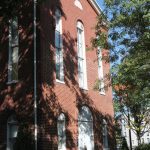
Adas Israel, the city’s oldest and very first synagogue, no longer holds a congregation in its original building (they moved to Cleveland Park in 1951). It was converted to the Jewish Historical Society of Greater Washington’s Lillian and Albert Small Jewish Museum in 1975. But as the relentless march of development once again menaced the small building, it was lovingly—and laboriously—carried to safety. It is the first of a two-part move to its final home, a trek scheduled for 2019.
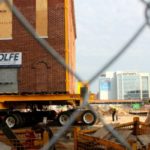
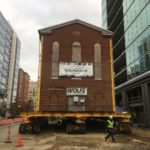
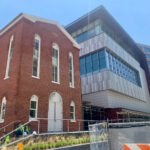
Movers mounted the building on sturdy wheeled scaffolding and tugged it over to a temporary location about 60 feet away from its original spot. It will eventually be nestled outside a new Jewish Historical Society museum on Third and F Streets in the seven-acre Capitol Crossing complex currently being constructed across I-395.
“[The new museum] will be a center of Jewish life and culture and will tell some of the stories that we haven’t been able to tell,” said Wendy Turman, Deputy Director of the Jewish Historical Society. “Our historic synagogue will the be the largest artifact in our collection and really the centerpiece, the sort of jewel in the crown of the new museum.”
Turman admitted she was a little anxious when the building was raised off of its foundation Monday, but laughed, “Everything went great! It didn’t fall over.”
Twelve-story office and retail buildings are planned where the synagogue previously stood, according to Bob Braunohler, the regional vice president of property group partners, the company managing the massive Capitol Crossing project. Because of its historical and religious value—it is one of the oldest surviving synagogues in the United States—the 25-by-60 foot, 273-ton Adas Israel was the only building in the area to be moved rather than destroyed.
“[The moving company] are religious too and are actually Mennonites,” Braunohler said. “So we couldn’t move on a Sunday. Of course we couldn’t move on a Saturday because of JHS [the Jewish Historical Society] so we picked Thursday. We’ve had no problems.”
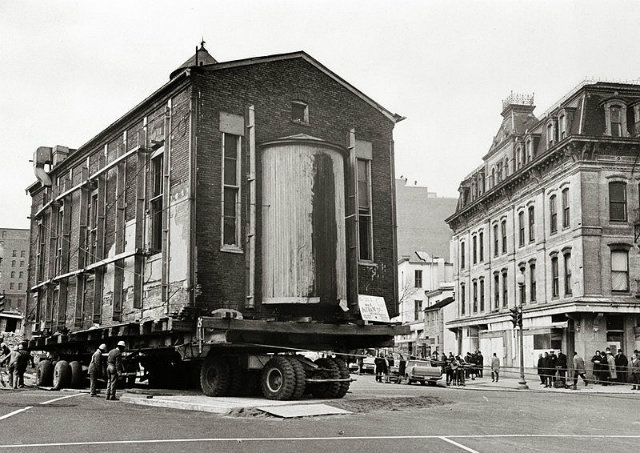 The synagogue moved for the first time in 1969. (Photo courtesy of Library of Congress.)
The synagogue was constructed in 1876 on the corner of Sixth and G Street Northwest near what is now the Verizon center. Ulysses S. Grant went to its dedication ceremony, the first sitting U.S. president to attend a Jewish service and a major news event at the time.
An influx of Eastern European immigrants swelled the congregation and they soon outgrew the tiny building, forcing them to relocate in 1908. The tiny building proceeded to wear many hats over the decades—not all of them kippahs.
DCist’s Catherine Finn wrote in 2011, “During the twentieth century, [the Adas Israel synagogue] housed several Christian congregations as well as a bicycle shop, a barber shop, a dentist’s office, a delicatessen, a real estate agent, and a grocery.”
Then decades later, the building itself had to relocate, too. In 1969 the Washington Metro Transit Authority bought the block and decided to build its new headquarters on the spot where the synagogue stood, threatening demolition if the building wasn’t moved. Moved it was, with painstaking care and burly Caterpillar tractors, to its new location a few blocks over on Third and G Street.
Only the second and third stories survived the journey, but the first floor was reconstructed and it continued its long and vibrant life, refurbished a few years later as a museum.
“I was there when the building celebrated its 125th year, and the streets were all full of chairs. The speakers…talked about the people who first built it and how much hope and faith went into the building,” said Jeanne Krone, a graphic designer who frequently does work for the museum. “I think you can still feel that. I think it’s because of that that this building has been preserved, and now preserved, and now preserved. I feel connected to those first people who built it with so much hope.”
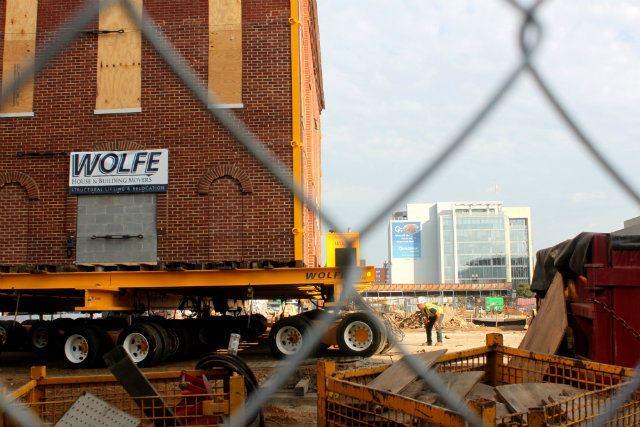 Adas Israel moved to a temporary location about 60 feet away today to make way for the Capitol Crossing project. It is slated to move for a third and final time in 2019. (Photo by Julie Strupp)
This time, much of both the reconstructed and original building survived the move. When it comes to rest in a few years, the bottom of the building will be again rebuilt to comprise three generations of physical history, said Christiane Bauer, head curator of the museum. She said the museum will focus on Jewish involvement in the Civil Rights movement and other protests.
“We want to talk about Jewish history in Washington through the lens of civic activism and advocacy and social justice,” Bauer said. “That ties our story to the city here, which has always been a stage of advocacy and political activism. The Jewish community here has been taking part in all those struggles.”
Many attendees spoke of their personal and familial ties to the little building.
Daniel Siesser, a lifelong Washingtonian who works in real estate, said the synagogue has deep personal meaning to him. “I’m trying to figure out more about [my wife’s] history and about my history, because I’m sure at some point they were connected to this building, and to these families.”
Albert Small’s father and grandfather were integral in assuring that the synagogue did not get torn down. He’s now a Board Member of the Jewish Historical Society and said he is proud to continue their legacy of preserving and promoting Jewish culture.
“Seeing transformative events happen, recording history, being able to keep things ever present and progressive and relevant is extraordinary and I’m glad to be a part of it,” Small said. “The new museum will be a wonderful way to tell the story not just of Jews in Washington, but of Jews and their impact on Washington.”