 Rachel Sadon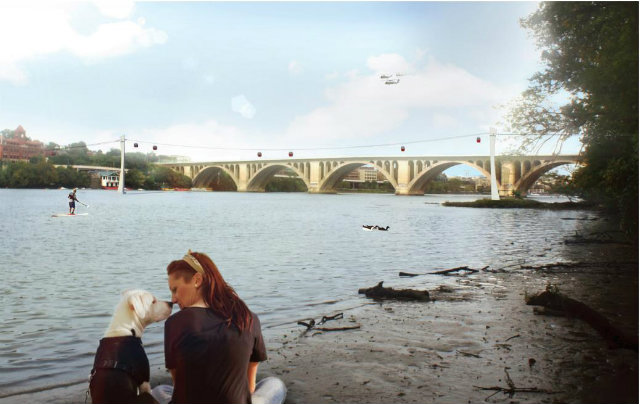
Once dismissed as a pie-in-sky idea—and laughed off as a joke—a proposed gondola between Rosslyn and Georgetown now has some serious study behind it. And the findings from outside consultants are as rosy as they come: it would be technically possible and legal to build.
The picture (and Potomac views) get prettier from there. ZGF Architects, which was commissioned to examine the feasibility of such a project, conservatively estimates a daily ridership of 6,500. And it would take significantly less time and money to build than a Metro station.
“They believe the technology and the mode is attractive enough to induce demand,” says Joe Sternleib, the president of the Georgetown BID. “That was the whole point [of the proposal], for the people who work here and live here, to make their lives easier.”
Still, completing the feasibility study is just one of the first steps in a process that would last years. “We are definitely optimistic about it,” says Mary-Claire Burick, president of the Rosslyn BID. “And we’re also realistic that this will take quite a bit of work.”
The out-of-left-field idea originated from the Georgetown BID’s 15-year action plan in 2013. It was one of a couple hundred suggestions that were winnowed down to the 75 recommendations in the final draft. “I thought this was one of the ones that would be killed off early,” Sternlieb recalls. “I was surprised by how receptive and enthusiastic people were about it.”
When the Georgetown BID first approached their counterparts over the river with the idea, they were skeptical. But they, too, thought it merited study and helped raise more than $200,000 to fund the research (contributed by the two BIDs, the D.C. and Arlington governments, and several private companies).
“I was pleasantly surprised, the more I learned about the technology and understood how it could address some of our very real transportation issues we have in this area,” Burick says. “We owe it to ourselves as a region to be looking at new and innovative solutions.”
One of the more attractive aspects is the cost, which the study puts at between $80 million and $90 million. By comparison, Metro would have to come up with north of $1.5 billion to build a second crossing under the Potomac and a Georgetown station, as has been proposed in Metro’s 2040 plan. Infill stations, like the in-the-works Potomac Yards stop, cost more than $130 million.
And they estimate robust demand. Depending on the methodology and specifics of the system, consultants pegged daily ridership around 6,500, with the potential to go as high as 15,000.
By comparison, the streetcar’s averages in recent months have hovered around 2,700 rides a day. The Rosslyn Metro station averages 13,666 trips a day.
Potential gondola fares have not been determined. Between eight and twelve people would ride at a time in cabins that would pick up new passengers every 20-60 seconds.
While a gondola could certainly be an attraction for tourism-heavy Georgetown, the study was focused on how the system could augment current travel patterns. “We’re not building a tourist attraction, we’re not marketing it for tourists,” Sternlieb says. “We’re really building something for the regional transportation network.”
The half-mile trip would take four minutes—as opposed to the 18 minute walk, a driving time of 6-10 minutes, or a bus trip of 6-20 minutes.
While the consultants found multiple alignments to be feasible, the most favorable was between N. Lynn Street in Rosslyn and near the Exxon gas station on M Street in Georgetown.
The BIDs will present the findings to the public at a meeting this evening. From there, the next step will be getting various regional stakeholders together to discuss next steps.
“While we are optimistic and we do see the opportunity, we also recognize that it has got to fit in with the rest of the transit and planning for both Arlington and D.C.,” Burick says. Should everyone get on board, they estimate that an environmental impact study would take three to four years to complete, and construction another two to three.
“Everyone has kind of the same trajectory of a response. When they first hear it there’s a lot of skepticism. They think of it like a ski resort application,” Burick says. “Those that are willing to keep an open mind and look at the results of the study, they go ‘this could actually make sense.'”
Georgetown-Rosslyn Gondola Feasibility Study by Rachel Sadon on Scribd