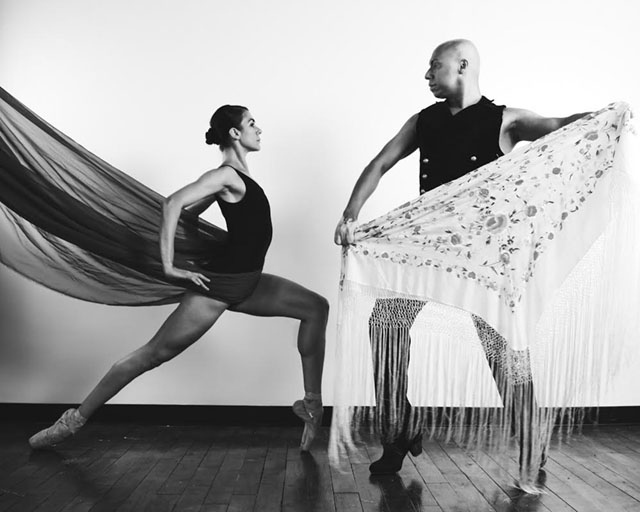
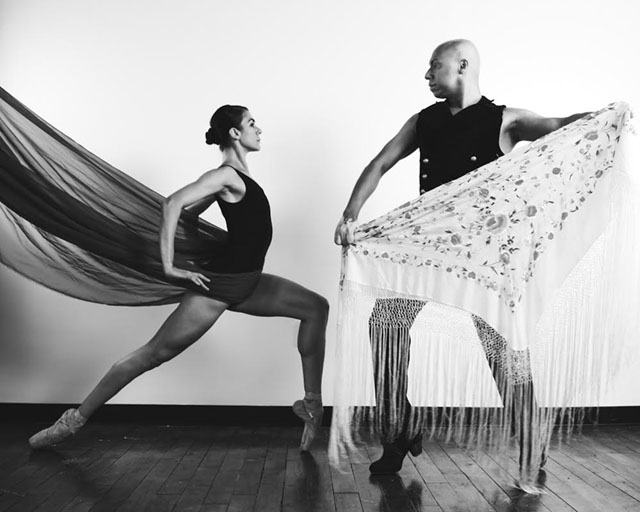
 Sona Kharatian and Edwin Aparicio (Veronica Weston Studios)
Flamenco typically conjures up images of tasseled scarves, long ruffled skirts, intense facial expressions, loud stomping, rhythmic clapping, and singing that sounds like shouting. But while a trip to Seville wouldn’t be complete without a pitcher of sangria and a traditional flamenco performance, modern flamenco can be as different from the art form’s stereotype as Septime Webre’s Hemingway: The Sun Also Rises is from Swan Lake.
Informed by tradition, but with its own flavor and story to tell, contemporary flamenco is what the audience will see in Flamenco Aparicio Dance Company’s Salvador, an autobiographical piece choreographed by the company’s founder and artistic co-director, Edwin Aparicio. Salvador will have its world premiere this weekend at GALA Hispanic Theatre, as part of the venue’s 12th annual Fuego Flamenco Festival.
Aleksey Kulikov is Aparicio’s artistic co-director and husband. He says people mistakenly think flamenco is mostly improvisational. “Because it’s so emotive, it feels like a burst of energy that’s uncontrolled,” he says. “[But] it’s a very, very controlled art form, and all this studying and effort and all these rehearsals go into making sure that it looks so raw.”
Salvador harnesses flamenco’s emotive energy while adding a storyline. “There’s a great range of emotion in flamenco from very happy to very dramatic to very sad, and it’s really a language that can be applied to any significant drama,” Kulikov says. His husband’s life story certainly fits the bill.
The multi-scene narrative begins in El Salvador during the early 1980s, a time of extreme violence. Young Edwin must stay in the war torn country with his grandmother until he can be reunited with his parents in America. After a heart-wrenching goodbye to his abuela, Edwin relocates to Washington, D.C., where he joins the massive influx of Salvadoran immigrants seeking safety and a new life in the United States’ capital.
Longtime D.C. residents, and probably a fair share of newcomers to the city, will recognize the next scene. It’s set in Mount Pleasant, the Northwest neighborhood that became home to many of D.C.’s Latino immigrants—including Edwin’s family.
Aparicio says he’s wanted to tell his story for a long time.
“We’ve been talking about this show, different parts of it, for 12 years,” Kulikov says. A 2004 Corcoran exhibit of work by photographer Muriel Hasbun inspired the couple to channel Aparicio’s memories into an artistic retelling of his life. Two of Hasbun’s photos are included in this multimedia production, which relies on photographs to help set the scene.
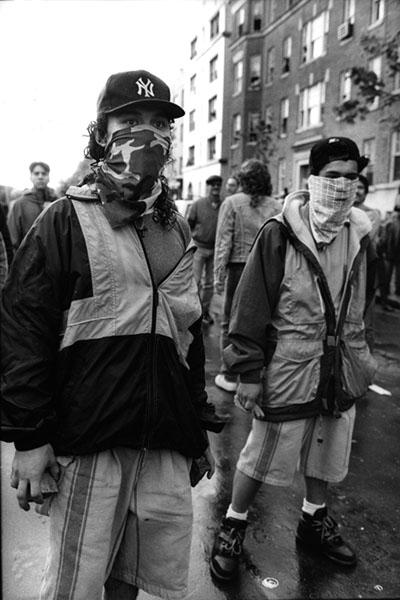 The 1991 Mt. Pleasant Riots (Rick Reinhard)
“We have several photographs by Michael Horsley, who took dozens of very interesting photographs of what’s now really lost D.C.,” Kulikov says. In addition to Horsley’s snapshots of Washington in the ‘80s and Mike Goldwater’s documentary photographs of El Salvador’s Civil War, there are also striking images by Rick Reinhard of the Mount Pleasant riots in 1991.
Some of the photos show familiar buildings in neighborhoods such as Chinatown and Adams Morgan. “They will recognize D.C., and sometimes they will see D.C. in a way that they have never seen it before,” Kulikov says. “A lot of people know about the [1991] riots; a lot of people don’t know about them. But very few people actually experienced them. They were not seeing them; they just heard about them on TV.”
The four-day-long event was sparked by the police shooting of a Salvadoran immigrant and stoked by deep-seated discontent among Central Americans immigrants, who faced poor living conditions and limited employment opportunities.
“I was going to high school at the time and I remember that period of my life extremely vividly,” Aparicio says. “The reason I’m addressing that is because I lived it.”
Aparicio says he hopes these rare photographs, which capture what that period of D.C. history looked and felt like, paired with the choreography, will intensify the performance. The co-artistic directors say they want people to walk away with a stronger sense of empathy for D.C.’s Central American immigrant community and their experiences.
Act II of Salvador deals with Edwin’s struggle adjusting to his new life in America, the alien culture, and the tensions in the city. We see him deal with assimilation and experience the riots. While cars are burning—and eyes, from the tear gas—Edwin discovers dance. A double-entendre, “salvador” means “savior” in Spanish. The production’s title pays tribute to both Aparicio’s homeland and to his personal saving grace.
“I was looking for all these saviors and dance was keeping me out of trouble, so dance was my savior,” he says.
But as audience members will see, although the teenager fell in love with ballet, his passion was not reciprocated. “I adored [ballet], but at the time they told me I was not tall enough or I did not have the body type for it,” Aparicio says. A teacher suggested he try flamenco, which soon became an integral part of his identity.
“Flamenco took me to different frontiers and it took me away from D.C. and whatever other path I would have taken that might not have been good for me, so flamenco ultimately was also my savior,” he says. “That’s why the word ‘salvador’ is so important in this production.”
Edwin’s initial rejection from the dance world stands in stark contrast to the recognition he receives in Act III—set in Madrid—as flamenco legends accept him as one of their own.
Today, Aparicio is a highly-sought after and respected flamenco artist. Earlier this year, King Felipe VI of Spain awarded him the Cross of the Order of Civil Merit, which recognizes “extraordinary service by Spanish and foreign citizens for the benefit of Spain.”
Kulikov says this is the right time for this performance, in large part due to the recent award acknowledging Aparicio’s contributions to flamenco and global appreciation of Spanish culture. “Telling his story is an opportunity, before anything else, to thank flamenco, to show what it is capable of, that it’s actually capable of giving somebody a voice,” he says.
During his acceptance speech at the award ceremony in February, Aparicio thanked flamenco itself, “this intense voice of antiquity, a cry from within—the result of so much pain, and happiness, and more pain.”
This weekend, he will share his own story of pain and happiness through the art form that saved him.
Salvador runs November 4-6 at GALA Hispanic Theatre. The Fuego Flamenco Festival continues through November 13. Tickets are available here.