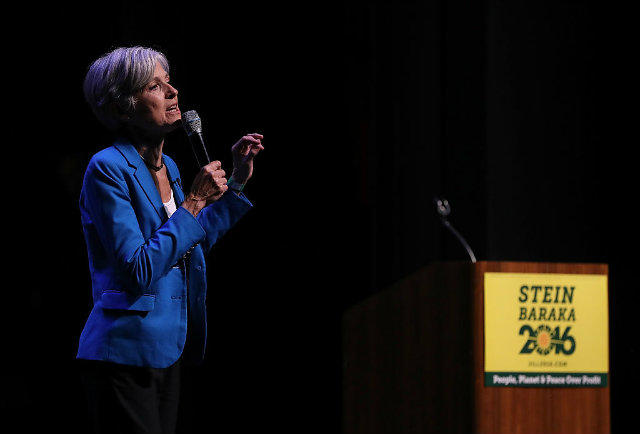
 Green party nominee Jill Stein speaks during a campaign rally earlier this month in New York. (Photo by Justin Sullivan/Getty Images)
By DCist contributor Courtney Steininger
The archetypal political rally scene consists of a strong, charismatic speaker at a podium outside, surrounded by an energetic crowd of people standing, chanting, and excited for change. The scene was rather more subdued, though, at a Jill Stein rally at the University of Maryland on Sunday, which drew just a couple hundred people.
While organizers originally planned on hosting the rally at the Nyumburu Amphitheatre, an exciting outdoor space that frequently attracts large crowds, they ultimately decided to move indoors. The official Facebook event tried to portray the change as a good thing, but it instead created a much more low-key environment than the term “rally” usually implies.
About 300 people, most of whom were not university students, filed into the 1,000-seat ballroom, leaving many seats empty. The music attempted to create hype among the audience, but Sunday afternoons in College Park are far more often associated with caffeine-induced study sessions than high energy events. The atmosphere was largely subdued and resigned.
Fighting that resignation seemed to be the rally’s major focus. It had been framed as a “last hurrah” before the election by sophomore Brendan Sullivan, the president U-Md.’s chapter of the International Socialist Organization and one of the main student organizers.
However, the intense push for early voting, especially on college campuses, meant that most individuals in attendance had already cast their ballots. And many said they had not voted for Stein, who is currently polling around 4 percent.
“I wanted to hear what Stein had to say, since she is a major political figure,” said sophomore government and politics major Audrey Anderle. “But I already cast my ballot. A third party vote would have been throwing that [right] away.”
Stein’s speech, nonetheless, focused on the same message she’s been emphasizing for weeks, urging people not to vote for the lesser of two evils, but rather for “the greater good.”
“Getting to five percent of the vote makes all the difference,” Stein said. “What it means is we hit the ground running, because we have automatic ballot access then in most states.”
She also argued that “fear mongering” has led to greater Green Party support. At least at the rally, though, that only seemed to be reflected in a handful of individuals wearing shirts that read, “Hillary? NOPE.”
Instead, the most effective stump speeches at the rally seemed to come not from Stein herself, but from other politicians and engaged students who introduced them. They seemed to be aware of the fact that the University’s “Students for Sanders” organization had been the largest political student group in the campus’ history, and tried to channel that support toward the Green Party.
“Implementing the Green Party’s platform will not fix America, but will certainly be a great first step,” said Stein’s running mate Amaju Baraka, earning the most vigorous applause of the afternoon.