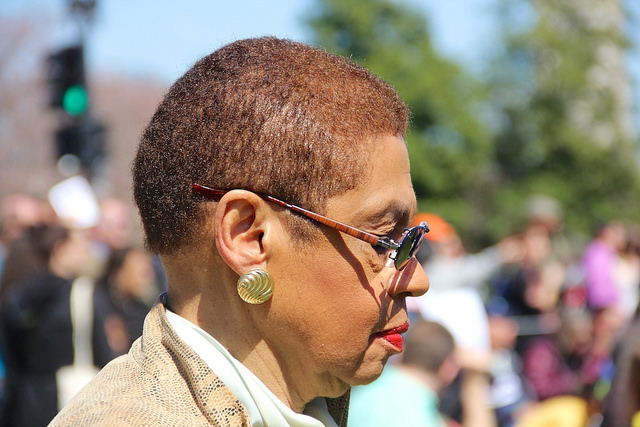
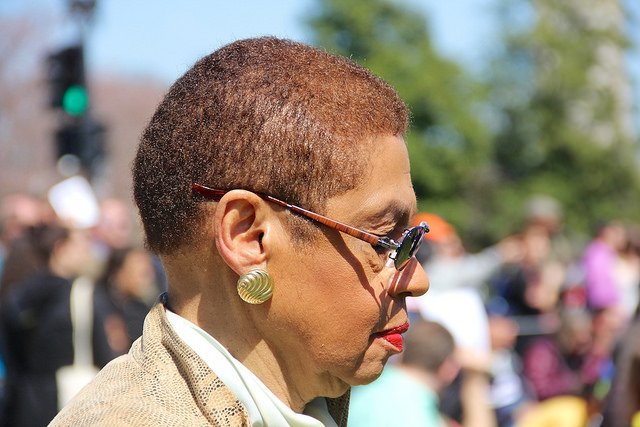
 (Photo by LarryJay99)
Eleanor Holmes Norton has represented D.C. in Congress since 1991, and she handily won re-election earlier this week. She’s a leading champion in the movement for D.C. statehood, and her prior work as a lawyer for the American Civil Liberties Union is part of the new Amazon TV series Good Girls Revolt.
It is based on the book of the same name by Lynn Povich, who took part in the events of 1970. In giving a brief history of the gender discrimination the women of Newsweek faced, Gothamist writes: “women were present, but not as writers. Instead, they were known as ‘the dollies,’ researching stories and often times being the ones who not only gathered information, tracked down and spoke to sources, but shaped and helped write the articles, for which they received no credit. Each ‘dollie’ was paired with a male writer, who got the byline.”
DCist talked to Norton on Thursday about the show, the future for the statehood movement, and her response to Donald Trump’s election. This interview has been edited for length and clarity. Note: she describes Good Girls Revolt as a film, though it is a TV show.
DCist: What did you think when you first learned they were making the show?
Norton: I knew about the book, but I was a little surprised they were making a movie out of it. These were such huge issues at the time, but there is the notion that millennials and younger women don’t see themselves as much as feminists. Of course you don’t make a movie like this and invest the kind of money it takes unless you think there’s an audience. Was I wrong. It’s very humbling to me because it does show that there’s an audience of women and men who understand that there were pioneers and that they too are still in a pioneering generation.
DCist: What did you talk to Joy Bryant [who plays Norton on the show] about? How do you explain to someone else how to portray you?
Norton: That I didn’t. That’s an artistic matter. They showed me parts of the script, and there were a few suggestions that I made. They also must have known that at the time I represented these women, I was a first amendment lawyer in the ACLU—I represented not only good girls like these but racists whose first amendment rights were being denied. But their portrayal was meant to reach a broad audience and you don’t do that documentary-style. You do that by putting some fun in it along with generally what happened.
DCist: What did you hope the show would bring to light about your work and your role in the story?
Norton: I don’t think about my work. I had been concerned at this myth that younger women believe we have arrived. We have not. How do you make that point? I really don’t think you get very far by lecturing to them. I think a film like this enables younger women to put themselves in the place of these young women.
DCist: Have you seen the full series at this point?
Norton: I haven’t. I meet people every day who say they binge-watched it. I think I ought to find the time to do that.
DCist: Are you a fan of binge-watching?
Norton: I just don’t have the time to binge-watch! [Laughs] I have seen maybe one full episode.
DCist: What does it feel like to have all these people seeing this story?
Norton: Strange. I never contemplated that it was as important as it turns out to be. At the time, I was completely caught up in it. When these women came into my office, there was a tentative quality of our meeting. That’s something that I think film will be very important in exploring. Everyone thinks that women today are like Hillary Clinton — she’s got what it takes and she goes in and demands it. They’d have a different view today if there had never been a class action brought by women. These women essentially challenged the very basis of the hiring system for the first time.
DCist: You faced a significant challenge in terms of the precedent you’d be setting for women’s rights in this country. People were hoping Hillary Clinton could shatter the final glass ceiling earlier this week. How do you feel about the fact that that goal wasn’t accomplished?
Norton: Women have every reason to be depressed. I’ve never even seen demonstrations at home, much less across the country, upon the election of a president. That just doesn’t happen. This is happenstance, but I think the film comes out at just the right time.
Young women who will identify with all these stories that came out about how Donald Trump used his celebrity as a sexual weapon, these are the women whose guts most turned. These women, hearing such stories—Donald Trump may not be the kind of president they hoped for. In the film, these young women had everything to lose. To see these young women demanding to be treated as professionals, seems to me to come at a particularly good time, and [will] cheer women to know that this too will pass.
DCist: How are you feeling about the results of the presidential election at this point?
Norton: I couldn’t be more disappointed, especially since I knew Hillary Clinton from the time she was the First Lady. She was destined to be the most pro-statehood president we’ve ever had. I really lost someone who could have helped us.
I have been first in the minority most of my time in Congress. I have had Republican presidents at least as often as Democratic presidents. I have never looked at a Republican president as the end of the world. I’m certainly depending on Donald Trump not to harm the District of Columbia.
He took no position on statehood when he was running. I don’t see animus to the District of Columbia. I will not presume it. If I find it, I will fight it.
DCist: How do you plan to proceed on the statehood issue now that both chambers of Congress and the executive will be controlled by Republicans?
Norton: I don’t think anyone was under the illusion that statehood would roll down the Hill. The mayor has spoken frankly that the election results certainly put a crimp in our statehood style. If there’d been a Democratic Senate, we still would have had a Republican house. We would still have had an uphill climb. This gives us time to put a number of strategies in place. We do not have a good social media strategy in place. I’m working on that now. I think we can use this period to the greatest benefits.
When it comes to the kind of House and Senate we have, that’s what I’m used to. The other reason I look more to the Congress than the president is that most of the work that’s done isn’t done at the presidential level. One of the best experiences I’ve had was when Newt Gingrich was speaker of the house. We got a huge amount done as speaker. Who would have thought that? I didn’t think that. By not presuming an enemy before he shows himself to be one, we were able to get a lot done.
DCist: How do you plan to make a case for the Democratic party and liberal ideas in the face of Republican control of two branches of government, and the almost certain nomination of a conservative-leaning justice to the Supreme Court?
Norton: I have to bifurcate my role for the District of Columbia from my role as progressive Democrat. We continue to press our issues. Bear in mind that Hillary won the majority vote. I don’t suffer the illusion that there are not a lot of people who agree with our policies. The way in which I’ve been able to get along with Republicans is that I’m more than a national Democrat. I’ve been able to get things done when I’ve found Republican leadership that understand that it wouldn’t hurt them and their majority to work on these matters.
DCist: What do you think it means for Barack Obama’s legacy that Donald Trump’s presidency can be owed to a large turnout of white voters and the prominence of racist rhetoric?
Norton: I don’t read this the way many people do that it’s basically a racial vote. There’s lots of racism in parts of that vote, so I’m not naive. But I don’t think that was the driving force of the Trump vote. That was trade and the loss of jobs by people who have what amounts to a minimum education. He has promised the impossible, that jobs that have moved offshore will somehow float back to our country. That makes me want to cry for those who have banked on that notion. It won’t take people long for people to recognize that as either an uninformed view, or even worse, a hoax.
DCist: What do you want to say people who are scared and worried about a Trump presidency?
Norton: I really think the fears are misplaced. That’s not the way to approach someone who in some ways expressed tyrannical views. Those views cannot be carried out even if he were so inclined. The First Amendment is a case in point. He’s going to be stopped by his own party in some of what he wants to do.
I really am cautioning my own constituents against any morose sense that the world has just stopped. I really do think that this is the time to show that the fight continues and not to make assumptions. I don’t expect to be cheered by the first 100 days, but I also know he can’t possibly do much of what he pledged to do. That’s what I tell my constituents. I do not need a bunch of people walking around saying we are lost at a time when we ought to be fighting.
Norton will discuss Good Girls Revolt along with author Lynn Povich; series stars Genevieve Angelson, Anna Camp, Erin Darke and Joy Bryant; and NPR’s Linda Holmes at a Newseum screening of the pilot at 8 p.m. on Saturday. Tickets are $20.