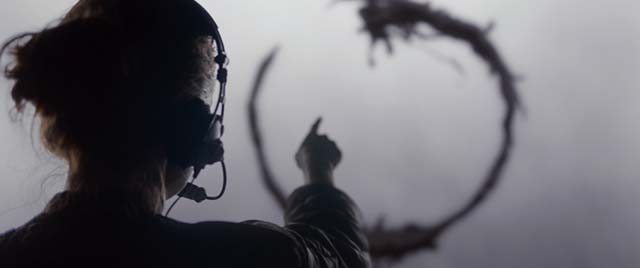
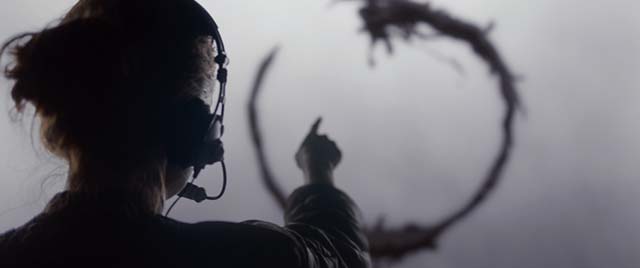
 Amy Adams. © 2016 PARAMOUNT PICTURES. ALL RIGHTS RESERVED.
As I was walking out of a screening of Arrival in Georgetown the other night, the overlapping circles in the multiplex’s carpeting strangely resembled a key visual in the film. The carpet seemed to be telling us something. But what? Director Denis Villeneuve (Prisoners, Sicario) takes on science fiction with his new film. But like the best science fiction (or at least, like the most), it’s about the human search for meaning—and ultimately, for love and understanding.
Yes, the movie is ultimately a love story, and anyone who prefers their science fiction to be dystopian or, you know, scientific, may prefer to steer clear of this sentimental picture about interstellar communication.
Dr. Louise Banks (Amy Adams) is a linguist who’s frustrated that her university students seem more interested in their cell phones than in learning. But class is interrupted by a news flash: massive objects from space have landed at twelve locations around the globe. Is Earth under attack?
Colonel Weber (Forest Whitaker) enlists a reluctant Banks to help translate the newcomers’ attempt at communication. After some resistance from military and scientific leaders, Banks makes progress with the alien visitors, and much of the film is spent working up to the pressing question: “What is your purpose on Earth?”
An image of Amy Adams holding up a small whiteboard was one of the first released from the film, and I won’t get into how the aliens return this volley of language. But this is the core of the film: the basic need to communicate, and the various factors—intent, bias, culture—that can make communication seemingly impossible even among people who speak the same language.
Arrival finds hope in these alien visitors, but how can we expect to communicate with alien life forms if it’s so difficult with fellow humans? The movie’s first arrival is in fact human: the film opens with the birth of a child. Which makes Arrival in some ways an easy-bake version of 2001: A Space Odyssey with a touch of Close Encounters.
Yet these clear influences tie in with the film’s theme of overlapping time. You’ve seen this before; but today it may have a different resonance. There’s a key line in the film: “You changed my mind.” It may be the kind of change of heart that can only happen in a big screen utopia. But with this Arrival comes understanding and hope.
—
Arrival
Directed by Denis Villeneuve
Written by Eric Heisserer, based on a story by Ted Chiang
With Amy Adams, Jeremy Renner, Forest Whitaker
116 minutes
Rated PG-13 for brief strong language
Opens today at a multiplex near you.