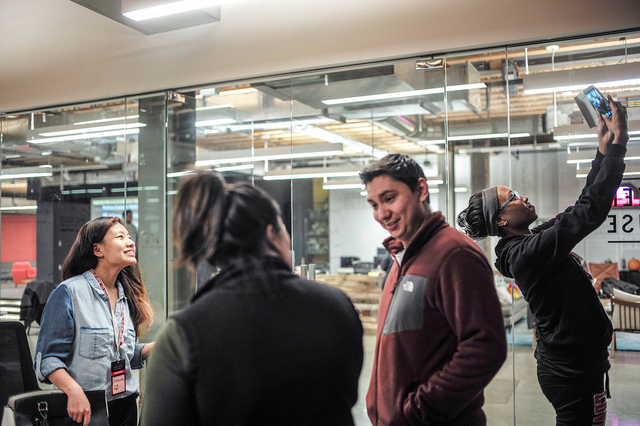
 Rudy Mireles and his team members hash out their plans as the Comedy Hack Day DC showcase approaches. Photo by Jati Lindsay.
 Comedy and code came together at DC Improv last night, provoking laughter even following a presidential election that has inspired the opposite reaction for many.
This year’s second annual Comedy Hack Day DC, an independently organized event, brought together creatives and tech experts for a fast-paced challenge. Participants met for the first time on Friday, and 48 hours later, five groups presented their finished apps and websites to an eager crowd. The winner had, fittingly, a political theme: “Caucus Clash,” a fantasy football-style tool that substitutes bills in Congress for plays on the gridiron.
The weekend began at ISL in Shaw on Friday night with a rapid-fire session that led to the formation of 11 teams, who worked the rest of the weekend at a CoWork space in Dupont honing the concept, developing the front and back ends of the product and constructing a presentation for three judges: local comedians Hillary Scofield and Haywood Turnipseed, and tech professional Sybil Edwards.
On the winning team, comedian Rudy Mireles and his brother fulfilled an idea they first came up with three years ago and had let sit until Friday, when he teamed up with tech experts who came out for the event. The biggest challenge for the group, he says, was accepting that the product wouldn’t be perfect only two days after work began. “Everybody was helping everybody in some way,” Mireles tells DCist.
The 2012 election, and the ensuing legislation that followed him, inspired the concept, which helps users connect with the more procedural aspects of government. He and his team plan to refine the tech specs and eventually push the app out once it’s fully formed.
Not all of the apps at Sunday’s event could be considered practical. One group offered an online tool for determining whether a man’s seated position can be defined as “manspreading,” while another presented “Out of Time,” a dating service for terminally ill people looking for one last hurrah. On the other hand, given the election results, “We might all need that,” Turnipseed joked to the app’s developers after their presentation.
Other references to Donald Trump’s name, mannerisms, and policies simultaneously lightened and dampened the mood all night. The presenter for an app called “Twitter Ninja” that translates verbal conversations directly into tweets, suggested that Trump could use the app to blame racist tweets on his friends. The “Out of Time” group said that concerns about the next four years alone wouldn’t constitute inclusion on the app. Developers of a Tinder-style pizza app described their algorithm as “yuuuge.”
Onstage, the mood about the election was light. But behind the scenes, the election results tempered enthusiasm for the event. A number of people who had signed up to participate dropped out of the event after Tuesday, according to organizer Kelli Herod. “I think people were just so mentally exhausted from it all,” says Herod, part of the local comedy group Bad Medicine.
The night was designed to give developers and the audience a break from external stressors, according to Herod’s fellow organizer Isaiah Headen, also a Bad Medicine member. None of the apps from last year’s inaugural D.C. show went on to success, taking the pressure off this year’s participants. “First and foremost, this is a comedy show,” Headen says.
The Comedy Hack Day concept originated in 2012 from the California-based comedy startup Cultivated Wit, the brainchild of several alums of The Onion, including Baratunde Thurston, a Columbia Heights native who went on to work for The Daily Show with Trevor Noah. Volunteers like Herod, Headen, and their colleagues have taken up the mantle in several cities with comparable events of their own.
For Herod, the event helps merge two communities with much in common, even if it doesn’t appear that way on the surface. The perception of D.C.’s tech and comedy scenes, Herod says, is that both tend to send their strongest talent to New York and Los Angeles. But the two have plenty to offer each other in D.C. as a result.
Another Comedy Hack Day DC organizer, Elizabeth Kemp, says she’s observed comedians contribute coding tips they didn’t know they had in them, and vice versa for the developers. The event helps people whose professions don’t encourage creativity to express themselves.
“People in any field who have fantastic senses of humor who don’t get to explore that on a day-to-day basis in their job,” Kemp says. “This is kind of an outlet for people whose job is very serious. This affords them a creative outlet that they couldn’t otherwise have.”
A previous version of this article incorrectly stated that the weekend work took place at a WeWork space downtown. A photo was also attributed to Isaiah Headen, who provided the photo but did not take it.