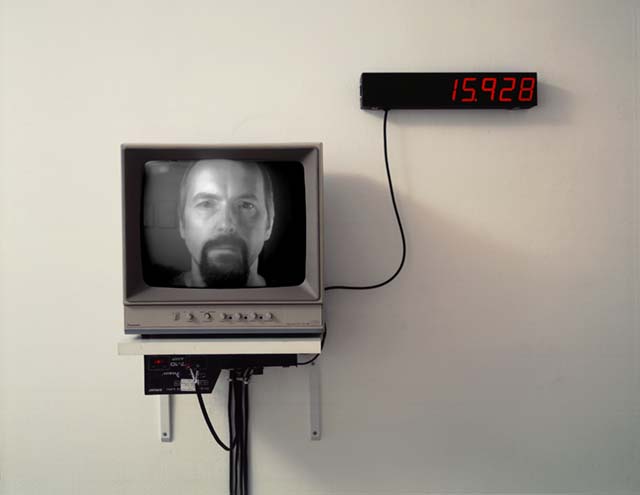
 Incrementation, 1996 © Bill Viola (Mike Bruce, courtesy Anthony d’Offay, London)
The slow-motion videos in Bill Viola: The Moving Portrait, with soundtracks featuring water—rippling, flowing, and crashing—and breathing, provide deep messages that inspire us to meditate on life’s big questions.
Fascinated by time, grief, and mortality, the artist unpacks these concepts through video. Viola’s exploration of the medium began in the early 1970s at Syracuse University’s College of Visual and Performing Arts, where he worked with such visionary artists as Nam June Paik and Peter Campus. Viola has experimented with new technologies and approaches to filming, editing, and presenting video over the years, but the human form has remained a constant.
Often, the artist casts himself as the subject in his videos, though he doesn’t always call these works “self portraits.” The National Portrait Gallery exhibit opens with Incrementation (1996), a black and white video and sound installation with a running display that counts his breaths. The counter is capable of climbing to about 900,000,000—roughly the number of breaths someone would take in 85 years of life.
Viola is the model in this piece, but he refers to himself only as “a man.”
“He considers himself a performer in the service of his art,” Exhibition Curator Asma Naeem, associate curator of prints, drawings and media arts, says. “But I find it more than that…I think he’s truly captivated by how he’s appearing at certain points in his life.”
In Nine Attempts to Achieve Immortality (1996), Viola records himself taking deep gulps of air. He holds his breath until expelling it loudly and forcefully, a failed attempt to defy nature.
Although it’s not included in the exhibition, visitors to the gallery will find Self Portrait, Submerged (2013) downstairs. Floating just below the surface of an apparent river, Viola remains serene in his single breath, which he accepts could be his last. This is where he is and the stillness covers him with a cloak of calm.
It provides a stark contrast to the younger version of himself, forcibly pushing the air from his lungs with a defiant stare before sucking in more oxygen and diving back into the process.
Although Viola has created many self-portraits—whether he defines them that way or not—Naeem says until now, the artist didn’t consider how his body of work fit into the context of portraiture.
While the videos in this exhibit clearly fit the definition of portraiture, together they also form a portrait of Viola’s career and the evolution of video technology.
The earliest example of his work greets visitors near the entrance to the exhibit. The Reflecting Pool (1977-79) was recorded on videotape then edited to create two different timelines. Again, Viola uses himself as the model but describes the artwork’s subject as “a man.”
In this piece, a man emerges from the forest and stands before a pool of water. He jumps into the air to do a cannonball, then freezes in place, suspended over the rippling water. Shadowy figures emerge and move around the perimeter of the pool, disappearing into the forest or into nothing. They seem ghostly, perhaps transitioning into the next realm.
“The work describes the emergence of the individual into the natural world, a baptism into a world of virtual images and indirect perceptions,” Viola writes in his notes.
A self-portrait in essence, The Reflecting Pool also speaks to Viola’s attraction to water and its symbolic properties. The element appears throughout his work, including in this exhibit.
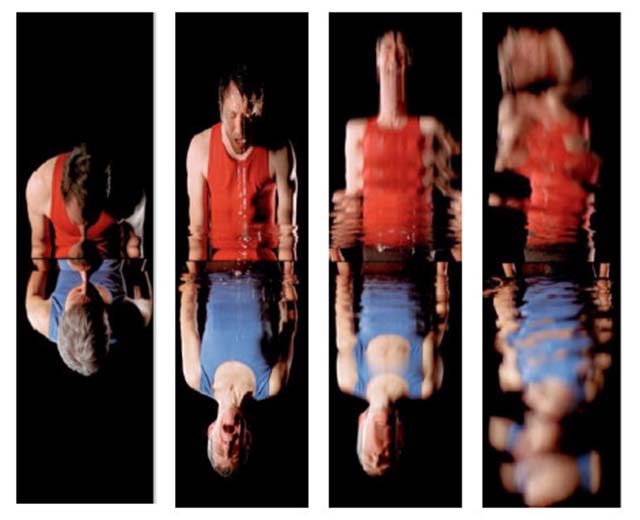 Surrender, 2001. Video diptych (Kira Perov © Bill Viola)
Viola’s fascination with water began when he nearly drowned in upstate New York as a child. “He fell off the kayak or the canoe and he drifted down to the bottom of a lake,” Naeem says, “And he saw the flowing vegetation and the tiny little fishes and he was just mesmerized and it was so peaceful. And then when someone grabbed his shoulder to pull him back up, he didn’t want to leave.”
That sense of tranquility in water is felt most acutely in The Dreamers (2013), a video and sound installation featuring seven plasma screens mounted vertically on the walls of a room. The subjects float in gently rippling water above a bed of river pebbles. Suspended in the water, a little girl in a red dress lies on her back, her long hair fanning out from her head in soft, waterborne waves. Slowing the video down draws viewers in and keeps them transfixed; a still photograph would be easier to just quickly observe, then dismiss.
Unlike the ethereal tranquility of The Dreamers or The Reflecting Pool, water plays a more violent role in The Raft (2004). Commissioned for the Athens Olympics, the large video and sound installation depicts a group of strangers gathering at a bus stop. Suddenly, they are hit with a wall of water from a high-pressure hose. In the aftermath, some people weep while others are frozen in shock. Those who are able rush to help the fallen.
While National Portrait Gallery exhibits have included one or two time-based media artworks in the past, this is the gallery’s first all-video art show. “We spent a significant amount of money to get this 19th century building hard-wired to accommodate these cables and these audio systems,” Naeem says.
The investment is well worth it, if you subscribe to her view on art and technology: “Technology is usually considered a way to make the world a more efficient place, but in many ways it has become an expressive art form and it is a way to find a meaning for how we deal in our day-to-day world.”
Bill Viola: The Moving Portrait is on view through May 7, 2017 at the National Portrait Gallery.