 Julie Strupp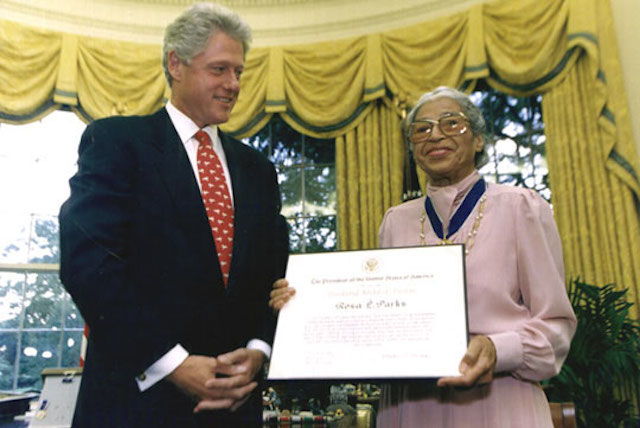
Transportation companies in Maryland and Virginia are honoring Rosa Parks today, which marks the 61st anniversary of the Civil Rights icon’s arrest for refusing to give up her seat to a white man on a segregated bus in Montgomery, Alabama.
The University of Maryland’s transportation department is leaving an empty front seat on all of its shuttle buses marked with signs saying “Reserved for Rosa Parks.”
UMD is honoring Rosa Parks by leaving an empty seat on all of their shuttle buses today. pic.twitter.com/SPLE8xFcKY
— DC Maryland Virginia (@DMVFollowers) December 1, 2016
The Greater Richmond Transit Company is also reserving the first passenger seat on each bus for a commemorative sign celebrating the civil rights icon. Bus drivers will keep the headlights on all day “to represent her light” and electronic headers on all 145 vehicles will read “Thanks Rosa Parks,” the GRTC said in a news release.
GRTC spokeswoman Carrie Rose-Pace said they have long conducted a Parks tribute during Black History Month in February, but this is the first year the transit system is doing so on the day she was arrested.
We honor #RosaParks on the anniversary of an historic Civil Rights movement: https://t.co/LZICkbc1En pic.twitter.com/NyBaBcTHiK
— GRTC Transit System (@GRTCTransit) December 1, 2016
To learn more about the woman who helped spark the Civil Rights movement, the Rosa Parks collection has been recently digitized at the Library of Congress, documenting “many aspects of Parks’s private life and public activism on behalf of civil rights for African Americans,” according to the Library of Congress website. Parks’ letters, family photos, books including the Bible she carried in her iconic purse, her Congressional Gold Medal and more are now available for “optimal access by the public.”
The collection is a favorite of 14th Librarian of Congress Carla Hayden, who in September became the first woman as well as the first African-American to oversee the Library.
You can also pay homage to the Civil Rights heroine at the iconic Parks statue in the National Statuary Hall of the U.S. Capitol, which was unveiled in 2013 approximately 100 years after her birth.
For more history, head to The Mansion on O Street, a historic Dupont Circle building where Parks lived for many years, or check out the dress she was making shortly before she was arrested at the National Museum of African American History and Culture.
The defiant woman Congress called “the first lady of civil rights” and “the mother of the freedom movement” died in 2005 at the age of 92.