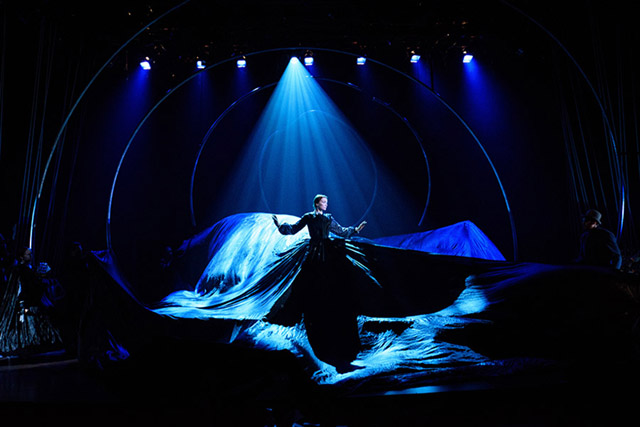
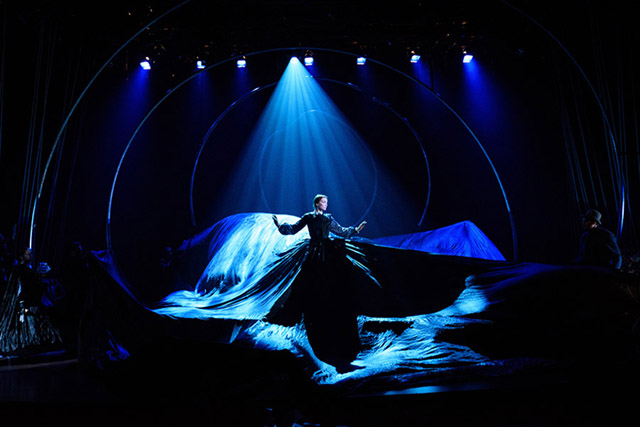
 Kasey Foster as Fate in MOBY DICK (Greg Mooney)
By DCist contributor Elena Goukassian
While the Pequod sets sail in search of the elusive white whale on Christmas day, Arena’s Moby Dick may be the least holiday-related play in town this month. But that’s not the only reason to get excited about it; Chicago’s Lookingglass Theatre Company also brings to D.C. one of the most original stagings of any play we’ve seen this year.
Adapting Herman Melville’s 1851 novel for the stage is never easy, but David Catlin—one of the founding ensemble members of Lookingglass and this show’s director, captures the essence of the doomed sea voyage with all its philosophical underpinnings, minimizing Melville’s tedious lessons in the science of whaling.
Just as Melville took inspiration from Shakespeare and the Bible, Catlin artfully combines these with aspects of classical Greek theater. A three-woman chorus narrates parts of the story, and performs multiple roles on top of that: wives of the Pequod’s crew, the three fates, sirens at sea, even whales. The addition of these three metaphorical characters (played brilliantly by Kelley Abell, Cordelia Dewdney, and Kasey Foster, the only women in the cast), are the glue that holds the whole story together, drawing the audience deep into the philosophical subtext of the classic tale.
But the main draw of this production lies in its visuals. A tale of biblical proportions deserves a matching set. Courtney O’Neill’s simple design has rounded poles doubling as whale ribs and ship masts, which the actors climb with ease, performing all kinds of acrobatics in the process. It’s as if the whole story takes place inside the belly of the beast, like the biblical story of Jonah, an important reference point for Melville.
Throughout the play, actors trained in acrobatics find themselves not only climbing and dangling from the masts, but also rigging the sets to create a sense of sailing on the high seas and performing all kinds of trapeze acts. When we see the crew extract whale oil, they catch a whale (one of the women), string her upside down, and spin her around, peeling her skirt off to reveal the bones of the hoop-skirt structure beneath.
The brilliance of the staging really comes out in “underwater” scenes. As men on boats rig themselves up closer to the ceiling, a man overboard falls slowly down aerial silk; behind him, his rescuer “swims” down, catches him, and “swims” back up. Such scenes reveal the aerial/acrobatic choreography by Sylvia Hernandez-DiStasi at its very best.
All these visual stunts and acrobatics add to the story rather than distract from it. The trapeze, although used often, always relates to the action, and the actors playing a minimized Pequod crew would be equally convincing in a pared-down, black box show.
Moby Dick is one of those rare theater productions that combine the visual and physical arts with exemplary acting and storytelling to create a truly affecting experience. Personally, I’d rather watch it again than read the book. (No offense, Melville.)
Moby Dick is at Arena Stage through December 24. Buy tickets here.