 (Angelisa Gillyard)
By DCist contributor Elena Goukassian
Local opera company In Series uses a 100-year old tragedy to frame its production of Goyescas, honoring the centennial of the opera’s premier as well as its author’s dramatic, untimely death.
On March 24, 1916, Spanish composer Enrique Granados suffered an unusual end at the age of 49. He was on a passenger ship on his way home from the world premiere of his short opera, Goyescas, in New York (moved across the Atlantic because WWI was raging in Europe), when a German submarine launched a torpedo that sunk the ship, killing several dozen passengers, including Granados and his wife.
“Granados was in a lifeboat, but he went to save his wife and drowned,” says Brian Shaw, artistic associate of In Series. In the aftermath, it turned out that the couple’s cabin actually remained intact, and had they not jumped ship, they probably would have survived. “It’s depressing and powerful, and very operatic,” he adds, “such a senseless death.”
In Series has been putting on chamber concerts and, little known, short operas since its inception in the 1980s. Shaw, who’s also a singer (“to a point,” he says), has been involved with the company for three years, starting out as its costume designer and working his way up the ladder. He calls their productions, “chamber pocket opera.”
Unlike the repertoire of, say, the Kennedy Center Opera House, these run only about an hour long, with fewer sets, singers, and musicians. It’s a more intimate opera-going experience. “Everyone has a gigantic notion of opera, but we’re distilling it,” Shaw says. “We concentrate on the music and the experience.” In Series founder Carla Hübner is Chilean, Shaw says, so she likes to do Latino programming every year. This year, it’s Goyescas, performed in Spanish with English surtitles.
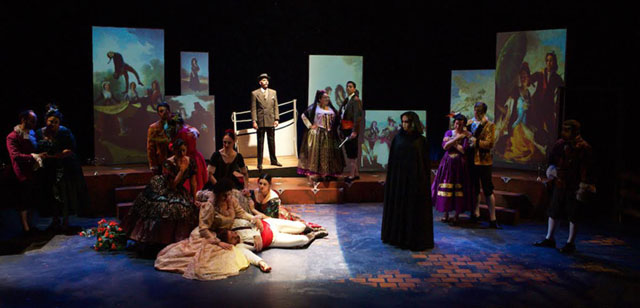
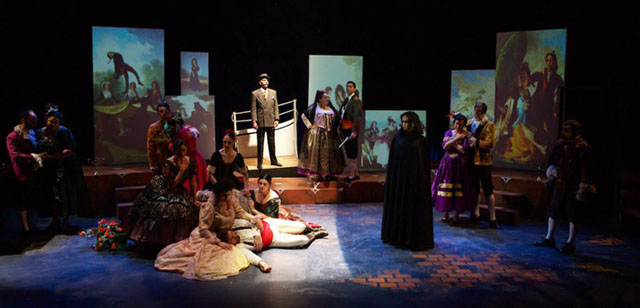
Granados’ final opera took a lot of its inspiration from the paintings of Francisco Goya. In fact, he first wrote a piano suite based on the paintings, before transforming it into an hour-long opera. In Series uses projections of the specific Goya paintings the composer was referencing in the production as a kind of backdrop. Shaw says that the costumes and staging also took inspiration from the paintings.
The story Goyescas tells is typical for an opera of the time. There’s a lower-class young man who attempts to woo a young aristocrat, and of course, her husband goes after him. There’s a lot of confusion, jealousy, and misunderstanding, all of which culminates in a duel to defend the young woman’s honor.
 (Angelisa Gillyard)
As with all operas, the plot takes a backseat to the music. In this case, Goyescas is coupled with Manuel de Falla’s 1914 Seven Spanish Folksongs, and all the musicians involved in the production are from the D.C. area.
“We only work with local artists,” Shaw says. “D.C. is such a great theater town. We have Washington National Opera choristers in productions. We like to pull from the community.”
He has special praise for In Series music director Carlos César Rodríguez, who accompanies the singers on the piano with flourishes of flamenco. “Carlos is a virtuoso,” Shaw says. “He’s Franz Liszt pushed into a tiny Latino man.”
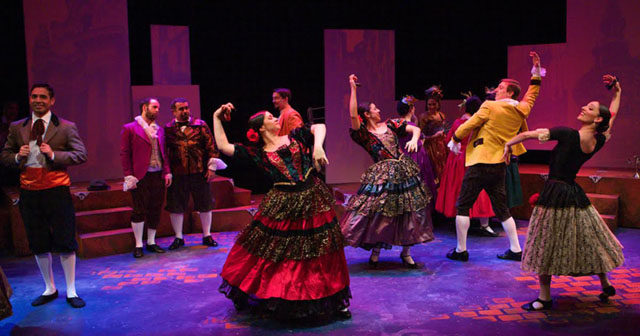
Goyescas also features a lot of dancing. “Dance is built into the opera,” Shaw says, adding that Jaime Coronado, the choreographer and stage director, is an expert flamenco dancer. “Dancers are part of the action and a method for storytelling,” Shaw adds.
In addition to Goyescas, In Series is also performing a separate, 40-minute adaptation for children, Goyesquitas. “It’s a children’s opera using Granados as a frame,” Shaw says. It’s about the composer’s remaining time in Spain, and kids get to participate from time to time, learning dance steps and playing with castanets.
Goyescas and Goyesquitas are at GALA Hispanic Theatre through December 18. Buy tickets here.