 Photo by it used to be me
As some District residents waited outside in the cold overnight for a chance to secure affordable housing, the DC Fiscal Policy Institute released a report today outlining the effects of D.C.’s housing crisis on families in extreme need of low-cost places to live.
Although the city is seeing the most housing construction activity in decades, the District’s investment in affordable housing is “not well targeted to the households in greatest need,” according to the report. While 77 percent of the D.C. renters who need affordable housing have extremely low incomes, only 39 percent of affordable apartments backed by the city with public dollars since 2010 are within reach of these families.
In this report, D.C.’s extremely low-income households are categorized as families of four with incomes below 30 percent of the area median income (AMI), which equates to $32,100 a year. Most of these residents are employed or actively looking for work, if they aren’t elderly or disabled. Many of them work in the service industry, retail, food service, or other jobs with low wages and only part-time options.
There are 43,000 D.C. households that are considered extremely low-income, according to the report. And 26,000 of them spend more than half of their income on rent. While one-third of these renters can’t afford to pay more than $200 per month, only nine percent have housing at that price. Meanwhile, the majority of them pay more than $800 on rent although almost none of them can afford it.
This amounts to 62 percent of extremely low-income renters facing severe hardships, that’s up from 50 percent ten years ago.
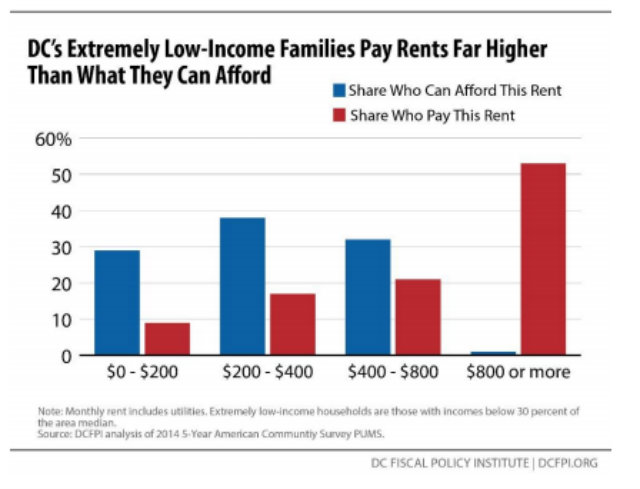 Chart courtesy of DCFPI
Because these families pay so much of their income on rent, they spend about $150 less per month on groceries than others and may be unable to afford transportation to work or school. And even though extremely low-income parents face high risks of depression, many of them don’t have the money to travel to medical appointments.
In addition, they face high risks of being evicted and move frequently or become homeless, which often starts a “downward spiral, as families frequently lose belongings, lose their job, have to move in with family or friends, or move to neighborhoods of higher crime and worse-performing schools,” according to the report.
The aforementioned 26,000 households includes one-fifth of all children in the city. Children who live in homes where the cost of rent is an issue or there are overcrowded conditions are more likely to fall behind in school or drop out altogether. Currently, the four-year high school graduation rates among black and Hispanic students are both at 67 percent compared to 93 percent of white students who graduated on time from the D.C. public school system.
DCFPI lists several ways that the city can alleviate the housing crisis and subsequent hardships by directing a greater share of its housing production and preserving existing subsidized housing to support extremely low-income residents.