 Rachel Sadon
 (Via DataLensDC)
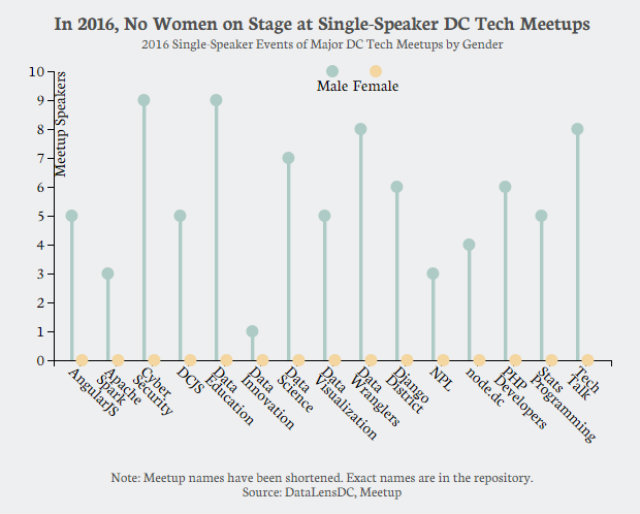
The teal circles bob up and down, but the yellow data points are all stuck flatly on zero. Whereas men gave scores of technology-related talks in D.C. in the last year, the yellow dots represent solo female speakers.
“2016 was pretty grim,” says Kate Rabinowitz, the data scientist behind the graph and a larger analysis of women’s representation at local technology events. “It’s not a good feeling to see that data, but at the same time it was reassuring in a way … I am justified in feeling that women are not always being put forth in these communities.”
After noticing a disconnect between vibrant female-focused tech groups and the community at large, Rabinowitz drilled into the speaker lists of more than 100 technology-focused talks in the D.C. area on Meetup.com that weren’t specifically aimed at women or minorities.
Certainly, there are tech events in the D.C. area that aren’t listed on Meetup, a portal for organizing events by interest. But the site is a particularly vibrant hub of meetings aimed at programmers, technologists, data scientists, and designers.
“If it’s not on Meetup, it’s likely a more private event or a more corporate-focused event,” says Sean Gonzalez, the president of Data Community DC. His own group counts more than 10,000 members and currently uses the site to organize events roughly once a week. In other words, Meetup is a pretty decent proxy for the larger tech community.
Rabinowitz honed in on organizations listed on Meetup that counted more than 1,000 members and events with a speaker-audience format that had some kind of educational component—be it explaining a project or discussing the specifics of a technology or programming language.
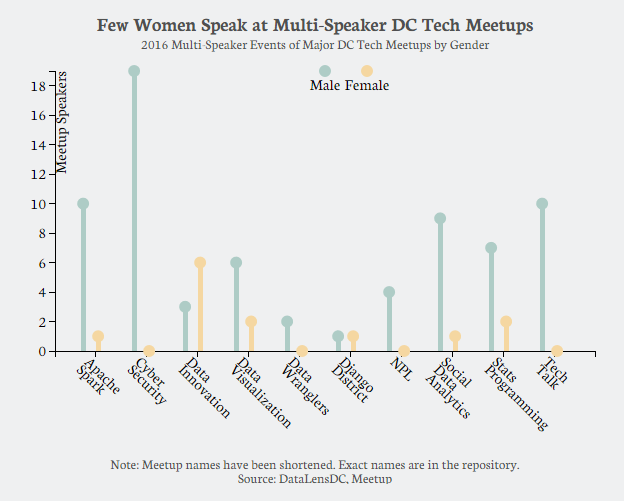
While women were completely absent as primary speakers, things were slightly better, if still paltry, when she looked at panel-style events, where women took up nearly 8 percent of the slots.
 (Via DataLensDC)
In addition to running DataLensDC, where she published the speaker data, and doing organizing work for Code For D.C., Rabinowitz is an active member of the female-focused local tech scene. There are groups like Women Who Code and DCFemTech, and the annual Tech Lady Hackathon, which Rabinowitz co-organizes. At related talks, there are plenty of experienced women who routinely speak on their areas of expertise.
“It’s a great community and you go to these events and you’re impressed by everybody there and how many people are there,” she says. “And then when you go to non-gender specific standard data or tech talks, you might not know that this other universe exists… gender neutral events shouldn’t mean they are male events.”
So she did something about it, creating a database called We Speak Too. In just a few weeks, more then 60 women and non-binary individuals have added their names and specialities.
“We’ve been wanting to improve our diversity for a long time,” Gonzalez says. “She provided a great resource that we could go to.”
Previously Data Community DC put out calls for speakers or reached out to people via Twitter or blog posts. “For whatever reason the system that we had wasn’t getting the job done,” he says, even when specifying that they hoped to find more female speakers. “Your guess is as good as mine as to why.”
Using Rabinowitz’s digital binder, though, they’ve already lined up at least three female speakers for the first few months of 2017.
“These organizations are huge,” Rabinowitz says. “They have thousands of members and they often hold monthly events. They have mega sponsors and a lot of networking and employment opportunities, and I think it’s the responsibility of these organizers to not just reflect but encourage the diversity of the industry.”
According to a new report from the District government outlining “pathways to inclusion,” the city has just under 30,000 tech jobs, defined as “occupations in computer and information systems, engineers, and natural sciences.” Of those, 49 percent are held by white men, 25 percent by white women, 9 percent by black men, and 8 percent by black women.
“This is absolutely not just a gender issue. It’s also very much a race issue,” Rabinowitz says, though the use of pronouns in event descriptions made it easier for her to document the gender disparity. “Once you have and underrepresented group on stage, the people from that group see themselves and become more involved. There’s a lot of research about why representation matters.”
The response thus far, she says, has been overwhelmingly positive. And a group in Austin is already using Rabinowitz’s open source code to create their own version of We Speak Too.