Rachel Kurzius
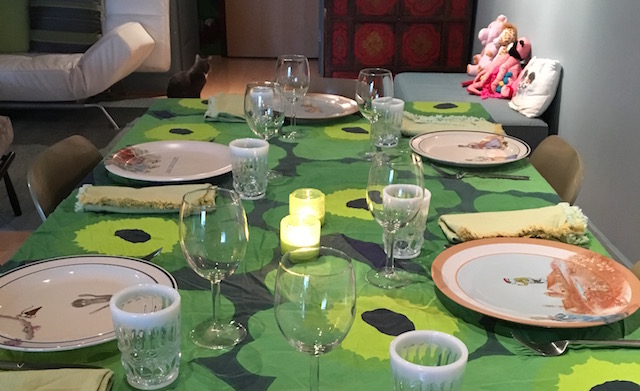 The table setting at Philippa Hughes’ “Trump Dinner.” (Photo via Philippa Hughes)
It’s been more than a month since the election, and D.C. arts advocate Philippa Hughes is “still fucking angry about it, no question,” she says.
Like many Washingtonians wondering “WTF now?” Hughes is trying to figure out what to do in the wake of Donald Trump’s surprise victory.
“I thought—what am I really good at?” she says. “I’m good at bringing people together and organizing fun things for people to do.” So that’s what the founder of The Pink Line Project did—she organized a dinner for six, including three conservatives, two of whom voted for Trump, on Sunday evening.
She says she wanted insight into why they voted the way they did. “I can totally accept different political ideology,” says Hughes. “I just want to know how you could vote for a sexist, racist pig.”
Shortly after the election, she put out the call on her Facebook page: “If you’re a Trump voter in my circle, please contact me.” No one did.
One friend, however, put her in touch with a former colleague who voted for the president-elect. That woman attended the dinner, and got her in contact with the other two conservative guests.
“It’s amazing that three strangers would just come to somebody’s house and be willing to talk about” their politics, says Hughes. “I was really impressed.”
The six guests had “civilized discourse and disagreement” over chicken marbella, brussels sprouts, and pasta, with “lots of wine—that was very important,” says Hughes. “Did we make any progress? I don’t know. This is one dinner that lasted two hours.”
Now Hughes is trying to figure out how to replicate the experience or scale it up as part of a new project she’s working on called the Citizen Innovation Lab, which focuses on “people taking charge and taking action in new and different ways.”
But there are some tricky logistics to work through first. For one, there’s a balance between trying to include more people and wanting to keep the dinners small, so folks can really get the chance to acquaint themselves with each other.
Another is the actual dinner. Hughes, who cooked the meal herself, says that “it can’t be some catered dinner. When somebody makes you dinner, there’s this code of civility that happens.”
There’s also the question of how to best format the conversation. While Hughes wanted to make sure it wasn’t too structured—”It’s not a conference or a panel discussion, it’s dinner”—she says the group struggled over agreeing on some basic facts. While no fact-checking happened at the table, Hughes says there were a few follow-up emails the next morning.
And then, there’s the question of finding willing Trump supporters in a city where he garnered 4 percent of the vote. Hughes’ three conservative guests all lived in Virginia.
Hughes admits that, at least a part of her, fantasized about changing her guests’ minds. A Washington Post article detailed how Derek Black, a former white nationalist leader, disavowed his beliefs after he began attending a weekly Shabbat dinner at his college.
“I thought, maybe somehow they’ll find a way to see it my way. A part of me did want that to happen,” she says, though it didn’t exactly pan out. “They say the same talking points they always say, and probably thought we said the same talking points we always say.”
The conservative guests declined to comment.