Rachel Kurzius
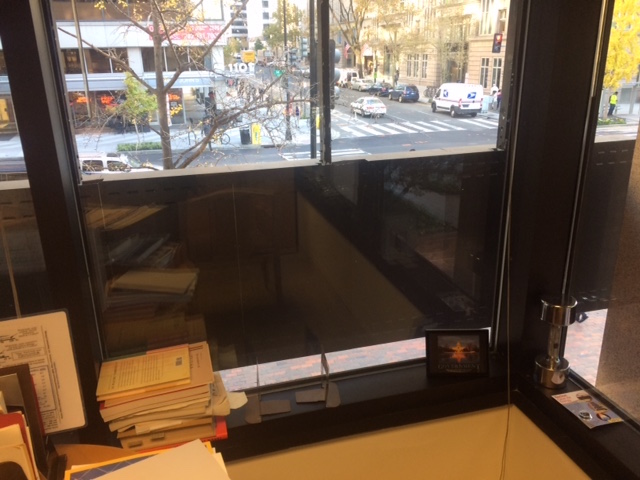 The view from inside a NARUC office after the installation of Digi Media signs. (Photo via James Bradford Ramsay)
During last week’s action-packed docket at the D.C. Council, Ward 2 Councilmember Jack Evans proposed, and then withdrew, a piece of emergency legislation would have changed the District’s requirements for sign permits.
Critics say that it represents a carve-out for one particular company currently being sued by the Office of the D.C. Attorney General.
“This purely impacts Digi Media,” says At-large Councilmember Elissa Silverman. “I think that’s a dangerous precedent to set—that the council will just come in and help a company when the courts and our regulations prohibit what you’re doing.”
Silverman says she believes Evans withdrew the bill when it became clear he didn’t have the votes.
Evans’ office has not responded to repeated requests to make the councilmember available for comment or to provide a statement.
His spokesperson, Thomas Lipinsky, says the emergency legislation was prompted by hearing “from multiple people that had already installed signs or invested in these digital ads that they believed they were complying with current regulations.”
Back in August, D.C. Attorney General Karl Racine filed suit against Digi Media Communications for putting up eight LED signs throughout the city “despite having no sign permits to do so and in clear violation of the District’s subsequent orders to stop,” according to court filings.
Digi Media argued in court that, because the signs were placed “within a building,” installed underneath overhangs in the buildings’ facades, the company didn’t need to acquire permits. The company has said it plans on installing a total of 52 signs in 20 different locations, which would display ads for 8 seconds in a 64-second loop on the LED screens.
The AG’s office contended that the signs face outward, so the exemption didn’t apply to Digi.
The D.C. Superior Court issued a preliminary injunction that orders Digi to cease work on the signs it has currently installed and stop installing new ones. It did not ask the company to take down already-erected signs until it fully hears the case, though the court wrote that it “finds that the District is substantially likely to succeed on the merits of its claim that Digi has engaged in illegal construction.”
But if Evans’ emergency legislation were to pass, the lawsuit would be moot. It amends the D.C. Code to “allow for the installation of certain commercial signs without permits.” The bill states it is necessary “to eliminate confusion in the real estate community and ensure prompt resolution of regulatory interpretation issues.”
Emergency legislation requires nine votes, rather than a simple majority of seven votes, to pass. It does not require public hearings, and expires after 225 days.
“While we respect the Council’s authority to establish sign policy and legislatively undo the Superior Court’s ruling in this case, our office has heard from many District residents and organizations firmly opposed to the proliferation of these signs,” said Racine in a statement provided to DCist. “In light of that strong public opposition, a legislative process that affords the public the opportunity to be heard is preferable to emergency legislation that precludes a public airing of the issue.”
One such opponent is James Bradford Ramsay, the general counsel at the National Association of Regulatory Utility Commissioners. He arrived at his office one morning in August to find Digi had installed signs that blocked a large portion of his windows, without warning from his landlord.
“I have a corner office and a spectacular view,” Ramsay says. “I walked into my office and said, ‘You’ve got to be kidding,’ and everyone who has walked into my office has said, ‘You’ve got to be kidding.’ Maybe you like signs, but if you look at them, they’re really ugly signs.”
When reached by phone, property manager Benjamin Eldridge said, “I can’t discuss that right now,” and has not responded to further requests for comment.
Ramsay says that his corner office view isn’t the biggest loser in the current signage situation, though he would like “to petition the court to walk into my office.” The other issues, he says, include the potential for distracted driving and traffic hazards.
NARUC has argued that the Federal Highway Administration could deny the city funds for allowing digital signs visible from federal highways without a permit.
“I have been advised by people in the District government that they are concerned that the District’s federal highway funds could be at risk if the signs are approved without FHA review and permitting,” says Dennis Davison, a lawyer advocating on behalf of NARUC.
Digi Media has declined to comment on the record.
Before the Office of the AG filed suit, the company received a series of stop work orders from the D.C. Department of Consumer and Regulatory Affairs, which says it cannot comment on ongoing litigation.
The mayor’s office says that DCRA’s actions “were strictly about compliance with current law, not an indication of the Mayor’s position regarding if current law should be changed,” spokesperson Susana Castillo said in an email. “The Mayor’s position is that this is an issue where [Evans] should be allowed to advocate for their District.”
The bill comes as the D.C. Council has begun to more broadly debate electronic billboards. A week ago, the council advanced legislation that would allow five such signs on the side of Nationals Park.
Silverman was the lone dissenting vote. “This isn’t just about Nationals Park,” she says. “We heard from other building owners that would be interested [in electronic signage]. I’m concerned about a Pandora’s Box that could be opening.” In addition to safety issues, she cited impacts on property values, aesthetics, and quality of life.
Committee of 100 On the Federal City, a citizen organization that opposes electronic signage, has been more focused on the Nats Park legislation, according to incoming vice president Meg Maguire. She says it’s because the group “thought that [the emergency legislation] was so outrageous that it would never gain legs.”
While Evans was initially planning on reintroducing the emergency legislation on December 20, it is unclear whether he has the votes for its passage.
Signs Appendix Regulation DEC (1) by Rachel Kurzius on Scribd