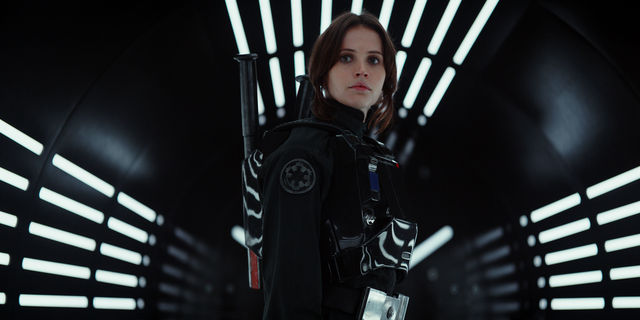
 (Photo courtesy of Walt Disney Pictures and Lucasfilm)
This weekend, millions of people will see a movie that features cutting-edge technology, secret messages, and uncertain alliances. No, it’s not a new James Bond flick. It’s Rogue One: A Star Wars Story. Dr. Vince Houghton, historian and curator of the International Spy Museum, contends that the Star Wars movies are, at their core, tales of spies and the processes that define their work.
“I’ve been arguing since I was 25 years old that these were not just science fiction movies or Westerns—they were spy movies,” says Houghton, 40. “Now I’m somewhat vindicated.”
The 1977 original hinges on rebels seeking to destroy the villainous Death Star using stolen plans—a classic example of a spy mission, Houghton says. That movie also introduces the concept of “turning to the Dark Side” of the invisible Force, which Houghton equates to double agents.
In The Empire Strikes Back, the Empire uses image intelligence to discover the location of a secret Rebel base on the ice planet Hoth—a search for “drones and insurgents,” Houghton says. In Return of the Jedi rebels hunt for another iteration of the Death Star using stolen plans, only to find that the Empire has planted an elaborate deception that temporarily cripples the mission. Even the Ewoks, with their paramilitary operations, remind Houghton of his profession.
Rogue One further proves Houghton’s point, dramatizing the effort to capture Death Star plans, which sets in motion the events of the original movie.”You have a full-fledged spy movie that is the basis for the original trilogy,” Houghton says.
Houghton first realized these films contained a major spy component while watching Star Wars 15 years ago and taking note of the double-agent intrigue. Since then, he’s seen each of the movies several dozen times, collecting more references, allusions, and full plot arcs ripped straight from real-life spy missions. He spends much of his energy convincing his friends to look at the movie the way he does.
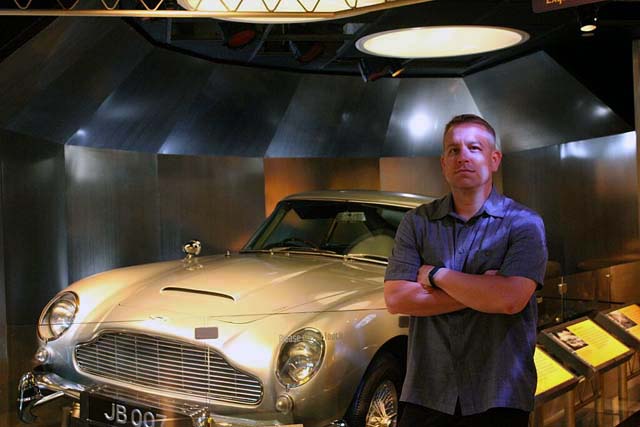 Are X-wing fighters the space equivalent of the Aston Martin? Vince Houghton serves as historian and curator of the International Spy Museum. (Photo courtesy of the International Spy Museum)
The curator’s knowledge of espionage combines firsthand experience and academic study. Houghton worked in intelligence while deployed as part of the Army in Bosnia in the 1990s, and he went on to secure a master’s degree and PhD in intelligence history. Now he spends his day immersed in spy history, working with artifacts and providing information to anyone who needs it. “It’s my job to know everything that’s possible to know about the state of intelligence,” Houghton says.
In the Ewoks, Houghton sees echoes of Americans’ use of rebel groups in Afghanistan and Syria. The deception in Return of the Jedi recalls Operation Bodyguard, a mission to mislead the Germans about the time and place of the Allied invasion of Normandy and surrounding areas during World War II. The Empire’s powerful sway converting weak rebels to the Dark Side recalls our dynamic with Cuba: “Every single agent we sent to spy on the Cubans was turned against the United States,” Houghton says.
We don’t know if series creator George Lucas intended these stories to reflect real-life spy missions. We do know that Lucas spent much of his early years gorging on 1950s pulp thrillers, many of which established the templates for modern spy movies, and drew on real-life history for entertainment. Consciously or not, that background likely informed his thinking.
“I always bristle at people who read stuff into art that doesn’t exist,” Houghton says. “But you can’t sit back and watch these and not think, God this is just chock-full of the spy world.”
Yet, many people do. That’s partially because few possess the depth of spy knowledge that Houghton has. But Pat Padua, DCist’s film critic and arts editor, thinks a different impulse may drive Star Wars fandom.
“The reason fans flock to these movies, and dress up as their favorite characters, has less to do with spycraft and more to do with fantasy and alternate worlds,” Padua says. “Perhaps that’s how fans come to terms with a world in which life-threatening spy intrigue exists.”
Indeed, a cursory Google search for “Star Wars spy” turns up 12 million results, seven million less than a search for “Star Wars western” and less than half the results for “Star Wars sci-fi.” Still, as Padua says, “The hologram as secret message seems like a descendant of the self-destructing tape of Mission: Impossible.” Rogue One makes the spy connection impossible to ignore with its “political defectors and betrayal.” (Read Padua’s review here.)
Houghton hadn’t seen Rogue One when he was interviewed for this story, but the prospect of a team effort, with each member contributing different skills, gave him hope that this explicit spy story would live up to the implicit ones earlier in the series. Either way, the movie promises to help him do his job better.
“The more people are talking about intelligence, Houghton says, “the more opportunities we have as a museum to educate people.”