Rachel Kurzius
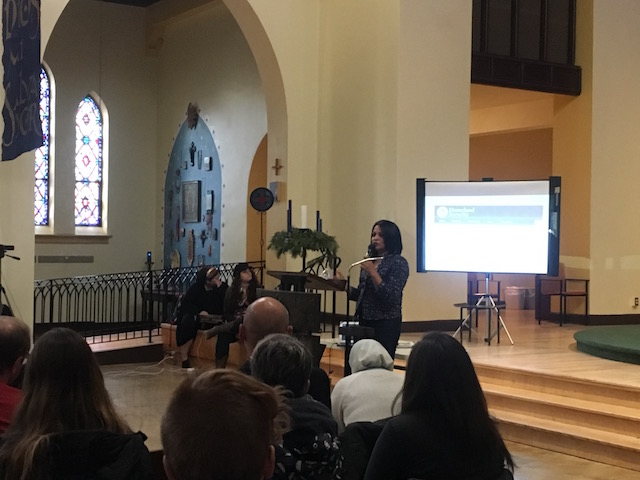 Deepa Iyer, a senior fellow at the Center for Social Inclusionspeaks at a teach-in about resisting Muslim registries. (Photo by Rachel Kurzius)
Advocacy groups are coming together to form the D.C Justice for Muslims Coalition. Founding members include the Washington Peace Center, the Muslim American Women’s Policy Forum, Collective Action for Safe Spaces, the National Coalition to Protect Civil Freedoms, and Hindus for Justice.
“These are local groups that intersect with the different ways that the Muslim community experiences anti-Muslim racism,” says Darakshan Raja, co-director of the Washington Peace Center.
The announcement occurred at a teach-in on Saturday afternoon about how to resist Muslim registries, which brought more than 100 people to Mount Pleasant’s Saint Stephen Church.
President-elect Donald Trump has floated having a national registry for Muslims who enter the country, a policy suggestion that had led to anxiety and questions about how to resist. What many people don’t realize, though, is that such a database already exists.
“Declarations of solidarity are appreciated,” said Ramah Kudaimi, one of the event organizers, while kicking off the teach-in. “But they demonstrate that [people] don’t know the history.”
Kudaimi was talking specifically about the National Security Exit-Entry Registry System, which was implemented in the aftermath of the September 11, 2001 attacks and suspended in 2011. It monitored the entry and exit of people from Muslim-majority countries like Iran, Iraq, Libya, Sudan and Syria, often requiring monthly check-ins. (One country on the list of 25, North Korea, was not Muslim-majority.)
More than 80,000 registered under the program, submitting themselves to fingerprinting and, at times, interrogations. While NSEERS did not lead to any known terrorism convictions, it sparked deportation proceedings for 13,000, earned condemnation from civil rights groups and other countries, and the Inspector General of the Department of Homeland Security recommended its termination in 2012, though it had already been suspended the year prior by taking the 25 countries off the list. However, it could be jumpstarted by adding nations to the list again.
Deepa Iyer, a senior fellow at the Center for Social Inclusion, described the confusion that marked the original NSEERS program. The news of the registry never made it to the front page of newspapers, and communities did not have answers to pragmatic questions, like what would happen to people who did not register.
She noted that, while many of the conditions that contributed to NSEERS forming were in place—namely widespread Islamophobia—there are some key differences: people are mobilized, the media is paying attention, and the Muslim community has allies, Iyer said.
“The goal is to create an environment where a Muslim registry is untenable,” Iyer said.
Organizers designed the teach-in as a way to help channel people’s concerns into ongoing local Muslim activism, which Raja emphasized has “been happening” long before Trump’s win.
Even prior to the election, people dressed in Muslim attire, or perceived to be Muslim, have been targeted for harassment, threats, and physical violence locally. In recent weeks, anti-Muslim slurs and threats have continued.
Noor Mir, an anti-war organizer with the Muslim American Women’s Policy Forum, asked attendees to raise their hands if they worked in policy (disclosure: Mir is a friend). A fair amount of people raised their hands. Then she asked who worked as lawyers, and more hands went up, followed by media, advocacy, and in the faith-based community, each to more hands in the air.
“There’s a lot of power in this room already,” Mir said.
The event also had three volunteer security guards. “On average, quite a few events, even the non-political ones, have gotten quite a few threats,” said one of them, who asked to be called “Comrade D,” over concerns that using his real name could lead to harassment from the same people sending those threats. “It’s better to be safe than sorry.”
Imam Ali Siddiqui, who serves on the board of Interfaith Action for Human Rights, said that “there is a lot of anxiety among Muslims at this time. I’m concerned that if the Muslim registry is reintroduced, it will create a lot of chaos.”
Disability advocate Steven Power, the co-vice president of Project Action, feared that a registry would soon affect people outside the Muslim community, too. “It could soon apply to people with disabilities or people of other races,” he said.
One attendee, Jess Brown, said that the results of the election compelled her to get involved. “For me, it was a homecoming back to organizing and protesting,” she said. “After the election, I feel like it’s more important to make that a priority.”
Since renewed support for a Muslim registry has emerged, some non-Muslim opponents vowed to add their names to the database to stymie the system.
“There are lots of things we can do before we get to that point,” said Iyer, including contacting
one’s members of Congress to dismantle the NSEERS framework, starting conversations with associations and faith-based communities, and shifting the narrative in the media.
Speaker Maha Hilal, the executive director of the National Coalition to Protect Civil Freedoms, said that speaking up about the way Muslims are represented matters because “government policy operates in tandem with society.”
Currently, the D.C Justice for Muslims Coalition is still in its infancy, and will be housed at the Washington Peace Center as they build a broader coalition, says Raja.
“We have seen this serious moment about people wanting to get involved, around Muslim registries and Islamophobia,” she says. “We’re trying to find a way to plug people in that is strategic.”