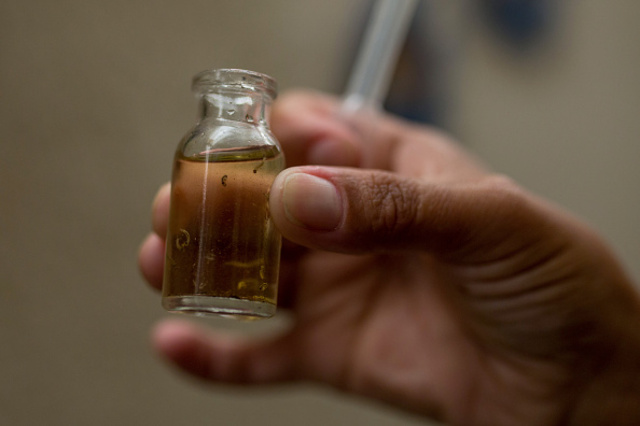
 Photo by Victor Moriyama/Getty Images
As D.C.’s mosquito season has ended, so has residents’ habits of covering their bodies in bug spray. But for Washingtonians who plan to travel this holiday season, protecting themselves from Aedes aegypti mosquitoes—which are known to carry the Zika virus—should be “in the forefront of their minds,” according to Dr. LaQuandra Nesbitt, Director of D.C.’s Department of Health.
Nearly 2.6 million people are planning to flee the D.C. region for the holiday season—the highest number on record, according to recent AAA Mid-Atlantic predictions.
“Some of our residents who are going to be traveling to Zika-infected areas are not thinking about mosquitoes at all while they’re planning their travel and when they get there—they may not even pack mosquito repellent at all to take on these trips,” Nesbitt says.
While D.C. didn’t have any locally transmitted Zika cases this year, there have been 27 recorded instances of Zika infections related to international travel.
It’s important to note that Zika-infected areas are “ever changing,” says Nesbitt, who suggests District residents check out the Center for Disease Control and Prevention’s updates on Zika infected places. Currently, the list includes Anguilla, Jamaica, Barbados, the Bahamas, and the Dominican Republic on a list of more than two dozen locations in The Caribbean. There are also Zika-infected regions listed in Central America, the Pacific Islands, Asia, and South America, among other places.
In U.S. states with warmer climates such as Florida, Texas, and Louisiana, mosquitoes tend to be present year round, Nesbitt says. She points to a travel alert for Brownsville, Texas, which the CDC recently labeled as a “Zika cautionary area” after Texas officials reported five cases of local transmissions.
Earlier this year, DOH hosted events where officials passed out Zika prevention kits to D.C. residents. While the government stopped administering those packages, the most important components for traveling—condoms and EPA approved mosquito repellents—can still be purchase in local stores, Nesbitt says.
People in Zika-infected areas are also advised to wear long sleeves and pants and stay in air-conditioned places or be sure that windows are covered with screens.
As there have been reports of sexually-transmitted Zika cases, Nesbitt says it’s also important that women who travel to infected regions do not have sex for two months—and for men, the wait time is six months. Further, a man who’s traveled to a Zika-infected region and is having sex with a pregnant woman should use condoms throughout the woman’s entire pregnancy.
Physicians have detected microcephaly—a condition affiliated with the Zika virus—when babies are in the womb or first born. But according to a recent CDC study, some babies aren’t diagnosed until several months after birth. Thus, researches are recommending continued medical care and follow-ups for infants who are exposed to Zika prenatally.