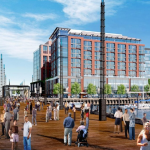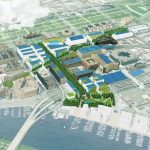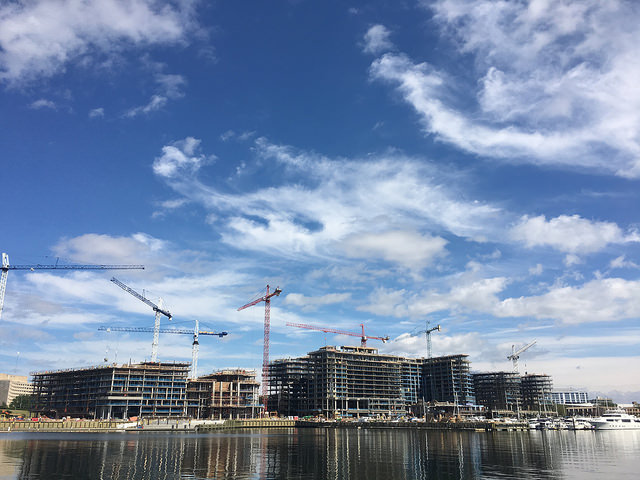
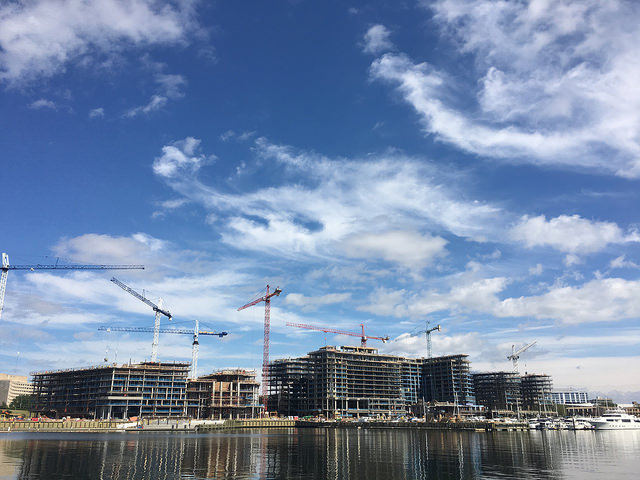
 Construction cranes have dotted the Southewst skyline, where The Wharf development is underway. (Photo by Aimee Custis)
With the first phase of The Wharf development set to open next year, there are a lot of eyeballs laid squarely on the future of the Southwest Waterfront. All the attention means people are rediscovering new pieces of the area’s past. And it’s a pretty rich history. Yes, there are fish involved, but there’s more to it than that. As with every other part of D.C., the nation’s history is tied up in the city’s, as is a complex weave of ethnic narratives—not to mention more than a few familiar names.
1. You can play tennis where they hanged John Wilkes Booth’s co-conspirators.
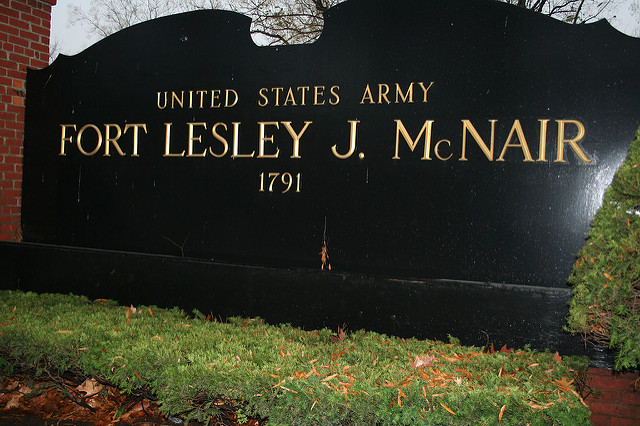
At the southernmost tip of the waterfront is Buzzard Point and Fort Lesley J. McNair. This is where the men and woman who helped the man who assassinated Abraham Lincoln were either imprisoned or executed for their crimes.
Booth managed to flee the city before being apprehended in Virginia, but eight of his co-conspirators were caught locally. After a trial, four received long jail sentences and the other four were hanged. Among the latter group was Mary Surratt, the first woman to be executed in the U.S. by federal decree.
The courtroom where their trial occurred has been reconstructed and is now open to visitors, which is more than you can say for the gallows. But preserving those would have been a bit morbid, not to mention logistically challenging. So now there are tennis courts there instead. Reflect on a grim chapter in the history of American criminal justice, then tighten up that backhand.
 (Photo by rachaelvoorhees)
2. Fort McNair has been guarding the city for 225 years. Fort McNair itself has a long history in the city. Military installations were first constructed on the site in 1791 to defend the nation’s capital.
Sitting at the confluence point of the Potomac and Anacostia rivers, the site was personally selected for its strategic value by George Washington and Pierre L’Enfant, D.C.’s chief architect. British forces destroyed the fortifications during the War of 1812, but they were later rebuilt. The nation’s first federal penitentiary—where the Booth conspirators were held and tried—was constructed there in the 1820s.
In 1948, the fort was named for Lt. Gen. Lesley J. McNair, who commanded Army ground forces during World War II and was killed in Normandy, France in 1944.
The base remains today on 21 acres and is now the home of the U.S. Army Military District of Washington.
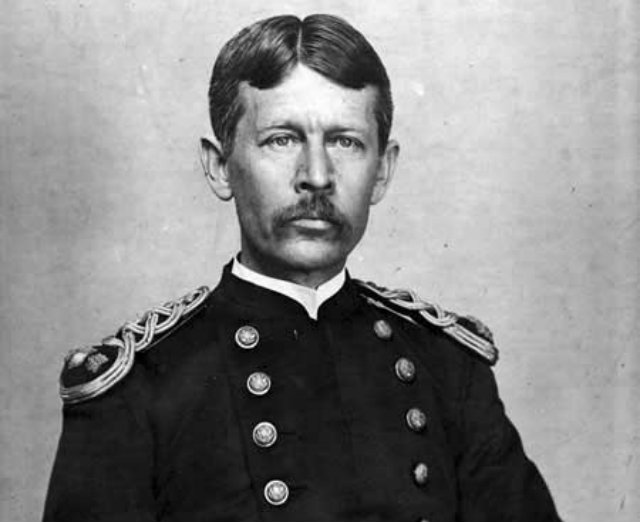 Walter Reed
3. Dr. Walter Reed studied yellow fever here. Yes, that Dr. Walter Reed. In the 1890s and early 1900s, Reed conducted seminal research on various infectious diseases including yellow fever.
Reed, an Army physician, used the marshy areas along the waterfront (and the men enlisted there) for his research. This was not long after Louis Pasteur’s groundbreaking discoveries about germs and disease transmission, and Reed was testing similar theories—specifically, that mosquitoes, not contaminated water or linen, spread yellow fever.
In October 1900, Reed announced that “the mosquito serves as the intermediate host for the parasite of yellow fever.” This led to, among other things, a vaccine for the disease and, less directly, the Panama Canal, where yellow fever was hampering construction.
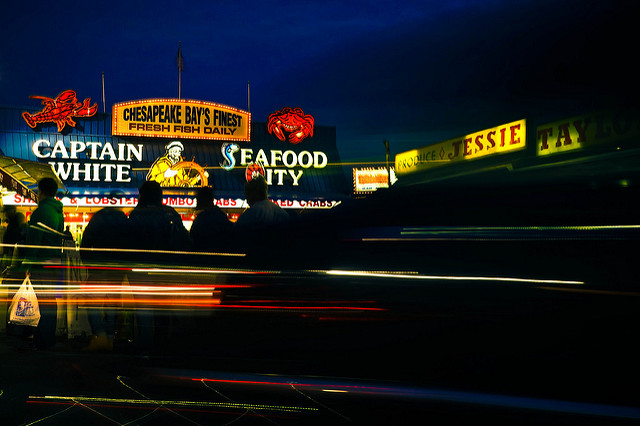 (Photo by Caroline Angelo)
4. The Maine Avenue Fish Market is the oldest continuously operating open-air fish market in the country. In-the-know locals are well-versed on this market, which offers mountains of fresh and cooked seafood in the shadow of I-395.
Known more generally as the wharf, this collection of barges and buildings was founded in 1805. That’s 17 years older than Fulton Fish Market in New York City, which sometimes erroneously receives the oldest distinction because, well, New York City.
Specific locations and vendors have changed at the wharf, but the market has persisted in some form ever since it opend.
The market is set to undergo a major renovation as part of the waterfront development. The plan isn’t without controversy, as some market business owners say the renovation could put them out of business.
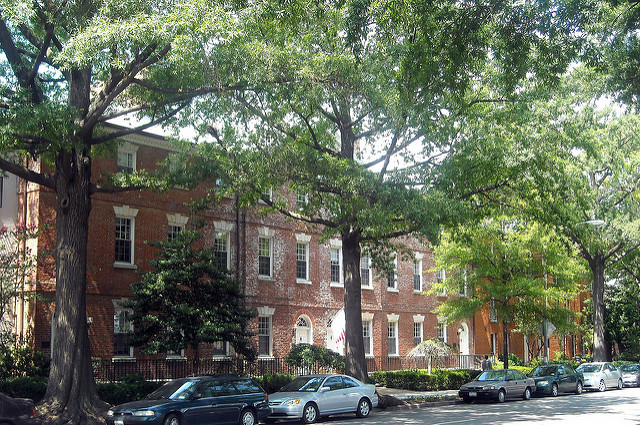 Wheat Row, seen in 2008. (Photo by Josh)
5. Wheat Row is the oldest block in D.C. Constructed in 1794, this block of row houses once purportedly hosted Thomas Jefferson. The houses are still private residences today and have been placed on the National Register of Historic Places.
John Greenleaf, the U.S. Consul to Amsterdam and one of the city’s first real estate speculators, purchased the land during a visit to Washington in 1793. Over the years, Wheat Row has been endangered by various development plans but has always managed to survive.
6. Marvin Gaye and Al Jolson lived here. Fourth Street SW, formerly known as 4 ½ Street, served as a de facto boundary for the area’s black and immigrant communities. Originally, much of the area was settled by free black citizens following the Civil War.
Marvin Gaye, arguably D.C.’s most illustrious non-politician resident, lived in the neighborhood as a child. So did jazz singer Al Jolson. Jolson’s father worked as a cantor at Talmud Torah Congregation, also in the waterfront neighborhood (it has since relocated and merged with another congregation).
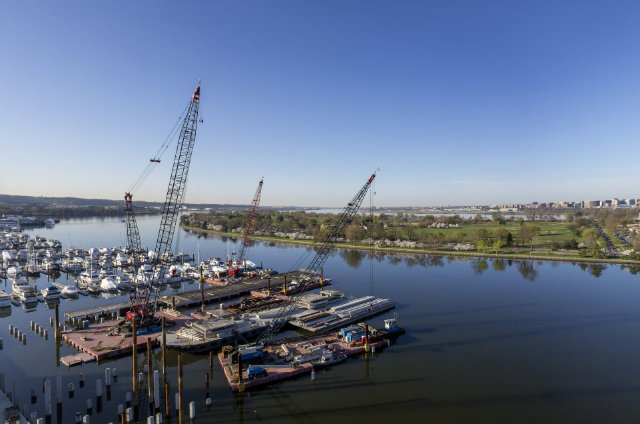 Screenshot via The Wharf.
7. A congressman demanded a recession after seeing Southwest’s cranes. When toodling around Southwest earlier this year, Iowa Representative Rod Blum grew alarmed by, heaven forbid, all the construction. “Washington DC is booming. Tower cranes everywhere. Being built on the backs of US taxpayers. DC needs a recession,” he tweeted, to Washingtonians’ endless frustration. The truth, in fact, is that the $2 billion The Wharf project is being funded by private developers… and also that real people live here, pay taxes, and, in no way, deserve a recession.
8. During the War of 1812, the Navy Yard was burned down—by U.S. troops. British troops were advancing up the Anacostia, and the situation seemed dire. What else was a cornered military to do? To keep the enemy from gaining resources, retreating U.S. soldiers torched the Navy Yard to the ground.
In hindsight, the British probably didn’t need a whole lot of help burning the nation’s capital to the ground. The original Library of Congress and a host of other buildings were among the architectural casualties of England’s attempted sack of the city. Still, not long after the invasion began, a major storm hit the region, putting out the fires and giving the Americans the time they needed to regroup.
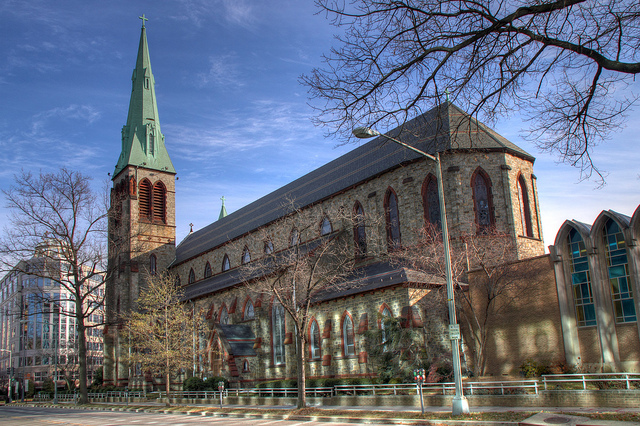 (Photo by Mr.TinDC)
9. St. Dominic Church has welcomed a slew of famous worshippers. And the old Catholic Church is still alive and well on E St. SW.
According to the church’s history, workers laid the building’s cornerstone in 1865, not long after the end of the Civil War. President Lyndon Johnson, Speaker of the House Tip O’Neill, actress Helen Hayes, and the best pitcher in baseball history, Walter Johnson, all worshipped at St. Dominic at one time or another.
This post has been updated to remove Kingman Island because it’s not on the Southwest waterfront.