Rachel Kurzius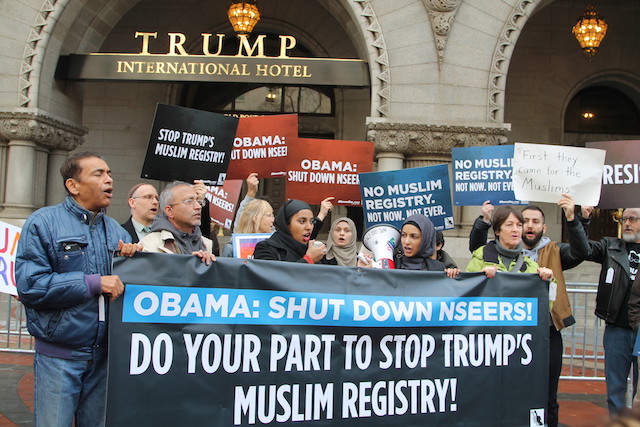
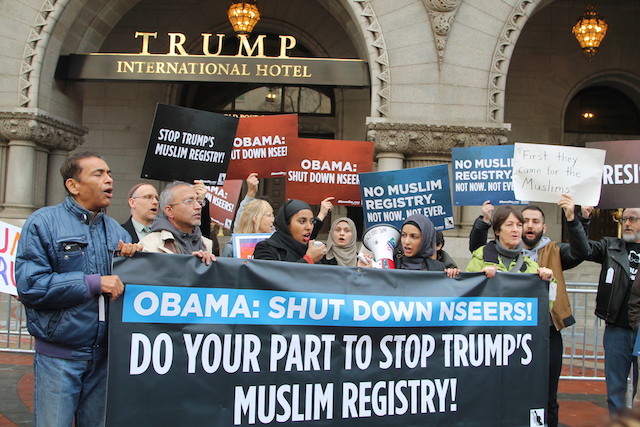 On Dec. 12, protesters marched down Pennsylvania Avenue and stopped in front of Trump’s hotel to make a statement. (Photo by Julie Strupp)
As President-elect Donald Trump stands by his plans to create a Muslim registry in the United States, the Obama administration announced it will dismantle a set of regulations that would make it easier to do so.
The U.S, first began requiring men from certain countries—originally Iraq and Kuwait—to register with immigration authorities in 1991. Though they were taken off the list two years later, the regulations for doing so remained in place. After the September 11, 2001 attacks, the Bush administration revived the program. Called the National Security Entry-Exit Registration System, it placed 25 countries on the list, requiring men over 16 visiting the U.S. to register. The only country on the list that wasn’t Muslim-majority was North Korea.
More than 80,000 people registered under the program, and it set into motion deportation proceedings for 13,000 of them. For years, civil rights groups have condemned the program as discriminatory. It did not result in any known terrorism convictions.
When the Department of Homeland Security suspended NSEERS in 2011, calling it “redundant, inefficient, and unnecessary,” it removed those 25 countries from the list but retained the regulations that provided the program’s framework. To bring it back, then, a president would simply have to add countries to the list.
That will no longer be the case after the White House dismantles the framework entirely.
“The regulatory structure pertaining to NSEERS no longer provides a discernable public benefit as the program has been rendered obsolete,” reads the new DHS rule, which will be published in the Federal Register on Friday. “Accordingly, DHS is removing the special registration program regulation.” The news was first reported by The New York Times.
Dismantling what remains of NSEERS has been a priority for Muslim advocates and allies. Last week about 200 people marched from the Department of Justice to the White House, calling on Obama to shut down the framework.
It’s not just activists. More than 50 Democratic members of Congress sent the president a letter saying that “eliminating the apparatus of NSEERS is consistent with our country’s fundamental values of fairness and equality.” The Inspector General of DHS called for the program’s full termination in 2012. A growing number of technology companies like Google and Apple have said they would not help build such a registry.
“This is a victory,” says Darakshan Raja, co-director of the Washington Peace Center and a founding member of the D.C. Justice for Muslims Coalition. “We were heard because there’s momentum, but it’s important to really keep in mind that the struggle is a 13-year struggle.”
While Trump won’t be able to use NSEERS, that doesn’t mean another Muslim registry is out of the question—even if it will have to be built from scratch, giving organizers time to fight it.
“We still have to continue to ramp it up on the local level because we don’t know what this administration will do and whether it will follow these processes,” says Raja. “I am really concerned that mass data on our community still exists which is accessible to this new administration.”
Hamzah Saif, a D.C. resident and activist originally from Pakistan, registered under NSEERS in 2003. Though the program was halted, Saif and all non-citizens entering the country are fingerprinted and must provide an address and other information, much as visitors from countries on the NSEERS list had been.
“This program has never, in that sense, been dismantled,” he says. “It has been strengthened.”
Indeed, the DHS rule says that the agency hasn’t needed to revive NSEERS since suspending it in 2011 because “during this period, DHS’s other targeting, data collection, and data management systems have become even more sophisticated.”