Rachel Kurzius
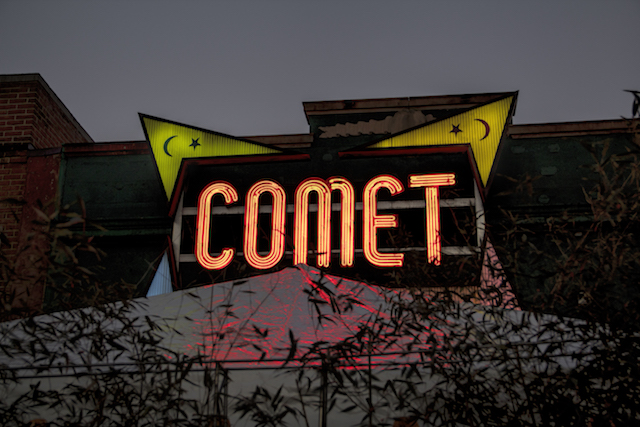 Photo by Daniel Kelly.
Nearly half of Donald Trump voters believe in “Pizzagate,” according to a new poll from The Economist/YouGov.
Interestingly, 17 percent of Clinton supporters also agreed that the leaked emails from Clinton campaign chair John Podesta used code words to discuss a pedophilia and human trafficking ring, a disproven theory that began circulating online shortly before the election.
The poll, conducted after an armed North Carolina man walked into Chevy Chase’s Comet Ping Ping to “self-investigate” the claims, found that Trump supporters were not the only ones with a propensity for conspiracy theories.
Half of polled Clinton supporters, for instance, believe that Russia tampered with vote tallies to help Donald Trump win the election—another theory with no evidence to back it up—as compared to 9 percent of Trump voters.
Another Russia-related theory, that Russia hacked Democratic emails to help Trump, has 87 percent of Clinton voters on board, and has the backing of the Central Intelligence Agency and Federal Bureau of Investigations. However, 80 percent of Trump voters do not agree with the CIA and FBI’s conclusions.
The results come as no surprise to Joseph Uscinski, co-author of American Conspiracy Theories. He says that people’s penchant for conspiracy theories exists on a separate spectrum from their political ideology, though which conspiracy theories they subscribe to has a lot to do with their partisan perspective.
“After an election, generally what we find is that conspiracy theories are for losers,” he says. “It’s the winning side that thinks the fraud didn’t occur, and the losers who think that it did.”
So, now that Clinton lost, a majority of her supporters believe that Russia interfered in the election, a theory espoused by prominent Democrats and liberal thought leaders. And, because Trump lost the popular vote, 62 percent of Trump voters believe millions of illegal votes were cast in the election, as compared to 25 percent of Clinton voters. Trump himself tweeted out this claim.
While it may be alarming to imagine such a broad swath of people ascribing to a fact-free theory like Pizzagate, Uscinski says that polls “serve a non-opinion sometimes,” meaning that the people asked about Pizzagate may not have a strong belief in Comet Ping Pong either way. Instead, because the theory centers on Democratic elites and Hillary Clinton, “it’s just a way to express dislike for the other party.”
But the online slander has had serious consequences, including death threats and harassment, for Comet Ping Pong, its employees, neighboring businesses, musicians who’ve performed at the pizzeria, and others.
How would one go about convincing these theorists that they’re wrong?
“It’s tough to change somebody’s worldview, and it’s tough to change somebody’s mind after they already believe something is true,” says Uscinkski. “Even when presented with authoritative information, people reject that information.”
We saw this at play after the alleged gunman fired at Comet Ping Pong. According to the criminal complaint, Edgar Maddison Welch came to the restaurant after he “read online that the Comet restaurant was harboring child sex slaves and that he wanted to see for himself if they were there … [He] stated he was armed to help rescue them.”
The theory centered upon basements in the pizzeria where these children were supposedly held, but Welch discovered what Comet Ping Pong had been saying from the start—the restaurant doesn’t have a basement. As Welch told The New York Times, “the intel on this wasn’t 100 percent.”
With his actions, Welch further disproved the Pizzagate theory. But many of the other self-termed “investigators” instead became convinced that he was another part of the conspiracy.
Uscinski says that the phenomenon of Pizzagate is “rare,” though. “I don’t think the internet is as kind to conspiracy theories as people assume—it gets debunked pretty quickly. Most of them die in the night.”