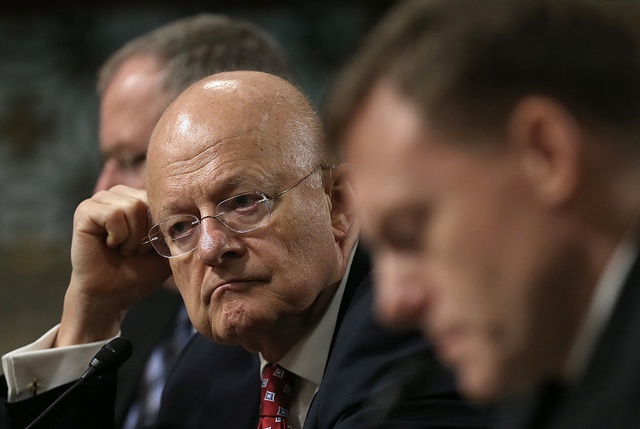
 National Intelligence Director James Clapper, center, and National Security Agency Director Admiral Michael Rogers, foreground (Win McNamee/Getty)
In a hastily scheduled Senate Armed Services Committee hearing today on Russian hacking of the DNC and the Clinton campaign, outgoing National Intelligence director James Clapper chided Donald Trump without naming him for his “disparagement” of the federal intelligence apparatus. Trump, of course, has expressed total skepticism of the FBI, CIA, and DNI conclusions that Russia was responsible for the hacks, and also falsely claimed that such conclusions were not publicized before the election.
Over the weekend, Trump claimed to know “things other people don’t” about the issue, and pledged to elaborate by Tuesday or Wednesday. It’s now Thursday.
Most recently, Trump pointed to his surrogate Sean Hannity’s interview with Julian Assange, in which Assange denies Russia was the source of the hacked emails Wikileaks published during the presidential campaign, as evidence that U.S. government spooks got it all wrong. After reading some articles about his bizarre behavior, Trump then claimed to be a “big fan” of “Intelligence,” which he put in scare quotes.
“@FoxNews: Julian Assange on U.S. media coverage: “It’s very dishonest.” #Hannity pic.twitter.com/ADcPRQifH9” More dishonest than anyone knows
— Donald J. Trump (@realDonaldTrump) January 4, 2017
Julian Assange said “a 14 year old could have hacked Podesta” – why was DNC so careless? Also said Russians did not give him the info!
— Donald J. Trump (@realDonaldTrump) January 4, 2017
The dishonest media likes saying that I am in Agreement with Julian Assange – wrong. I simply state what he states, it is for the people….
— Donald J. Trump (@realDonaldTrump) January 5, 2017
to make up their own minds as to the truth. The media lies to make it look like I am against “Intelligence” when in fact I am a big fan!
— Donald J. Trump (@realDonaldTrump) January 5, 2017
Today’s hearing showed that lawmakers still aren’t totally sure how to maneuver in this new landscape where an unbalanced man who openly praises Assange and Vladmir Putin over the U.S. spy establishment is preparing to take the nation’s highest office.
Democratic Sen. Claire McCaskill of Missouri struck a tone of strident opposition in asking Clapper, “Let’s talk about who benefits from a president-elect who trashes the intelligence community. Who benefits from that, director Clapper? The American people? Them losing confidence in the intelligence community? Who exactly is the benefactor of the man who is about to become commander in chief trashing the intelligence community?”
Clapper responded, “I think there is an important distinction here between healthy skepticism…and disparagement.” He was joined by Under Secretary for Intelligence Marcel Lettre and National Security Agency Director Admiral Michael Rogers. Each said that they welcomed and were used to dialogue with elected leaders about their intelligence assessments but insisted that they were certain Russia was to blame and that the U.S. must come up with a formal structure for responding to cyber-attacks, which it currently lacks.
“We stand actually more resolutely on the strength of that statement,” Clapper said of the October determination that Russia was behind the spear-phishing intrusion into longtime Hillary Clinton aide John Podesta’s email account.
Clapper and CIA Director John Brennan are scheduled to meet with Trump tomorrow to present him, as they will Obama, with a classified version of their findings on the hack. Obama ordered the review following the election. Trump claimed yesterday—falsely, according to intelligence officials—that they had postponed an earlier meeting, speculating that it was “to build a case.”
NPR reports that a public version of the report will be released Monday.
Some Republicans in attendance at the hearing didn’t care to dwell on the Trump-Russia implications of the hearing, which was officially on cyber attacks in general. “I heard this morning that a lot of the news media was characterizing this as a hearing on Russian hacking, and actually it’s on foreign cyber threats to the United States,” said Sen. James Inhofe of Oklahoma. “I would like to cover foreign cyber threats to the United States.”
Sen. John McCain, who chaired the committee, openly embraced the topic of Russian interference, though, calling the hacking an “unprecedented attack on our democracy.” Without naming Trump, McCain heaped praise on the intelligence officials before him, saying, “I am confident that Director Clapper will conduct this review with the same integrity that has characterized his nearly half a century of government and military service. I am equally confident in the dedicated members of our intelligence community.”
South Carolina Sen. Lindsey Graham, an early dropout from the Republican presidential primary, sought to paint President Obama’s sanctions and expulsion of Russian diplomats as weaker than what’s needed.
“We are in a fight for our lives,” he said. “I just got back from the Baltics—Ukraine and Georgia—and if you think that it is bad here, you ought to got here.”
He continued:
And so, ladies and gentlemen, it is time now not to throw pebbles, but to throw rocks. I wish we were not here. And if it were up to me, we would live in peace. Mr. Putin is up to no good, and he needs to be stopped. Mr. president-elect, when you listen [to intelligence chiefs], you can be skeptical, but understand they are the best among us, and trying to protect us.
Republican Sen Thom Tillis noted that, when it comes to throwing rocks at countries trying to interfere with our elections, the U.S. should be careful, because the government’s history of extensive intervention in other countries’ politics means we live in a glass house.
Beyond referencing the bogus intelligence used to justify the Iraq War, Trump has not made a coherent argument as to why people should distrust the FBI, CIA, and DNI conclusions, but smarter people than him are in agreement that, while Russian responsibility is likely, the case has not been conclusively made.
Buzzfeed reports that the FBI did not directly examine the hacked servers of the DNC before issuing a report attributing the hacking to Russia. Rather, the FBI relied on the forensic analysis of the third-party company CrowdStrike, which determined in May that the intrusion was by hackers tied to the country.
Also, The Intercept reports that the recently released Department of Homeland Security and FBI report on the hacks claims that 876 IP addresses belongs to Russian cyber attackers, yet at least 367 of those are exit nodes for the anonymizing service Tor, meaning they are IP addresses that anyone using Tor could have been assigned, now or in the last few years.
Next week’s public-facing report may leave those hungry for evidence unsatisfied, as the authors will leave out classified information that they believe could expose their methods or sources.
Democratic senators have called for the formation of a select committee, gathering legislators from across the Senate, to specifically investigate the hack, but Senate Majority Leader and Republican Mitch McConnell has said that it’s unnecessary.
Meanwhile, asked if Trump’s off-the-wall comments have hurt morale in his agency, Clapper said, “It certainly hasn’t helped.”