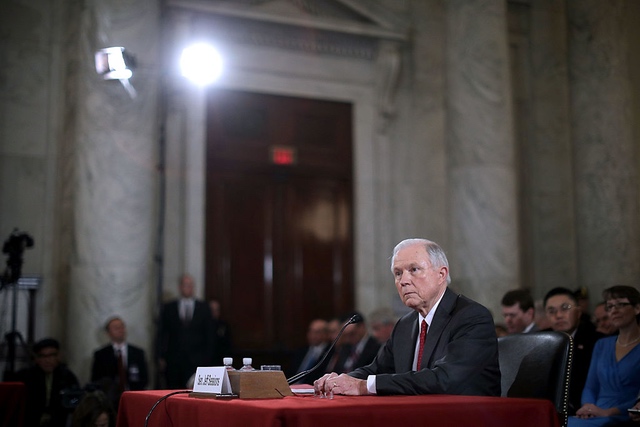
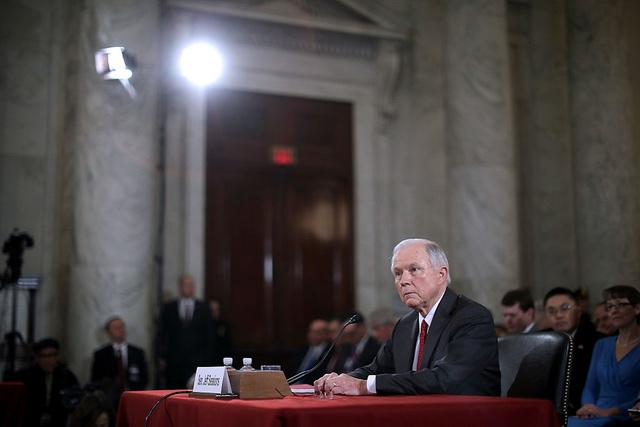
 Senator Jeff Sessions during the first day of hearings on his nomination for attorney general. (Getty)
The Senate Judiciary Committee is holding hearings on the nomination of U.S. Sen. Jeff Sessions (R-Alabama) for attorney general. Today’s the first day of hearings. We’re breaking down highlights of Sessions’s testimony. We’ll keep updating.
Torture
Sessions said he believes that waterboarding is “absolutely improper and illegal.”
Still, he has expressed support for the tactic in the past and in 2015 was one of 21 Republican senators to vote against an amendment to require all government agencies to abide by the Army Field Manual on Human Intelligence Collector Operations, which prohibits so-called “enhanced interrogation” techniques.
Abortion
“I believe it violated the constitution and really attempted to set policy and not follow law,” Session said of Roe v. Wade. However, he added that the decision “has been so established and settled for quite a long time, and it deserves respect and I would respect it and follow it.” He also said: “I would use the appropriate federal agencies and I believe it is violation of the law to excessively or improperly hinder access to an abortion clinic.”
Sessions has a long rabidly anti-abortion record in the Senate, which includes votes for bans on military base abortions, federal funding for abortions, and late-term abortions (with a limited except for the health of the mother). In 1999, he voted against a resolution expressing congressional support for the principles of Roe v. Wade.
Muslim Ban
Sessions said he would not support the kind of ban on Muslims entering the U.S. that Donald Trump has proposed. He later said, “If their interpretation of their religions views encompasses dangerous doctrines or terrorist attacks, I think they deserve closer scrutiny.”
Last year, Sessions said he’d be ok with such a ban. “We have no duty to morally or legally admit people,” he said. “We need to use common sense with the who-what-where of the threat. It is the toxic ideology of Islam.”
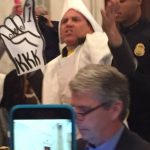
The Klan
“I abhor the Klan and what it represents and its hateful ideology”
This would ordinarily be a slam-dunk even for a hard-right nominee, but during the 1986 Senate Judiciary Committee hearings on Sessions’ (ultimately unsuccessful) nomination to a federal judgeship,Thomas Figures, a black prosecutor who had worked under Sessions, testified that Sessions once joked to him that he’d thought the Klan was “ok, until I learned they smoked pot.” (He also said Sessions called him “boy.”)
NAACP
“I never declared that the NAACP was un-American.”
During the 1986 hearings, a Justice Department official testified that Sessions, then a U.S. Attorney in Alabama, called N.A.A.C.P., along with the American Civil Liberties Union, “un-American” and said the organizations were trying to “force civil rights down the throats of people.”
Voting Rights
“I think my responsibility would be to ensure that there’s no discriminatory problems with a Voting Rights Act of a state. If it violates the Voting Rights Act or the Constitution, the attorney general may well have a responsibility and a duty to intervene. You cannot allow improper erosion of the right of Americans to vote.”
Sessions has consistently opposed efforts to enforce voting rights law. Figures testified that session called the VRA “an intrusive piece of legislation.”
Conflicts of interest in the administration
Sessions would not commit to appointing a special counsel to investigate specific cases of potential conflict of interest involving the Trump administration. “I would do my duty,” he said, but he wouldn’t get into particulars.
The potential conflicts of interest facing the administration are legion, from the financial entanglements of son-in-law Jared Kushner (also, nepotism), the shady, Trump’s many business dealings.