Rachel Kurzius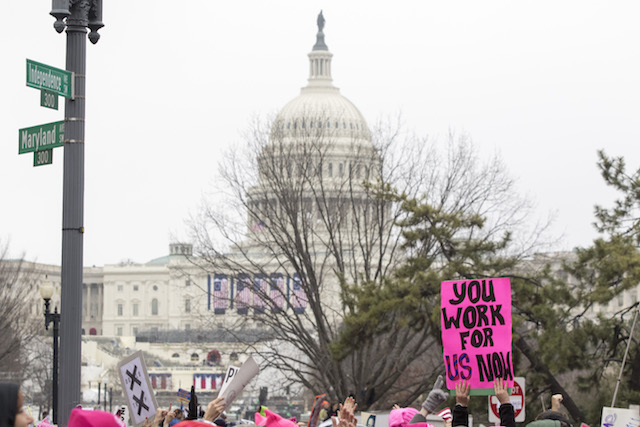
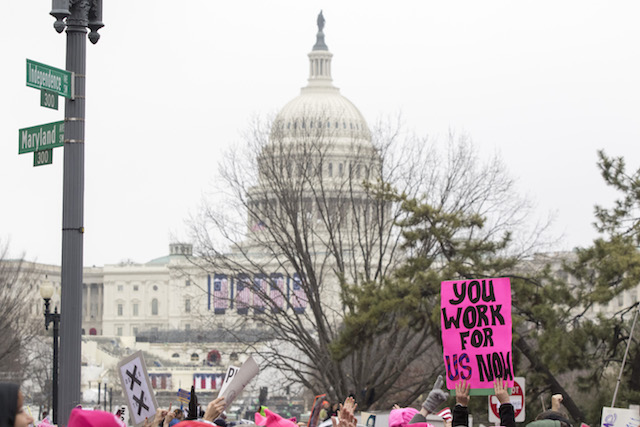 Women’s March protesters in front of the U.S. Capitol on Saturday. (Photo by Alex Edelman)
Update: The bill “to prohibit taxpayer funded abortions” has passed the House on a 238-183 vote, with 11 abstaining. While no Republicans voted against the bill, three Democrats voted in favor—Henry Cuellar (D-TX), Dan Lipinski (D-IL), and Collin Peterson (D-MN).
D.C. Delegate Eleanor Holmes Norton vowed to work with colleagues in the Senate to defeat the legislation. As she told DCist earlier this month, “Basically, the House will always do the bad thing and you have to go to the Senate.”
Original: It’s been a bleak week for home rule in the District, as Congress made quick work in trying to trample on D.C. abortion, gun, and death-with-dignity laws even before President Donald Trump took office.
One of the bills—Congressman Chris Smith’s (R-NJ) No Taxpayer Funding for Abortion and Abortion Insurance Full Disclosure Act—includes a portion that specifically targets D.C. and how it uses its locally raised funds.
In addition to permanently banning federal funding for abortion and insurance plans that cover them, HR 7 also prohibits D.C. from using its local dollars, local facilities, or local employees from covering or providing abortions.
“There’s a growing recognition that abortion is violent,” Smith told The Washington Times. “Whether it’s by poison pill or dismemberment and other chemicals, the fact is there’s a trend, virtually every poll you look at, that says people don’t want public funding for abortion.”
The ban on using federal or local D.C. money towards abortions already functionally exists. Every year Congress includes riders on appropriations bills to prevent the use of funds like Medicaid for abortions, except in cases of life endangerment, rape, or incest.
In D.C.’s case, what’s often called the Dornan Amendment has been used as a bargaining chip. It wasn’t included in the 2009 and 2010 appropriations cycles, when Democrats controlled Congress, but President Barack Obama and Speaker of the House John Boehner reached a compromise in 2011 that included reinstating the ban. That meant a local clinic had to tell 28 women who were scheduled for abortion procedures in the District the next day that they would be unable to rely on D.C. Medicaid to pay for those procedures.
The impact of these policies “generally falls hardest on women who are struggling already economically and already have barriers to accessing good quality healthcare,” said Georgeanne Usova, legislative counsel at the American Civil Liberties Union.
On Monday evening, D.C. Delegate Eleanor Holmes Norton introduced an amendment to the House Rules Committee that would strike the new bill’s “application to District of Columbia.” The Rules Committee, which decides which amendments are considered in order, rejected the amendment. (Another reminder: Norton doesn’t get a floor vote, so even if the amendment were considered in order, she couldn’t vote for it.)
“Republicans did not make my amendment to exempt D.C. from this national anti-choice bill in order because they are afraid of an open debate about their abuse of federal power by uniquely intruding into the District’s purely local affairs,” Norton said in a statement.
This isn’t Smith’s first rodeo introducing his bill, nor Norton’s with the amendment. Though her office expected this outcome for the amendment, “it’s our job to offer it and make our case for it,” says Benjamin Fritsch, Norton’s spokesperson.
Norton noted that the “congressional attack on the constitutionally protected reproductive rights of women in the District and throughout the nation is always timed with the annual March for Life,” when thousands of anti-choice activists come to the city for their annual protest.
There’s a companion bill in the Senate now, introduced by Senator Roger Wicker (R-MS). “Senator Wicker has made attacking women’s constitutionally-protected reproductive rights and D.C. home rule an early tradition each Congress,” Norton said. She vowed to fight off his attempts as well. In the previous terms, the Senate did not take up a vote on Wicker’s bill, even as Smith’s passed the House.
Republicans often use the District’s willingness to fund abortions for its low-income residents as a reason for why it should not have more political representation or control of its budget. “The D.C. government wants to use revenues to fund abortions in the District,” House Speaker Paul Ryan said in a statement last May. “House Republicans will not stand for that.”
And now, he has an ally in the White House. One of President Donald Trump’s first executive orders was the reinstatement of the so-called “global gag rule,” which prevents any international NGOs from providing or mentioning abortion if they receive any federal money, even if they use their own money on those services.
Republicans and the new administration have talked a big game of ceding control to local government—when it aligns with their interests. That generally goes out the window when it comes to the District.
“Congress has prohibited D.C. from using its own locally raised tax dollars against their own ideological principal of local control. How ironic, how insulting to the 600,000 people who live in D.C.,” said Laura Meyers, the president of Planned Parenthood of Metropolitan Washington. “That flies in the face of everything they supposedly stand for.”
Norton’s failed amendment by Rachel Kurzius on Scribd