 Rachel Sadon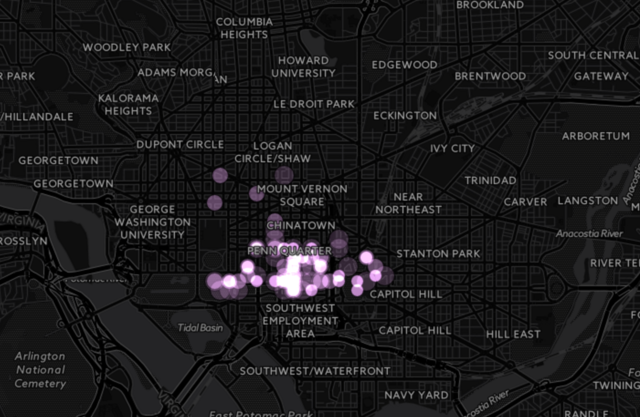
Wireless carriers spent millions upgrading their permanent and temporary infrastructure on the National Mall to handle a steady torrent of data during inauguration. It wasn’t enough, as service ground to a halt at the Women’s March on Washington.
The time series map above, created by GIS specialist Randy Smith, helps show why. It tracks geo-tagged tweets with hashtags like #WomensMarch and #WhyIMarch. As the day goes on, they converge en masse around a huge swath of Independence Avenue and the National Mall (zoom in to see it in detail), where activity peaked between noon and 3 p.m. You can also make out Metro stations in all corners of the map, where marchers propelled the system to its second-busiest day ever.
It’s a rough estimate, but Hood says his data shows that around 45 percent of of all geo-tagged tweets on Saturday in D.C. were directly related to support for the Women’s March.
And this is just Twitter—live streaming, posting to Facebook, phone calls, and whatever else the kids are doing these days with their phones all sapped the networks. Even text messages, the least data-intensive form of wireless communication, weren’t going through for nearly every march attendee that I spoke to.
For whatever this is worth, networking specialists with Global Wireless Solutions found that AT&T had the best service during the actual inauguration, though speeds were comparable among the four major networks during the parade.
Verizon estimated that inauguration attendees used about 7 TB of data, with about 67 percent dedicated to browsing the web and using social media. AT&T estimates that its customers used 4.5 TB of data on Friday, which the company said translates to more than 11 million selfies. Neither carrier released data from Saturday.