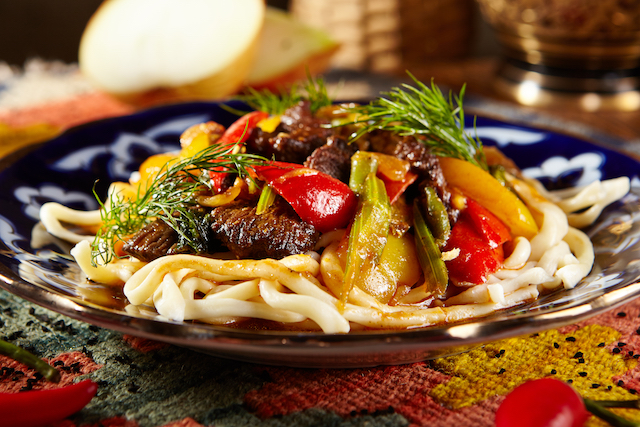
 Uyghur noodles with meat and laghman sauce. (Image via Shutterstock)
Don’t recognize that word on your dinner or drink menu? Sick of surreptitiously Googling at restaurants? Menu Decoder is your guide to obscure ingredients popping up on local dinner and cocktail menus.
D.C. residents like to pride themselves on being internationally aware, especially when it comes to dining options. Salvadoran? Done. Ethiopian? Easy. Uyghur cuisine, however, is something that not everyone may readily recognize. But even those who haven’t encountered it before will find hints of the familiar in the cooking. Its ingredients and taste are somewhat similar to the Chinese cuisine we know. Digging in, however, there’s much more complexity.
The Uyghur (also spelled Uighur; pronounced wee-gur) people live in the far western reaches of China, on the border of Kyrgyzstan and Tajikistan. Descendants of Turkic groups that migrated centuries ago, they live along the ancient (and fragrant) paths of the Silk Road. This means that while elements of Far Eastern and Chinese cooking are in the fore (see: long noodles), Middle Eastern spices and cuts of meat (see: kabobs) end up in the pot for an intoxicating and thrilling dining adventure.
It’s not all hugs and culinary camaraderie over steaming bowls of shared noodles, however. The Uyghur ethnic group is a Muslim-practicing minority, putting it very much outside the Han majority population. Like other western-region minorities, Uyghurs have maintained a strong, unique identity outside of the Mandarin mainstream—and Beijing exerted strong control in the Uyghur homeland.
Only a few thousand Uyghurs have made their way to the U.S., mostly settling on the Eastern Seaboard. Still, the D.C. area boasts two Uyghur restaurants for exploring this cuisine.
The original is Queen Amannisa (320 23rd St. South, Arlington), which opened in Crystal City in 2015. The owner tells us that, “Our people come from the Silk Road area, and so we have unique cuisine and customs. We want to preserve our traditional cuisine.”
The other option is the newly opened Dolan Uyghur (3518 Connecticut Ave. NW) in Cleveland Park. The restaurant took over the old Sorriso location just last month.
So, if you’re hungry after all that, here’s what you need to know:
Appetizers
Salad: The traditional salad is fresh and made of cubed vegetables, much like a traditional Middle Eastern salad with cucumber, tomato, onions, and feta. However, it can also be made sweet, with an inclusion of beets, berries, apples, or pineapple.
Samsa: This is related to the samosa. The difference is that it’s always baked, not fried. Traditionally cooked in a clay oven, they’re most often stuffed with minced marinated lamb and onion, and occasionally with chicken, beef, or completely vegetarian. They come brushed with oil and liberally sprinkled with sesame seeds.
Main Dishes
Laghman (lagman): Perhaps the most famous and fundamental part of the cuisine, lagman is a specialty noodles dish. Starting from a dough ball, these noodles are hand-pulled and hand-cut, a labor-intensive process of repetitive stretching and pulling. It’s as much a display of immersive art as a science behind the process to attain the desired thickness and consistency. The noodles are boiled extra-long to achieve a chewy consistency. They’re then smothered with a filling meat-and-vegetable stir-fry sauce, traditionally mutton (lamb) and tomatoes, peppers, onions, cabbage, chilis, and other spices.
The noodles can also be served dry-fried, a process involving quickly tossing the boiled noodles in a wok with lightning-hot oil—something akin to lo mein. Finally, the noodles can also be served chopped and fried to get a more even mix with the stir-fry topping.
Meat nan: A spiced bread reminiscent of the familiar Indian naan, but this time filled nearly overflowing with a minced and marinated lamb and onion mixture.
Kawap: The Uyghur version of kabobs, these are made with ground or whole lamb chunks, chicken, or other meats. They are highly spiced, skewered, and grilled over an open flame.
Manta: These are large dumplings served as entrees, set in a soup stock and filled with a liberal helping of ground lamb and onion. The dumplings are steamed and not fried.
Polow: Rivaling laghman for the most important dish in the cuisine, it’s a pilaf-style rice. The veggies (onions, carrots) and meat (lamb, again) are tossed together in plenty of oil and fried. Rice and spices are added along with water to cook the rice, and then the entire thing is steamed. Dried fruit or nuts may be added.
Da pan ji: Also known as Big Plate Chicken, the name is all you really need to understand what your getting. It’s a rich, hearty, savory chicken stew. It’s all piled high with tomatoes, peppers, onions, garlic, and earthy spices like star anise, chili, and ginger. Most traditionally, the chicken is served bone-in.
Dessert
Napoleon cake: The traditional cake seen around the world made its way here, too. A puff pastry layered with cream filling, it can be topped with crumbled nuts, especially walnuts.
Tea: Instead of alcohol, there are a dazzling array of teas, including a strong black tea and herbal infusions, like rose and jasmine.