Rachel Kurzius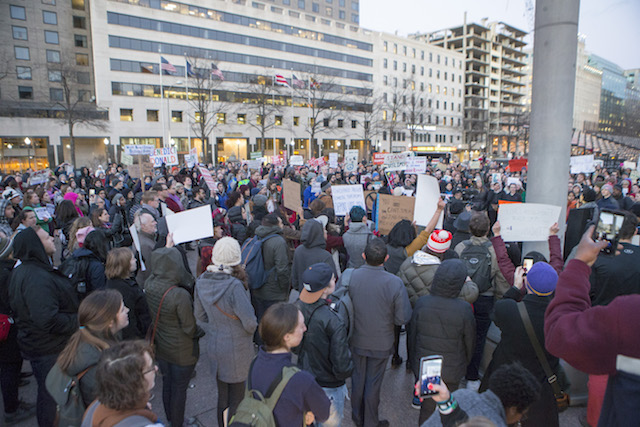
Like every day since the inauguration of Donald Trump, a large group of people came together to protest the new president’s policies on Thursday evening.
This time, the crowd gathered in front of the Wilson Building wearing hijabs, yarmalukes, hoodies, and a whole lot of winter hats. They held signs saying “Muslims and refugees welcome here,” “Won’t you be my neighbor?” and “Caring for each other.”
The demonstration was organized by the Muslim American Women’s Policy Forum to “stand with Muslim, refugee, and immigrant communities” in the square outside the D.C. government building that houses the offices of councilmembers and the mayor.
While Mayor Muriel Bowser affirmed on Wednesday that D.C. was a sanctuary city and the D.C. Council unanimously passed a resolution vowing not to infringe on human rights, protesters wanted D.C. officials to know that they better keep their word.
“It is not enough to pay lip service and feel good about themselves,” said Darakshan Raja, co-director of the Washington Peace Center and co-founder of the D.C. Justice for Muslims Coalition. “Don’t give me a resolution when people are already being deported.”
Before the rally began, activists had coordinated a phone campaign to urge D.C. officials to stick to their word and pledge not to cooperate with federal deportation orders or attempts at Muslim registries.
At-large Councilmember Robert White told DCist that his office receive so many calls Thursday afternoon that he had to jump on the phones himself, though “a lot of calls were thank yous.”
“Residents have been feeling a lot of fear,” White said before speaking at the rally. “It’s important for them to know that I stand with them.”
Other than White, the rest of the speakers were activists and religious leaders in the community.
“Are you prepared?” April Goggans, an organizer with the Movement for Black Lives, asked the crowd. “Are our actions going to match our words?” She challenged attendees to meet someone they didn’t know at the rally. “Now’s the time to get connected and plug in,” she said.
After the nearly two-hour rally, Goggans observed that she saw a lot of new faces, “which is great. It means a lot because we get burnt out,” she said. With executive orders coming down rapid fire from the White House, she is trying to make sure that activists can sustain themselves for the long haul.
“A lot of it has to do with community building. There’s an educational component, too,” she told DCist. “Learning more about issues makes you more committed.”
Goggans said that she didn’t want the group rallying to be called protesters any more. “We’re resisters,” she said.
As the crowd continued to swell to about 400 people, they stood between two flagpoles with the American and D.C. flag, both whipping loudly in the wind.
“People will die” if Trump bans refugees from majority Muslim countries, Rabbi Joseph Berman of Jewish Voice for Peace told DCist as he blew his hands from the cold. (It did not escape speakers that, of the seven countries on that list, the U.S. is currently bombing five of them.)
He had earlier told the crowd that Trump was like the Pharaoh in the story of Exodus, urging people to be like the midwives who resisted Pharaoh’s call to kill male Israelite children.
He said that on one side of his family, he had a great-grandfather who arrived in the U.S. illegally after escaping the czar, and other who escaped Nazi Germany. Grandparents on the other side of his family survived Auschwitz.
“Thank God they found refuge here—many were turned away” Berman said. He said his group was involved in this issue because “the liberation and safety of Jews is bound with the liberation and safety of other communities.”
In addition to Trump’s policies, attendees like Jocelio Viera were worried about his rhetoric. Originally from Brazil, he has been in D.C. for four months. “Every time I see an immigrant or black person being attacked, I feel that too,” he said through his boyfriend, who translated for him from Portuguese while holding a sign that said “I Love My Black, Latino, Gay, Immigrant Boyfriend.”
For Remaz Abdelgader, a young Muslim woman who lives in the area, “it’s great to see people validating your identity, speaking out loud to say they stand with us,” she said. “I cried a little bit.”