Rachel Kurzius
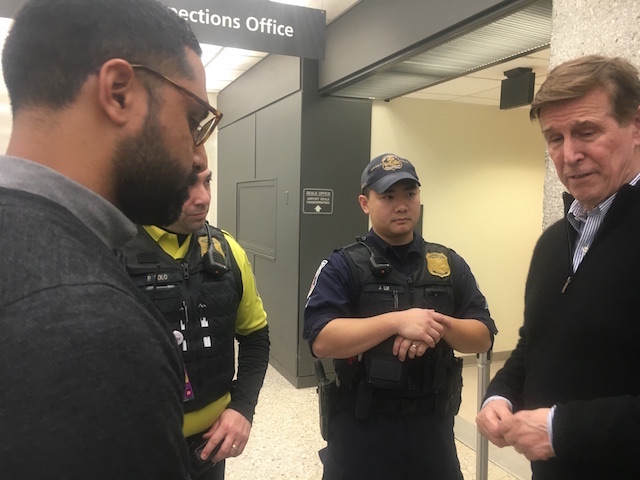 Congressman Don Beyer (D-VA) tries to get through to CBP officials, unsuccessfully. (Photo by Rachel Kurzius)
Update: Four local members of the House of Representatives unsuccessfully tried to speak with Customs and Border Protection at Dulles International Airport on Sunday afternoon.
Congressmen Gerry Connolly (D-VA), Don Beyer (D-VA), Jamie Raskin (D-MD), and John Delaney (D-MD) went to the airport to sit down with CBP and learn how many people were being held at the airport and why lawyers had not been permitted to meet with legal permanent residents.
On Sunday evening, Congressman Bobby Scott (D-VA) was similarly unable to talk to CBP officials at Dulles.
A temporary restraining order from a Virginia federal judge on Saturday grants attorneys access to permanent legal residents at Dulles, though CBP has not spoken directly to attorneys or lawmakers, or let them back.
It is in response to an executive order signed by President Donald Trump that bans people, including legal residents, visa holders, and dual citizens, from seven majority-Muslim countries from entering the U.S. for the next 90 days and suspends the refugee admissions program for 120 days.
“When you are not willing to answer questions, I can only conclude that you’re violating law and in contempt of court,” Connolly told DCist of CBP. “I think it shows a special arrogance that somehow they think they’re above the law.”
That means lawyers and advocates still didn’t know how many people were being held in the secondary inspection area at Dulles or what their immigration status was, which led to a catch-22: Attorneys couldn’t file for contempt of court without having proof that legal residents were being detained and not being given access to lawyers, but they couldn’t get proof without getting access.
While lawyers don’t usually have access to the secondary inspection area, “it is unprecedented for green card holders to be held in secondary inspection,” says lawyer Dan Press.
Beyer characterized CBP not following the judge’s order as a “constitutional crisis.” He learned late Sunday afternoon that a Sudanese green card holder in his district, Nahla Gadalla, was not being let through. Her husband was talking to volunteer immigration lawyers who had set up at Dulles while her young son cried. “This never happened before,” the boy said.
Beyer returned to where Metropolitan Washington Airport Authority police, who have been acting as an intermediary to CBP, stood. He was doubtful the gambit would work, but “we need to try,” he said.
Now @DonBeyerVA in holding pattern waiting to see if CBP will let him back to see Sudanese green card holder allegedly detained @ Dulles pic.twitter.com/dZbvQ3sVh2
— Rachel Kurzius (@Curious_Kurz) January 29, 2017
Shortly after Beyer spoke to MWAA officers, they told him that Gadalla was being released. But lawyers still weren’t allowed to enter the secondary inspection area, nor were they getting information about who was held there.
Saif Rahman is an American citizen who was pulled into the secondary inspection area on Sunday afternoon when his plane arrived from Frankfurt on Sunday around 2:30 p.m., and he estimated about 16 people were back there, though he didn’t know their immigration status.
“They had Customs and Border Protection officers waiting plane-side, which is unusual,” he told DCist. He also observed a CBP officer “scrolling and going through the phone of a man with a red passport for about 20 minutes.”
Lawyers are asking people who plan to enter the Dulles international terminal in the coming days to get in touch. “We need eyes and ears behind the scenes,” says D.C. attorney Sara Dill. Especially pertinent information is names of people in the secondary inspection area and their immigration status.
They’re also asking families expecting someone flying in the next few days to come to Dulles. “We need to know who these people are so we can begin helping them,” she says. They’ve heard reports that people who have been pulled off planes before they take off.
Dill adds that more than 500 lawyers in the D.C. area have volunteered to help people affected by the executive order.
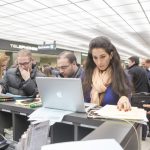
Many of the attorneys are at Dulles, working in shifts where they get information about conditions for arrivals and identify who needs their help. Others are part of an off-site litigation team.
While representatives from the offices of Virginia Senators Mark Warner and Tim Kaine were both at Dulles, there was one conspicuous absence—Representative Barbara Comstock (R-VA), in whose district Dulles resides. She issued a statement opposing Trump’s ban over the weekend but did not show up at the airport.
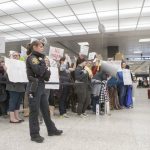
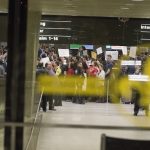
Hundreds of protesters did, though. They were in full force on Sunday, cheering new arrivals at the international terminal. Legal observers from the American Civil Liberties Union were there, too.
MWAA police had closed off Door 1, which leads to the international terminal, for security. Bryan Norwood, vice president for public safety at MWAA, was there on Sunday, “It’s all good,” he said of the protests, noting that a mutual aid agreement with Loudoun County brought them some additional sheriffs.
So what happens next? “Your guess is as good as mine,” Congressman Connolly said.
Original: A day after a Virginia federal judge ordered that lawyers be permitted access to legal residents at Dulles International Airport, Customs and Border Protection still isn’t complying.
“Customs and Border Protection is still violating the court order,” says Sirine Shebaya, a civil rights attorney in D.C. who was at the airport last night, and will return later this afternoon. CBP also isn’t communicating with lawyers at the airport, she adds, and they’re directing all questions to its public affairs office.
The lack of communication from CBP means that we still don’t know how many people were or continue to be stuck “back there,” as people ominously referred to the secondary inspection area. Lawyers on Saturday estimated that, at one point on Saturday, dozens were in holding, based on family members waiting for them. They did not know how many refugees were there.
The temporary restraining order from U.S. District Judge Leonie Brinkema, which also prevents the Department of Homeland Security from removing lawful permanent residents who arrived at Dulles for a week, came from a lawsuit filed against an executive order signed by President Donald Trump on Friday.
The order bans people, including legal residents, visa holders, and dual citizens, from seven majority-Muslim countries from entering the U.S. for the next 90 days and suspends the refugee admissions program for 120 days.
Civil rights advocates and lawyers immediately deemed the order unconstitutional.
Tom Perriello, a former Virginia congressman now running for governor, went to Dulles on Saturday evening. He told DCist the order “eats away at the soul of the country and community” and “directly undermines our resilience and intelligence-gathering, emboldening our enemies.”
A federal judge in New York issued a legal stay against the order, which protects those who are here with valid papers from deportation. A Massachusetts District Court judge went even further, barring anyone from detaining people who couldn’t have been held before the order was signed.
The silence from CBP at Dulles even extended to a U.S. senator. Before midnight on Saturday, Senator Cory Booker (D-NJ) arrived at the airport to hand-deliver Brinkema’s decision.
No one from CBP would present themselves to Booker, according to people familiar with the conversations. Instead, they used a police go-between to pass written questions and answers to the senator.
Afterward, he told the crowd he believed CBP violated the court order. “One of the things I will be doing is fighting to make sure that executive branch abides by the law as it was issued in this state and around the nation,” he said. “This will be an ongoing battle.”
In a statement, DHS said it “will comply with judicial orders; faithfully enforce our immigration laws, and implement President Trump’s Executive Orders to ensure that those entering the United States do not pose a threat to our country or the American people.”
However, at Dulles, those pledges seem to be in conflict.
Dozens of lawyers staked out at Dulles on Saturday, after the International Refugee Assistance Project put out a call. They signed up for rotations to keep a presence at the airport through Sunday and planned to do so “for as long as we have to,” according to attorney Dan Press.
What also remains unknown is whether CBP removed people from the airport. Booker said that CBP said that no detainees were transferred from Dulles, though his office is still working to independently verify that claim.
Lawyers were dubious. “I don’t believe it for a minute,” said Press. “The problem is we don’t know because [CBP] won’t let us back there.”
Attorney Ofelia Calderon said that lawyers would be calling up local jails on Sunday to check up.
At least one person held up in Dulles last night was not released by the end of Saturday night. Syrian doctor Said Hajouli was waiting all day on Saturday for his wife, also Syrian, who was arriving on a J-2 visa. While they’ve been married for two years, they’ve only spent one week together, Hajouli said.
His wife called him when her plane landed at Dulles, and said she was waiting in a line. She does not speak English.
The couple’s lawyer, Alfred Robertson Jr., who asked that we not use the wife’s name, said a second party told him she’d have “a comfortable place to stay” on Saturday night, though he did not know what they meant by that. Robertson said that she is now officially an asylum-seeker.
“They released everyone except for my wife,” Hajouli said at the end of Saturday night. “How am I feeling? I’m not happy.”
Congressman Gerry Connolly (D-VA), said Sunday afternoon he was heading to the airport.
On my way to @Dulles_Airport to demand that @CustomsBorder follow the Constitution and stop defying court order. #NoBanNoWall
— Gerry Connolly (@GerryConnolly) January 29, 2017