Rachel Kurzius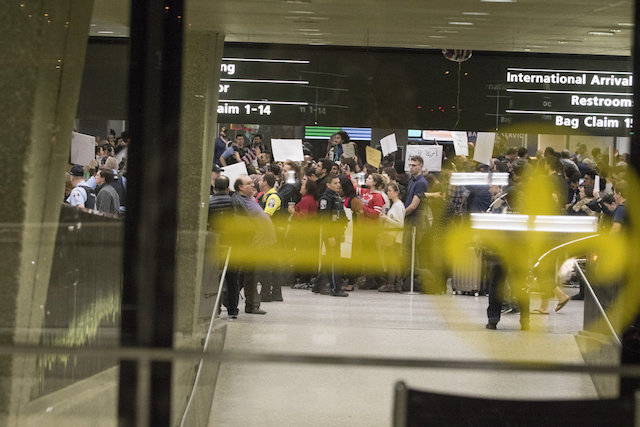
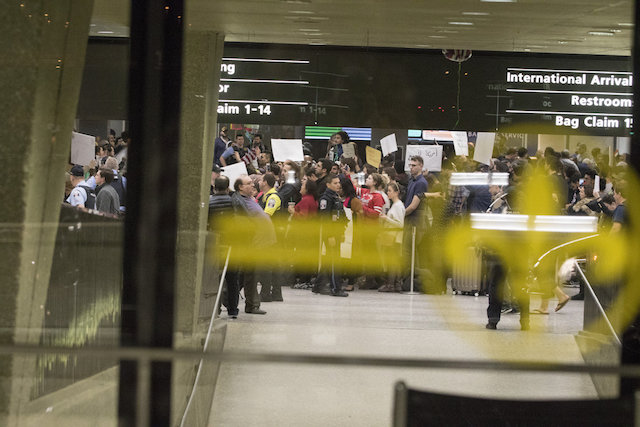 The scene at Dulles on Saturday night. (Photo by Alex Edelman)
Virginia is suing President Donald Trump over his immigration ban, which the commonwealth’s attorney general called “unlawful, unconstitutional, and un-American.”
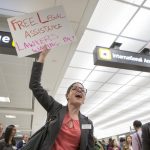
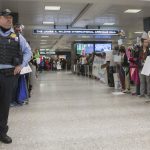
The ban, which President Donald Trump signed last Friday, temporarily prevents citizens and refugees from seven majority-Muslim countries from entering the United States. Its immediate implementation led to chaos and detentions at airports across the globe, including at Dulles, where protesters and an army of lawyers have been posted up for days.
Already, the order has faced a bevy of legal challenges.
The state of Virginia is joining a preexisiting lawsuit called Aziz v. Trump, which focuses on Yemeni green card holders Tareq Aqel Mohammed Aziz and Ammar Aqel Muhammad Aziz. The brothers flew into Dulles on Saturday from Ethiopia, where they were slated to meet their father, a U.S. citizen.
Instead, they were handcuffed and held in a secondary inspection area at Dulles, the lawsuit filed by The Legal Aid Justice Center and Mayer Brown on Saturday alleges. Other plaintiffs include up to 60 John Does, who lawyers believe were blocked from entering the U.S.
On Saturday night, a U.S. federal judge in Virginia issued a temporary restraining order that permitted legal permanent residents like the Aziz brothers access to attorneys.
By the time Judge Leonie Brinkema issued the order, though, the Aziz brothers were already on a plane back to Ethiopia. An amended complaint filed Monday outlines how the Aziz brothers, and potentially as many as 60 others, were coerced into signing away their green cards under the bogus threat of being barred from the U.S. for five years.
Attorneys and lawmakers say that Customs and Border Protection is not complying with the order. “DHS is not providing lawyers access to secondary inspection,” says Paul Hughes, a partner at Mayer Brown.
On Saturday night, Senator Cory Booker (D-NJ) went to the airport to deliver the order, and CBP refused to speak with him directly. “This order was issued by the judicial branch and it was violated tonight,” Booker told the crowd.
As of Sunday afternoon, CBP was giving people arriving at Dulles a printed copy of Brinkema’s order with lawyers’ phone numbers on it. Lawyers say that action alone is not compliance.
On Sunday, at least five congressman were denied when they tried to speak to CBP or go back to the secondary inspection area, leading Congressman Don Beyer (D-VA) to call it a “constitutional crisis.”
DHS Secretary John Kelly told media on Tuesday that no one from CBP knowingly or intentionally violated the court order.
The difficulty is that, because lawyers don’t have access to the secondary inspection area, they don’t have proof of CBP violating the order, so they can’t file a contempt of court claim. CBP says that it’s not detaining people at Dulles, but the agency does not define holding people in secondary inspection as detention.
“We think that’s inaccurate,” says Hughes of Mayer Brown. “These individuals were detained because they were not free to go. They were not free to leave.”
Herring formally requested information about the implementation of the travel ban at Dulles.
Even people who ultimately emerged from the secondary inspection area at Dulles recounted harrowing experiences—a five-year-old boy detained and separated from his family for hours, a women and her two kids held for 20 hours without food, wheelchair-bound octogenarians denied life-sustaining medication.
“We think that the [Virginia] commonwealth intervention just confirms the serious constitutional and statutory flaws wth the administration’s executive order,” says Hughes.
Along with the attorneys general of D.C. and Maryland, Herring was among 16 AGs to sign onto a statement condemning the executive order. Rob Marus, a spokesperson for D.C. AG Karl Racine, says that the are “definitely monitoring the situation and it is certainly within the realm of possibility that we would bring our own action on behalf of District residents or intervene in an action,” as Virginia did.
The next time the parties are slated to be in court for Aziz v Trump is February 10. The Department of Justice filed a notice of appearance on Wednesday morning, meaning it will attend on behalf of the Department of Homeland Security.
Trump fired acting Attorney General Sally Yates on Monday when she refused to enforce the ban. Her replacement, Dana Boente, is the former U.S. Attorney for the Eastern District of Virginia, the same court where the Aziz v Trump suit was filed.
“As we speak, there are students at our colleges and universities who are unable to return to Virginia,” Herring said on Tuesday. “We have professors, researchers, and employees at our colleges and universities and Virginia businesses who either cannot enter the country, or who will be barred from returning should they leave.”
For Hughes, “our major issue is trying to get the Aziz brothers back in the States and give them the immigration status they were entitled,” he says. “We think the law is on our side.”