Rachel Kurzius
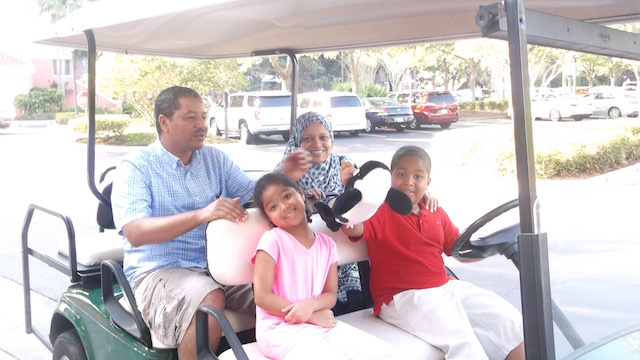 The Gadalla Family. (Photo courtesy of Nahla Gadalla)
It was Nahla Gadalla’s first time leaving her two children behind with her husband while she traveled to Sudan for a 10-day business trip in mid-January.
Her return trip was filled with anxiety after President Donald Trump signed an executive order banning people from seven majority-Muslim countries from entering the U.S. She says she wasn’t sure whether she’d be allowed back in the country when she left but “I had to try.”
She emailed a lawyer during her stopover in Doha, who advised her to request a court hearing if she was denied entry upon her return to the States. “That wasn’t really 100 percent reassuring,” Gadalla says. She is a Sudanese green card holder and a doctor who works as the executive director of the Sudanese American Medical Association.
“I spent the 14 hour flight [from Doha] being concerned about what would happen if I was not allowed to enter. We just purchased a house a few months ago,” Gadalla says. “We have mortgage commitments, we have cars. This is our home now.” The family has lived in the U.S. since 2012.
Gadalla’s sense of uncertainty mirrored that of thousands of travelers that weekend, who faced chaos, confusion, and detention at airports around the world.
While a federal judge in Washington blocked the immigration ban last Friday, temporarily halting it, the Trump administration appealed. The Ninth Circuit Court judges heard arguments on Tuesday. Legal observers expect the case will go to the Supreme Court.
More than 100,000 visas were revoked as a result of the ban, a Department of Justice lawyer said in Virginia court last week, though the State Department said the true amount is less than 60,000.
As the ban winds its way through the judicial system (other cases, including one with the Commonwealth of Virginia as a party, are also ongoing), Sudanese doctors in training are stuck in a holding pattern. For instance, they remain unsure if they’ll be able to secure visas to take a clinical medical examination that is only offered in the United States.
“They’ve already paid their examination fees,” Gadalla says, which cost around $3,000, and that’s “after all the preparation and material they have to buy to prepare, and all the effort and time.” The exam would license the doctors to practice stateside.
“Friend of the court” briefings filed by state attorneys general in support of lawsuits challenging the ban, including D.C. AG Karl Racine, cite the harm it causes to state medical institutions.
Since the stay of the ban last Friday, at least three Sudanese doctors, who acquired visas before the ban, have successfully entered the country. A Sudanese doctor at the Cleveland Clinic, Suha Abushamma returned after her visa was revoked after border officials told her that, if she didn’t “voluntarily” give it up, she wouldn’t be able to return to the U.S. for five years.
The lawsuit that Virginia joined alleges that as many as 60 people at Dulles were similarly coerced into signing away their rights.
The Sudanese American Medical Association continues to collect data on members who might be prevented from taking the medical exam. Gadalla says they’ve been in touch with at least five Sudanese doctors whose B-1 visitor visa status remains up in the air.
“We don’t know for certain whether the embassy is receiving applications or doing interviews,” she says.
Sudanese doctors who are already in the States worry that the ban, or whatever else is coming down the pike, could impact their careers. “The residency results are expected mid-March and they want to know whether this will affect them being considered for positions or not,” says Gadalla. “It’s giving them a disadvantage at this already competitive process.”
Gadalla is feeling the impacts on a personal level, too. “My sister is here on a student visa and she doesn’t know what is going to happen next,” she says. And while her parents traditionally visit from Sudan every summer, that plan is also on hold.
“It touches every single family who lives in the States with ties back in Sudan,” she says, as well as the other affected countries: Iran, Iraq, Somalia, Yemen, Syria, and Libya.
By the time Gadalla got to Dulles on January 29, a Virginia federal judge had issued a temporary restraining order that, along with other court decisions, should have ensured her reentry.
Travel ban or not, Gadalla is used to being pulled into secondary inspection. As a hijab-wearing Muslim woman, “I am always chosen for secondary security checks,” she says. “Airport security say it’s random, but it’s not random. It’s not just a matter of what’s going on now. Security has always been tight for us and travel has always been a stressful experience.”
As she waited in Dulles’ secondary inspection area in late January, her husband was talking to immigration lawyers and Congressman Don Beyer (D-VA), trying to ensure her release. As a green card holder, Gadalla was ensured access to lawyers in secondary, per Judge Leonie Brinkema’s order.
Lawmakers and attorneys say Customs and Border Protection officials at Dulles violated that court order. Beyer and other local congressmen had unsuccessfully attempted to get back to the secondary inspection area earlier that day. He tried again after learning Gadalla was back there.
Her eight-year-old son, Muhammed, was crying in the terminal as lawyers spoke with his mom on the phone. “This never happened before,” he said tearfully as his father tried to comfort him. Muhammed and his six-year-old sister, Judy, had come to the airport to greet their mom.
“My son is really a sensitive person and it really affected him,” says Gadalla. She says the school counselor called the house the following day to tell her “he was upset and sad about what happened to his mom.”
While Gadalla spent less than half an hour waiting for her name to be called in secondary, she says those minutes went by slow. “You’re always under the stress and the pressure that you’re in their hands. When they say case by case, you don’t know what that means,” she says. “I was just either lucky or the classification on my green card helped or something.”
She observed more than 100 people back there when she was there. “The lady I sat next to had a young child, about two years old. He was crying and you could feel that he just wants to go.”
While Gadalla had made commitments to return to Sudan for work over the summer, now she’s not so sure. “It’s not just traveling in Sudan, it’s traveling anywhere—you have to think about it very hard,” she says. “Even citizens are being cautious.”
Donald Trump continues to defend the policy. “We must keep ‘evil’ out of our country!” he tweeted over the weekend.