Rachel Kurzius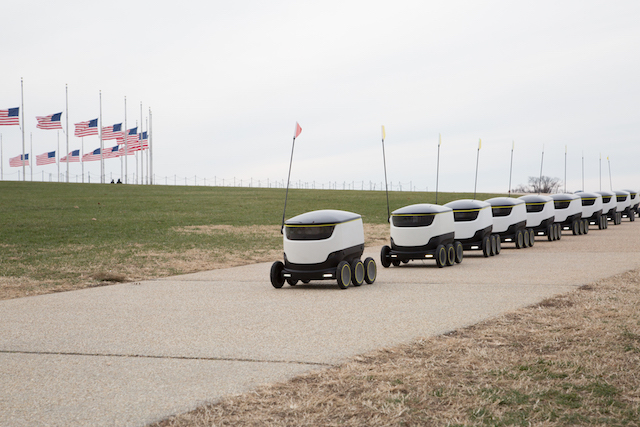
It’s easier than ever to be a hermit in D.C., with services offering to bring everything from food to marijuana to your doorstep.
Soon, there’ll be another option: delivery via robot.
These drones won’t fly overhead, though. Instead the Starship Technology robots more closely resemble Wall-E, the humble garbage compactor from Pixar’s eponymous film, than a Predator as they roll down the sidewalk.
The ground delivery robots can go up to 4 miles per hour and hold about 20 pounds, which comes out to about three shopping bags, says Henry Harris-Burland, the head of marketing for European-founded Starship Technologies. It also has “very sophisticated obstacle technology,” including nine cameras and a two-way audio system. To open the locked lid of the bot, customers will receive links through their phone. Otherwise, an alarm will sound.
In the coming weeks, Starship will roll out its pilot program with delivery company Postmates. For now, the company is conducting test deliveries from its headquarters in the 20009 zip code, says Harris-Burland.
Already, the D.C.-based Starship team is about 10 people strong. While they are 99 percent autonomous, the five robots currently conducting practice deliveries are traveling alongside robot handlers.
“They look after the robots and keep an eye on them,” he says. They’re also charged with what Harris-Burland calls “social integration”: introducing the bots to curious people they might encounter on the street. Plus, “if anything was to go wrong, the human could always complete the delivery.”
He says the company chose D.C. for its pilot program for two major reasons.
“You guys have really good neighborhood layouts with good sidewalks,” he says. The robots don’t travel in the streets or on bike lanes.
The other reason has to do with the local government. “We have a great relationship with the city,” Harris-Burland says.
Ward 3 Councilmember Mary Cheh championed bringing ground robots to the delivery sphere, even using a Starship bot to introduce legislation at the Wilson Building.
The council agreed to a pilot program in June 2015, making the District the first U.S. jurisdiction to do so, according to Starship.
Cheh reintroduced the legislation this January for the council’s new term. It was referred to Committee on Transportation and the Environment, which Cheh chairs.
“I’m very excited,” Cheh tells DCist. “There’s great potential. It cuts air pollution from cars and it points the way to other uses down the road. I want to be ready for the District to be poised for all emerging technology.”
Similar programs are now ongoing in Fayetteville, Ar. and Redwood City, Ca., in addition to some European cities, according to Harris-Burland.
For Postmates, the robots are a way to better meet the different kinds of deliveries customers want. “We see this as having the ability to loosen up our human fleet to do the jobs a robot cant do,” says Andy Perry, an operations manager at the delivery service.
In particular, he sees the Starship bots helping with so-called “last mile” deliveries. “There are so many deliveries that take place in short distance, and they’re not necessarily the most attractive deliveries for a person,” says Perry. “Other Postmates will be freed up to focus on jobs that will provide more earnings to them.”
Perry emphasizes that the company doesn’t intend for robots to replace humans on the job, just to have the drones help Postmates better “utilize a person and their time and efforts.”
Harris-Burland also argues that the robots will not take jobs away from people. “In the long term, we see net creation of jobs, because of the wealth of opportunity offered by new devices,” he says. “No one knows what a robot handler is but its a job that’s being created because of this business,” though he later acknowledged that “we won’t have robot handlers forever, of course.”
Starship’s goal is to get delivery costs down to a dollar, as well as bring costs for robots down to the price of a smartphone. Harris-Burland declined to state their current price tag.
Having a robot delivery is supposed to become an option for some Postmates customers in the coming weeks at no additional cost. An exact date, though, is tough to come by.
“We are taking our time to make sure that when we roll out to the customers it’ll be as seamless and customer friendly as possible,” Perry says.
Also unknown is whether the robots will eventually deliver east of the river. Currently, Postmates, along with many other food delivery services, does not go to some of the communities with the fewest options for dining and grocery stores.
“Postmates services all areas between Bethesda, Md., the majority of the District, including Capitol Hill, all the way to Arlington, Va. and we just expanded to include College Park, Md. into our zone,” says spokesperson April Conyers.
While Postmates declined to provide the number of people working with the company or deliveries occurring in D.C., Conyers says that the District is one of the company’s top five markets. Nationwide, there are 60,000 people working on a total of 2 million deliveries each month.