Rachel Kurzius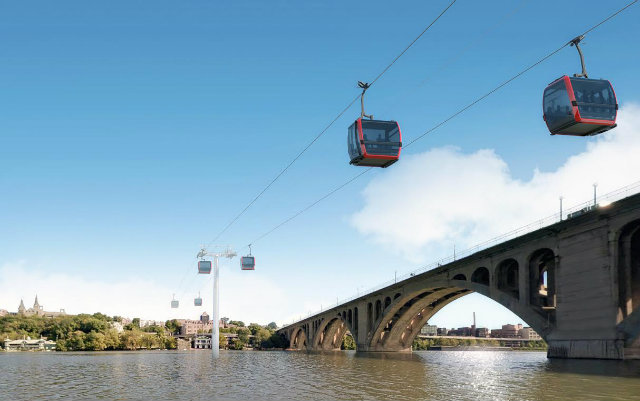
Arlington threw some cold water on a plan to transport people over the Potomac using a gondola.
The Arlington County Board said Friday that it would not help fund a plan to shuttle people via cable chair from the Rosslyn Metro to Georgetown.
“Given our identified and pressing transportation needs, along with some ongoing concerns about the long-term value of the gondola, the Board is not in favor of any further funding of the gondola project,” said Board Chair Jay Fisette in a letter first reported by The Washington Post. Other projects identified in the county’s master transportation plan—like Metro and Columbia Pike—are taking precedence.
The move didn’t come as a surprise to the Georgetown Business Improvement District, which first floated the idea in its 15-year strategic plan in 2013, which “envisions riders enjoying a hassle-free, four minute
ride that whisks them across the Potomac River as they savor the aerial and
skyline views.” (DCist’s take at the time was “Why the heck not?”)
Will Handsfield, the transportation director at the Georgetown BID, said Arlington alerted them of their choice “a few weeks back. It didn’t come as a surprise,” he says. “They have a lot on their plate in Arlington.”
But that doesn’t mean the BID is backing off the idea. “The project is still very much on our front burner,” says Handsfield. “We will continue to work on it and further study it on our side.” He adds that they never formally requested further funding from Arlington, and because the project is still at its early stages, the county’s decision is “really not determinative at all.”
A public-private partnership, which included the governments of D.C. and Arlington and the Rosslyn and Georgetown BIDs, helped fund a feasibility study released in November.
ZGF Architects, which conducted the study, conservatively estimated daily ridership at around 6,500, with the potential to go as high as 15,000. Around eight to 12 people would ride at a time in cabins that would pick up new passengers every 20-60 seconds.
As of last February, the Rosslyn Metro station had a daily weekday ridership of 13,666. Georgetown doesn’t have stop, much to the chagrin of its businesses, though the transportation agency included a future one in its 2040 plan. A Greater Greater Washington estimate says that if the neighborhood did have its own station, it would be among the system’s 10 busiest, though it didn’t address how many of those riders would be going to Rosslyn.
While Arlington cited cost as a factor in its decision, gondola cost estimates are at $80 million – $90 million, with annual operating costs between $2 million and $3 million. Building a Metro stop in Georgetown and connecting it under the Potomac to Rosslyn has a price tag of at least $1.5 billion, and infill stations cost more than $130 million.
The study lists a number of ways to pay for the project, including private sponsorship funding and a public-private partnership. “If we came up with a funding plan that didn’t draw out of the Arlington county coffers, I suspect that they wouldn’t oppose it,” says Handsfield. “And that’s a scenario that’s quite plausible.”
Currently, the Key Bridge connects the two neighborhoods. It is served by Metro and Arlington County buses, shuttles from Georgetown, and a Circulator route. Once Metro began its yearlong maintenance program in June 2016, bike ridership on the bridge increased by 42 percent.
According to the feasibility study, the half-mile gondola trip would take four minutes, plus two additional minutes to get from the gondola to the Metro or vice versa, instead of an 18 minute walk, a 6-10 minute drive, or a 6-20 minute bus trip.
“The Rosslyn BID understands the County Board’s decision, and recognizes that there are many projects and issues that must be prioritized at the moment,” said the BID’s president, Mary-Claire Burick in a statement. “As our region grows, the BID believes we need to continue to invest in innovative transportation solutions.”
The District Department of Transportation is exploring a streetcar project that would connect Georgetown to Union Station.
“This region is anticipated to grow. Driving around is not going to get any easier,” says Handsfield. “We are committed to exploring the options.”