 Rachel Sadon
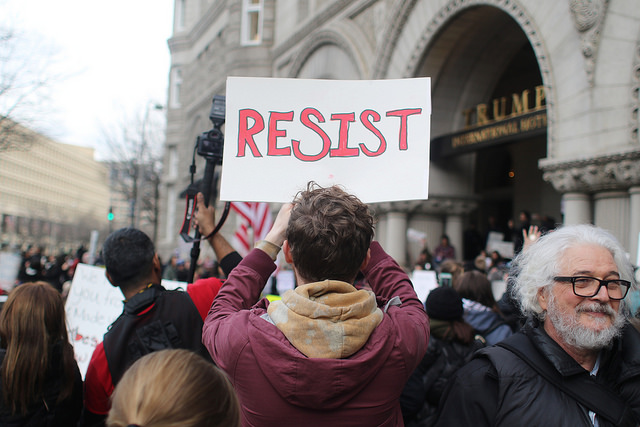 (Photo by Fritz Myer)
For four weekends in a row, and many of the weekdays in between, protesters have been out in full force in the nation’s capital—at the White House, in front of the Trump Hotel, near the Capitol, outside Mitch McConnell’s house, inside airports, on the streets near the Naval Observatory, at schools. The question in this deeply Democratic city these days isn’t “will there be a protest?”, but “when and where?”
Jamie Davis Smith has made it a whole lot easier to answer that question with a Facebook page that lists them all out.
“It is a way for people to easily find out about these things when they might not know where to start,” says Smith, a photographer and stay-at-home mom who previously practiced civil rights law.
After the election, she attended a number of the early protests—having heard about them in a scattershot fashion, often through friends or people she knew from past work doing legal support for demonstrations. Other friends who were less plugged in to D.C.’s activist community would see a picture on Facebook and ask Smith how she’d found out about the rally or march. If they’d known it was happening, many told her, they would have joined in.
Seeing the need for a clearinghouse—and wanting one for her own ability to attend as many actions as possible—Smith went about filling it.
The “DC Protests Against Trump: Listings” page isn’t meant to facilitate discussions or organizing strategy, just a clear calendar of events. Two moderators—one a friend, the second a complete stranger—jumped in to help keep track of the growing number of them.
“I definitely think it is an important thing to do. Trump has said that protests bother him,” Smith says. “We’re trying to get as many people as possible out. And a lot of people are going to protests for the first time—especially if they’re new to activism or caring about certain issues.”
At the Women’s March, for example, several people said it was the first time they’d felt compelled to hit the streets. Others said they hadn’t done so in decades.
In addition to first-time attendees, a number of recent rallies have been coordinated by first-time organizers—including a protest against Betsy DeVos started by two kindergarten teachers and the reading of Coretta Scott King’s letter outside Mitch McConnell’s house by a 60-something lawyer and several friends.
The Facebook page is aimed at helping connect people from different networks to such events—even on short notice. An action against DeVos at a school in Southwest on Friday, for example, was only organized the night before. But as soon as someone alerted the team behind the page, they worked to get it up as quickly as possible so their followers could find out.
“A lot of people are feeling helpless and they want to show up and do something—and people are showing up. Something has really awoken in the city, but also all over the country,” Smith says, citing the scene in Utah at Jason Chaffetz’s town hall.
But for concerned Washingtonians, who don’t have a representative with a floor vote or a senator to call, protest is one of their only options.
“As D.C. residents, most of us are frustrated that we don’t have a vote. It is particularly hard in times like these. We’re not a constituent of anyone who has a vote that counts,” said Keira McNett, a Capitol Hill resident who came out to McConnell’s house last week. “This is the little we can do.”
More information can be found here. Protest organizers can message the team directly on Facebook to have events added.