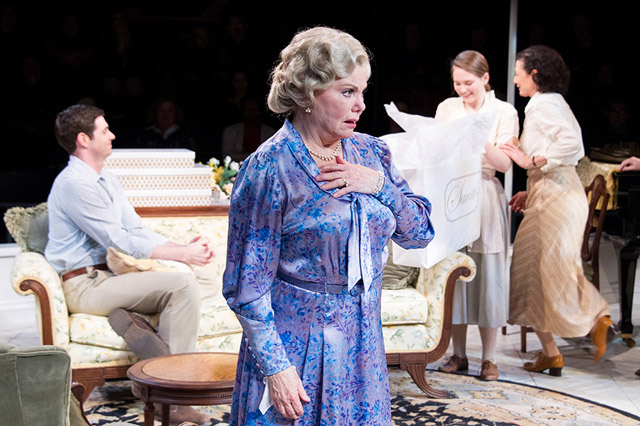
 Thomas Keegan, Marsha Mason, Lucy Breedlove, and Lise Bruneau. Photo by C. Stanley Photography.
By DCist contributor Elena Goukassian
Lillian Hellman wrote Watch on the Rhine in 1941, but its larger theme of resisting an unjust government rings true today. On opening night at Arena Stage last Thursday, a loud burst of applause followed a very specific line: “You’re a political refugee. We don’t turn back people like you—people in danger.”
The play starts with a wealthy family reunited in the D.C. suburbs after 20 years of separation. The adult daughter, Sara; her German husband, Kurt (the political refugee); and their three children have just arrived from war-torn Europe, where they were actively fighting against fascism. Unfortunately, Sara’s mother has been unknowingly renting a room in her house to a conniving fascist sympathizer. Needless to say, things get ugly.
As the line that caused such thunderous applause might suggest, Hellman’s play feels more like wartime propaganda than art (in fact, the U.S. turned away hundreds of refugees during WWII, effectively sending them back to the death camps), with very little in the way of subtlety and a cast of one-dimensional characters that are all either pure good or pure evil. This is all rather disappointing considering Hellman’s otherwise keen ability to delve deep into the human psyche and dig up all the ugliness as a microcosm for the world at large. (She did this so well in The Little Foxes, which was at Arena Stage last fall.)
Hellmann wrote Watch on the Rhine as a call to arms for the U.S. to join the fight against fascism, which it finally did after the surprise attack on Pearl Harbor in December 1941. Keeping this in mind, perhaps the most interesting takeaways from the play are historical.
For example, it’s no accident that the villain—you can almost see him twirling his mustache on stage—is a Romanian count. Lest we forget, Romania had its own fascist movement at the time, headed by Ion Antonescu and the Iron Guard, that had recently come into power and had just joined the Axis in 1940.
Despite the play’s inherent flaws, Arena Stage does a fine job portraying the political intrigue of the early 1940s. Marsha Mason lights up the stage as family matriarch Fanny, and like any truly great actress, she becomes her character, subtly reacting to every bit of dialogue even when no one is watching. Helen Hedman, who plays Anise, the family maid, is delightful, and with a very believable French accent to boot. The actors who play Kurt the Hero (Andrew Long) and Teck the Villain (J. Anthony Crane) also excel at their respective roles as self-righteous political outsider and greedy nihilist, although their accents could use a brush-up.
If you’re looking for a great drama from the 1940s that captures the essence and complexity of the beginnings of WWII, watch The Grand Illusion or Casablanca. If you’d rather get pumped up to fight today’s potentially dangerous political leaders, Watch on the Rhine was made just for you.
Watch on the Rhine is at Arena Stage through March 5, 2017. Buy tickets here.